End of "Chat Control": EU parliament stops mass surveillance (patrick-breyer.de)
435 points by amarcheschi 7 hours ago
nickslaughter02 7 hours ago
> Despite today’s victory, further procedural steps by EU governments cannot be completely ruled out. Most of all, the trilogue negotiations on a permanent child protection regulation (Chat Control 2.0) are continuing under severe time pressure. There, too, EU governments continue to insist on their demand for “voluntary” indiscriminate Chat Control.
> Furthermore, the next massive threat to digital civil liberties is already on the agenda: Next up in the ongoing trilogue, lawmakers will negotiate whether messenger and chat services, as well as app stores, will be legally obliged to implement age verification. This would require users to provide ID documents or submit to facial scans, effectively making anonymous communication impossible and severely endangering vulnerable groups such as whistleblowers and persecuted individuals.
JumpCrisscross 32 minutes ago
> further procedural steps by EU governments cannot be completely ruled out
In a democracy, we don't kill our opposition. If they hold views we don't like, e.g. that security trumps privacy, they're going to litigate them. Probably their whole lives. That means they'll keep bringing up the same ideas. And you'll have to keep defeating them. But there are two corollaries.
One: Passing legislation takes as much work as repealing it; but unpassed legislation has no force of law. Being on the side that's keeping legislation from being passed is the stronger position. You have the status quo on your side. (The only stronger hand is the side fighting to keep legislation from being repealed. Then you have both the status quo and force of law on your side.)
Two: Legislative wants are unlimited. Once a group has invested into political machinery and organisation, they're not going to go home after passing their law. Thus, repeatedly failing to pass a law represents a successful bulwark. It's a resource sink for the defense, yes. But the defense gets to hold onto the status quo. The offense is sinking resources into the same fight, except with nothing to show for it. (Both sides' machines get honed.)
Each generation tends to have a set of issues they continuously battle. The status quo that persists or emerges in their wake forms a bedrock the next generations take for granted. This is the work of a democracy. Constantly working to convince your fellow citizens that your position deserves priority. Because the alternative is the people in power killing those who disagree with them.
lpcvoid 24 minutes ago
Great comment, thank you. I know that I could simply upvote, but this deserved more.
1vuio0pswjnm7 2 hours ago
"> Furthermore, the next massive threat to digital civil liberties is already on the agenda: Next up in the ongoing trilogue, lawmakers will negotiate whether messenger and chat services, as well as app stores, will be legally obliged to implement age verification. This would require users to provide ID documents or submit to facial scans, effectively making anonymous communication impossible and severely endangering vulnerable groups such as whistleblowers and persecuted individuals."
Perhaps this is bad news for "messenger and chat services, as well as app stores" who solicit "users" to exploit them for commercial gain, for example _if_ users are unwilling to accept "age verification" and decide to stop using them. The keyword is "if"
The third parties know it's possible for capable users to communicate with each other without using third party "chat and messenger services" intermediaries that conduct data collection, surveillance and/or online ad services as a "business model". Thus the third party "tech" company intermediaries strive to make their "free services" more convenient than DIY, i.e., communication without using third party intermediation by so-called "tech" companies
But users may decide that "age verification" is acceptable. For many years, HN comments have repeatedly insisted that "most users" do not care about data collection or surveillance or online advertising, that users don't care about privacy. Advocates of "Big Tech" and other so-called "tech" companies argue that by using such third party services, users are consciously _choosing_ convenience over privacy
Perhaps the greatest threat to civil liberties is the mass data collection and surveillance conducted by so-called "tech" companies. The "age verification" debate provides a vivid illustration of why allowing such companies to collect data and surveil without restriction only makes it easier for governments that seek to encroach upon civil liberties. While governments may operate under legal and financial constraints that effectively limit their ability to conduct mass surveillance, the companies operate freely, creating enormous repositories that governments can use their authority to tap into
sveme an hour ago
There's a fairly non-invasive way to do age verification: ID cards that connect to a smartphone app that only provide a boolean age verification to the requesting service. Requesting service can be anonymous to the ID app and the requesting service can only receive a bool.
That most implementation will try to collect far more data is the real concern.
brightball 3 hours ago
The timing of having Meta dropping encrypted chats on Instagram is...interesting.
zoobab 3 hours ago
"Next up in the ongoing trilogue, lawmakers will negotiate whether messenger and chat services, as well as app stores, will be legally obliged to implement age verification."
Trilogues should be burned down, closed doors meetings with Ministers writing laws from their own services.
pnt12 2 hours ago
See you soon folks!
benced 2 hours ago
> Recently, only 36% of suspicious activity reports from US companies originated from the surveillance of private messages anyway.
I don't have many opinions on this but this sort of lazy logic would make me nervous. 36% is not a small number and that's before the folks doing this activity find out that private message is less patrolled.
dgellow an hour ago
Yeah, that number is actually really high. I’m wondering how noisy those reports are
_fat_santa 5 hours ago
It seems like an almost never ending hamster wheel of chat control being introduced, voted down, then introduced again in the next session.
ryandrake 4 hours ago
That's the problem with modern democracies (it happens in the USA too). They only have to win once and it's law. We have to win every time.
JumpCrisscross 25 minutes ago
> They only have to win once and it's law. We have to win every time.
Passing legislation takes about as much effort as repealing. (The exception being if the legislation spawns a massive bureaucracy.)
Chat Control 1.0 was de facto passed. It's now being unpassed. We don't have to win every time. Just more.
__loam 3 hours ago
Need to amend constitutional rights to privacy then these laws can be struck down in courts.
bigyabai 3 hours ago
moffkalast 2 hours ago
It's a problem when the parliament can't propose the laws it has to vote on and the commission isn't elected and continues to be presided by the most corrupt person in the EU. She is blatantly EPP and just keeps proposing the shit they want.
For Americans, imagine if only Republicans ever got to propose legislation and only Democrats could vote on it. That's more or less it.
petre an hour ago
tpm an hour ago
toyg 35 minutes ago
xeonmc an hour ago
I think the more fitting imagery would be https://en.meming.world/images/en/4/4a/Moe_Tossing_Barney_Fr...
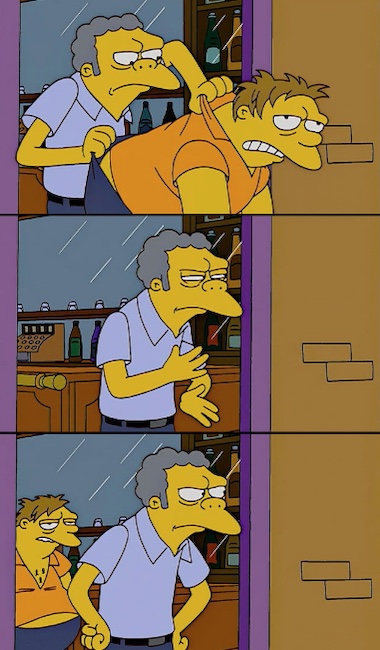
hkpack 23 minutes ago
The alternative is a dictatorship.
cess11 4 hours ago
The US really, really wants it implemented, and several national police institutions in the EU does too. Plus the politicians that start to drool a little at the prospect.
moffkalast 2 hours ago
Given the current US-EU relations I'm more surprised we're not telling them to go fuck themselves on this.
dmitrygr 2 hours ago
We need a double-jeopardy-like constitutional amendment for legislation. Legislation once-tried and failed cannot be tried again.
krapp 2 hours ago
That would be antithetical to democracy. The people must be allowed to introduce any legislation they want, as often as they want.
Otherwise it would be trivial for a government to intentionally fail to pass anything they disagree with, and thus act as a de facto dictatorship.
jagged-chisel 2 hours ago
dmitrygr 2 hours ago
beej71 5 hours ago
Political engineering angle: "These people will not rest until they are able to read your child's messages."
YeahThisIsMe an hour ago
It's never going to stop. They'll keep trying until they get it because they're sick people.
amarcheschi 7 hours ago
I would say "end of chat control, for now"
vintermann 7 hours ago
Those guys only ever have a "maybe later" button.
rsynnott 6 hours ago
That's pretty much how it works; there's generally no way, in a modern parliamentary democracy to say "no, and also you can never discuss it again". You could put it in the constitution, but honestly there's a decent argument that parts of chat control would violate the EU's can't-believe-it's-not-a-constitution (the Lisbon Treaty is essentially a constitution, but is not referred to as such because it annoys nationalists) in any case and ultimately be struck down by the ECJ, like the Data Retention Directive was.
account42 6 hours ago
cucumber3732842 5 hours ago
leosanchez 7 hours ago
For today or for this month.
lo_zamoyski 7 hours ago
The value of persistence!
someguyornotidk an hour ago
The fact that they could pull a stunt like this shows that the EU is no democracy. Shame on the politicians who tried to rob people of their rights.
hkpack 20 minutes ago
How have you came to such conclusions?
If anything it proves the opposite.
Look at how laws are passed in russia for example for comparison and let me know what similarities you see.
amarant 18 minutes ago
I feel like someone ought to dramatise this seemingly endless struggle in a seemingly endless series of movies.
-The Spying Menace
-Attack of the conservatives
-Revenge of the marketing conglomerate
-A new hope
-Chat Control strikes back
-Return of the Pirate Party
Etc,etc.
cryptonector 2 hours ago
> The Hard Facts: Why Chat Control Has Failed Spectacularly
The ostensible reasons for mass surveillance fail. That's very interesting.
fcanesin 4 hours ago
To get "End of Chat Control" EU should actually pass laws prohibiting it, this whack a mole will eventually lose.
_the_inflator 4 hours ago
No, this is the end of the wording for the initiative, nothing else.
We will see many new initiatives, old wine in a new bottle. Any bet that EU diehard bureaucrats will change tune, not the goal. They are going to use the so called salami tactic.
Death of free speech by many cuts, so to say. It is in the left wing DNA. Have a look at German history regarding "Landes-Verfassungsschutz" units. It is disturbing to read this article here: https://de.wikipedia.org/wiki/Verfassungsschutz_Nordrhein-We...
And back then already it was the so called center-right party ruled against this left wing initiative - imagine, first thing you do right after WW2 is ramping up a control unit to control freedom of speech.
Please value free speech. Agree to disagree, but remember: those who live by prohibitions will ultimately use this tool against you as well. Consider wisely what is something you dislike personally and simply exercise your right to not listen to certain voices or appeal to prohibition.
Prohibition becomes a tool and everybody knows that people love to use their tools. And since I have a law degree, often times what you plan is not what is finally what courts decide, how they apply the law.
Freedom rights are fundamental.
em-bee 4 hours ago
this is the end of the wording for the initiative, nothing else
it is more than that. since 2021 an EU interim regulation (2021/1232), set to expire on 3 april, was allowing companies to voluntarily scan messages. this vote was about the renewal of that regulation. since it has been rejected, the regulation is no longer in effect.
adw 3 hours ago
You’re painting an EPP/ECR initiative as left wing? That’s inconsistent with the facts.
hermanzegerman an hour ago
He's rambling about "left-wing DNA" in the Verfassungsschutz, who is famously quite good at turning a blind eye to right wing extremists. Probably because AfD got rightfully classified as far-right-extremists.
So to him they are probably left-wing.
astrashe2 7 hours ago
Here's a mirror link: http://archive.today/CJlNk
ramon156 6 hours ago
See you next year!
glenstein 5 hours ago
Is the snow melting? Do you hear birds? Must be chat control season.
Someone should sell calendars based on when this typically gets proposed as well as dates throughout the year when past instances of check control came up against key procedural hurdles.
Arubis an hour ago
Good.
Now let's start preparing for the next one.
rvz 4 hours ago
Until next time.
fsflover 4 hours ago
Related discussion : https://news.ycombinator.com/item?id=47529646
freehorse 6 hours ago
So, in the end a big majority of the conservative/liberal faction (EPP) voted against, and the vast majority of the social democractic faction (S&D) voted for chat control.
https://howtheyvote.eu/votes/189270
Just pointing this out because yesterday there was the myth around that "chat control is pushed by the conservatives", obscuring the actual political dynamics in the EU about it.
skrebbel 5 hours ago
EPP proposed it, but then it got amended (ie toned down) so much that they turned on their own proposal. This apparently happens quite a lot. So the way I understand it is they turned it down not because they thought it was bad, but because they didn't think it was bad enough.
nickslaughter02 6 hours ago
> So, in the end a big majority of the conservative/liberal faction (EPP) voted against, and the vast majority of the social democractic faction (S&D) voted for chat control.
EPP wanted indiscriminate scanning instead, not targeted one.
marginalia_nu 6 hours ago
There's also the DDR and Stasi as a counter example if anyone think mass surveillance is incompatible with socialism.
Mass surveillance isn't really a question that projects well onto the left-right scale, and attempting to make it fit a left-right question is more likely to distract than provide a useful understanding.
geon 5 hours ago
Yes. I would place it on the authority–liberty axis.
While your examples were on the economic left, they were clearly authoritarian.
iknowstuff 5 hours ago
Greens based as always
miroljub 7 hours ago
[flagged]
tomhow 2 hours ago
We detached this subthread from https://news.ycombinator.com/item?id=47529682 and marked it off topic.
bilekas 6 hours ago
[flagged]
boxed 6 hours ago
"What did the Romans ever do for US?" :P
camgunz 7 hours ago
They literally just voted it down. Twice in 2 days. Also compared to whom?
miroljub 6 hours ago
> They literally just voted it down. Twice in 2 days.
And they will try again tomorrow. Until it passes.
> Also compared to whom?
Why compare? The fact that there are worse regimes than the EU doesn't make the EU even a single bit better. Lesser evil is still evil. Let us strive for good.
vrganj 5 hours ago
rsynnott 7 hours ago
> With every new proposal, every vote, they are closer to the totalitarian regime. Proposals can be declined a million times, but the EU regime is always finding sneakier and more manipulative ways to push again and again.
... I mean this is how all parliamentary systems work. It's more _visible_ in the EU than in others, I think, because the council/commission are more willing to put forward things that they don't really think the parliament will go for (in many parliamentary systems, realistically the executive will be reluctant to put forward stuff where they think they'll lose the vote in parliament).
But there's not really a huge difference; it would just be _quieter_ in most parliamentary systems, and you wouldn't really hear anything about it until the executive had their votes in place, brought it forward, and passed it. I actually kind of prefer the EU system, in that it tends to happen more out in the open, which allows for public comment. And public comment and pressure is a huge deal for this sort of thing; most parliamentarians, on things they don't understand, will vote whatever way their party is voting. But if it becomes clear that their constituents care about it, they may actually have to think about it, and that's half the battle.
andai 4 hours ago
We already don't have free speech. There's nothing protecting it (and many laws already to the contrary.) There aren't really any such constitutional protections from what I can tell.
Once laws are passed they aren't revoked. So it's just a matter of political climate. Just wait for people to get a little more negative, a little more paranoid (which has historically been "helped along" in various ways)-- a law only needs to pass once, and then we're stuck with some stupid bullshit forever.
It doesn't really seem like how you'd want to design it.
hermanzegerman an hour ago
Obviously you can revoke Laws.
And not being able to deny the Holocaust doesn't mean you don't have free speech
mariusor 4 hours ago
"fascism" has a pretty well defined meaning, which is not whatever the EU would become if something like chat control ever passes. Towards totalitarianism, sure, but again not all totalitarianism is fascism. I wish people would stop using le mot du jour as a replacement for everything in an subconscious need to increase others' engagement.
sveme 7 hours ago
So in summary: because the law was avoided today, the EU needs to be abolished? Weird take.
You can see it the other way around, without the EU, Denmark and others would have already implemented ChatControl in their country. This is driven by member states (Denmark), not the parliament, after all.
miki123211 4 hours ago
There are advantages to "government by evolution", as opposed to "government by monoculture"
With the former approach, every country is allowed to try different things, some amazing, some dumb, and learn from the amazing and dumb things that others have done.
In the latter, there's only one governing body, and whatever that body said, goes. There's no science or statistics, just sides shouting their arguments at each other, calling people names.
Both the EU and the US used to heavily lean towards the former approach, but they're slowly but inexorably moving towards the latter.
miroljub 6 hours ago
> So in summary: because the law was avoided today, the EU needs to be abolished? Weird take.
There are many reasons to abolish the EU, but the topic here is chat control.
> You can see it the other way around, without the EU, Denmark and others would have already implemented ChatControl in their country. This is driven by member states (Denmark), not the parliament, after all.
Would they? We don't know. Would the government of Denmark be ready to commit political suicide by insisting again and again on something so unpopular?
The whole premise of the EU is to allow various unelected interest groups to push unpopular regulation to the EU member states without any consequences.
anonymars 6 hours ago
dyauspitr 4 hours ago
What a joke. Compared to US, implementing chat control is like a pin prick compared to the scale of MAGA fascism. The EU is probably the best example of functional government anywhere in the world right now.
ecshafer 7 hours ago
The EU is fundamentally flawed. There are no checks and balances, and its only democratic if you squint and look at it the right way. People need to directly elect the MPs, directly elect some kind of president. They have no accountability, no checks and balances.
freehorse 6 hours ago
I agree there is a strong democratic deficit in the current EU governance structure, but I disagree with a proposal such as
> directly elect some kind of president
We do not need a president with over-powers, and electing directly one does not solve anything for democracy, as the recent history in countries like the US and France shows. The point of directly electing a president is giving that role more power. The current structure in the EU is not so much president-centric either executive or legislative wise, but more like comission-centric, which is what imo has the biggest problem in terms of democracy in the EU.
bilekas 6 hours ago
> People need to directly elect the MP
They do.
> directly elect some kind of president
I get the impression you're coming at it from a US perspective, and it's not that, and doesn't intend to be for now. The president is elected by majority of the MP's who have been elected by the people of their respective countries. Almost like the US electorial system, except it's done internally because people generally only vote for their own best interests and not that of the entirety.
Perfect, no, it can be slow and a lot of red tape, but what system isn't flawed.
gpderetta 6 hours ago
People directly elects MEPs. And the Parliament literally right now just put a check on the Council.
Many EU nations are not presidential, and personally I prefer parliamentary republics than presidential ones.
sveme 7 hours ago
The commission is checked by the parliament is checked by the council is checked by the commission. Most other national organizations only have one check - Germany, for example, only has the Bundesrat as a check of the Bundestag.
Kim_Bruning 6 hours ago
Checks and balances means some folks should NOT be directly elected. if everyone is <directly elected>, then you have <directly elected> checked and balanced by <directly elected>. Which is to say, not at all. :-P
em-bee 4 hours ago
naasking 6 hours ago
rsynnott 6 hours ago
> People need to directly elect the MPs
...
We do? What did you think the European Parliament elections every four years were for?
> directly elect some kind of president.
Why? Nowhere in Western Europe except very arguably France (France, as always, has to be a bit weird about everything, and has a hybrid system) has a directly elected executive. True executive presidential systems are only really a thing in the Americas and Africa (plus Russia, these days).
Like, in terms of big countries with a true executive presidency, you’re basically looking at the US, Russia and Brazil. I’m, er, not sure we should be modeling ourselves on those paragons of democracy.
> They have no accountability, no checks and balances.
The parliament has the same accountability and checks and balances as any national parliament, more or less (more than some, as the ECJ is more effective and independent than many national supreme courts).
gpderetta 6 hours ago
em-bee 3 hours ago
cbg0 6 hours ago
> The EU is fundamentally flawed. There are no checks and balances
You're missing a [citation needed] on that.