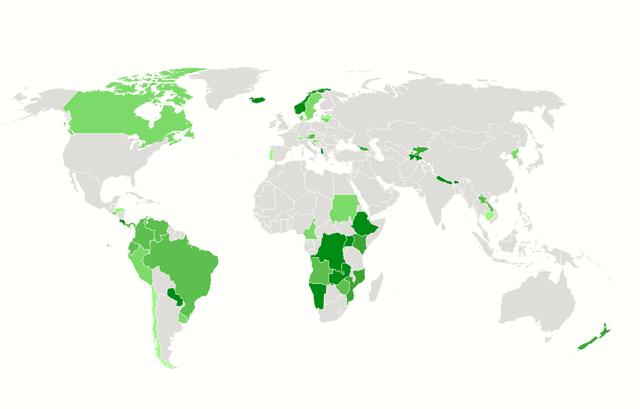
Seven countries now generate 100% of their electricity from renewable energy (the-independent.com)
360 points by mpweiher 7 hours ago
phtrivier 5 hours ago
> Albania, Bhutan, Nepal, Paraguay, Iceland, Ethiopia and the Democratic Republic of Congo produced more than 99.7 per cent of the electricity they consumed using geothermal, hydro, solar or wind power.
Let's head to electricitymaps.com !
Albania (https://app.electricitymaps.com/map/zone/AL/live/fifteen_min...)
- On 2026-04-12 16:45 GMT+2, 22,67% of electricity consumed by Albania is imported from Greece, which generates 22% of its electricity from gas. Interestingly, Albania exports about as much to Montenegro as it imports from Greece.
Bhutan:
- 100% hydro, makes perfect sense
Nepal:
- 98% hydro, a bit of solar for good measure
Iceland:
- 70% hydro, 30% geo
Paraguay:
- 99,9% hydro
Ethiopia:
- 96,4% hydro
DRC
- 99.6% hydro
So, the lessons for all other countries in the world is pretty clear: grow yourselves some mountains, dig yourselves a big river, and dam, baby, dam !!
(I'm kidding, but I'm sure someone has a pie-in-the-sky geoengineering startup about to disrupt topography using either AI, blockchain, or both.)
input_sh 5 hours ago
I guess somewhat of a fun fact: Albania has rented(!) two floating(!) oil-powered power plants near the city of Vlöre that are there in case of emergency. The last time they were really needed was in 2022 (if I remember correctly), but these days they're not turned on any more than they need to be to make sure they're operating properly. That very expensive backup system is basically the only non-renewable source in the whole country, and most of the time it's just sitting there doing nothing.
Being powered almost entirely by hydro means that the system is highly susceptible to droughts, so then they either have to spin up those oil plants from time to time or import electricity from abroad. I think it's also worth pointing out that nothing really changed because of climate change, the decision to rely on hydro was made in the 90s. The country used to have its own oil power plant that it heavily relied on before that decision, which slowly produced less and less until it was shut down for good in 2007. Some images of it from 2019: https://www.oneman-onemap.com/en/2019/06/26/the-abandoned-po...
PaulDavisThe1st 7 minutes ago
> I think it's also worth pointing out that nothing really changed because of climate change, the decision to rely on hydro was made in the 90s.
Why do you think it is worth pointing this out?
graemep 2 hours ago
Sri Lanka used to rely on hydro, with oil as a backup, and has added a lot of coal.
I wonder how many other countries are increasing non-renewable output?
bartvk 9 minutes ago
direwolf20 4 hours ago
And this is an expected problem with renewables that can be engineered around. It's unlikely the whole world has a drought at once during a calm night, so developing ways to transmit power long distances will be important.
ambicapter 3 hours ago
izacus 4 hours ago
pstuart 4 hours ago
Shitty-kitty 3 hours ago
Funny, TAP runs straight-thru Albania. They could just build a gas power station. Of course rented rigs line the pockets much better.
Tepix 2 hours ago
WinstonSmith84 5 hours ago
fun fact for Paraguay: the Itaipu Dam is one of the largest in the world located between Brazil and Paraguay, where each country gets 50% of the production. But 50% of that production for Paraguay, a country of 7 millions inhabitants, means that it cannot consume that much, so it's essentially reselling that energy to Brazil, a country with 30x more inhabitants. Paraguay only uses about 1/3 of its share (and thus resells 2/3 to Brazil).
neves 4 hours ago
And it means that it has been oil free since the 70's.
Brazil, a continental country, has more than 80% of its energy from renewables
ptman 4 hours ago
jacquesm 5 hours ago
And have either a small population or a very low per-person energy budget.
But: 7 isn't the number that matters, what matters is that next year it will be 8 or 9. That would be worth documenting.
tyfon 4 hours ago
There are a few countries just below as well like Norway with about 98% renewables in 2024 [1]. The gas power plant is mostly up north powering the gas compressors that fill LNG ships headed for Europe and the coal I think is for Svalbard but that mine/plant closed in 2025 [2].
[1] https://www.nve.no/energi/energisystem/energibruk/stroemdekl...
[2] https://www.nrk.no/tromsogfinnmark/norges-siste-kullgruve-pa...
ZeroGravitas 3 hours ago
With modern tech, these 100% renewable electricity countries have effectively overshot. Many other countries would be better off getting to 85% and then shifting to focusing more on EV and heat pump uptake to get the best bang per buck.
jacquesm 3 hours ago
happosai 4 hours ago
Well hydropower is the "easy" level of the decarbonization game. So it's not really surprising first countries to leave fossil fuels behind are also countries with mountains and rivers.
geoduck14 3 hours ago
>So, the lessons for all other countries in the world is pretty clear: grow yourselves some mountains, dig yourselves a big river, and dam, baby, dam !!
It is a relief that Environmentalists have decided that hydro counts as "renewable" energy! When I was in school, hydro was considered really bad for the environment, and projects like the Hoover dam and Yangzie River dam were "not helping"
psychoslave 2 hours ago
They certainly can be disastrous in ecological terms, and will disrupt all biotopes along the concerned water flows.
But it's extremely renewable none the less.
setsewerd 2 hours ago
Reminds me of when Bjork was protesting the construction of a new hydropower plant in Iceland, when the Director of Iceland's National power company (behind the project) was actually her uncle. I used to be romantically involved with someone in his side of the family and noticed Bjork was conspicuously absent from any family gatherings he hosted, of which there were many.
JoBrad 4 hours ago
Or, more charitably: use the Strangler Fig method to modernize your systems, and start with low-hanging fruit.
Flere-Imsaho 2 hours ago
Hydro electricity is also one of the most dangerous forms of energy production:
https://en.wikipedia.org/wiki/1975_Banqiao_Dam_failure
(This is the worst disaster, but could put Chernobyl to shame?)
Full list here:
https://en.wikipedia.org/wiki/List_of_hydroelectric_power_st...
iso1631 2 hours ago
Well most dangerous apart from coal, oil, gas, biomass?
https://ourworldindata.org/grapher/death-rates-from-energy-p...
And that's before you bring into the deaths due to climate change
Flere-Imsaho an hour ago
Sharlin 3 hours ago
I guess if you're not allowed to use solar in the form of chemical potentials frozen long ago into carbon-y molecules buried underground, the second best thing is to use solar in the form of gravitational potential stored in water molecules that's constantly getting replenished because the planet just happens to work like that.
KellyCriterion 5 hours ago
wasnt New Zealand also already far up beyond 90% renewable electricity a couple of years ago?
direwolf20 4 hours ago
They are blessed with all three of hydro, geothermal, and wind.
bogeholm 2 hours ago
WarmWash 4 hours ago
I'm wondering how this picture holds up if we include cooking and water heating.
BigGreenJorts 4 hours ago
And cars. Lots of diesel in Albania.
LastTrain 3 hours ago
They worked within the constraints of their own topography - good and bad - to make it work. That is too hard for everyone else?
littlestymaar 2 hours ago
> So, the lessons for all other countries in the world is pretty clear: grow yourselves some mountains, dig yourselves a big river, and dam, baby, dam !!
Came to say that, every time you'll see a country running on 100% renewables for an extended period, it's going to be hydro, because it's the only controllable supply among renewables (with geothermal as well, but it's been so niche so far I put it aside, but I hope it will change).
Unfortunately most of the hype and investments go to solar and wind power, which fundamentally don't offer the same capabilities. (Solar is fine as long as you're in q sunny place that is not in Europe though because it can be predictable enough to be relied on, but Solar in above 40° North and wind are borderline scams at this point).
_blk 2 hours ago
Makes me wonder why solar is not on the list.. I thought all gore said that was gonna solve all energy problems. (Of course not, he's a politician, but I'd have expected to at least see it with some relevant percentage in the African countries) Or could it be that solar is distributed enough to not appear because it's set up directly by/with the consumer rather than the grid producer?
tootie 4 hours ago
I think they missed Uruguay which is a similar case. They have also traditionally benefitted from a hydro able to cover 80-90% most of their needs but they made a concerted effort to fill the entire remaining gap with wind and solar.
ZeroGravitas 4 hours ago
Recent video by someone from Puerto Rico comparing their island's renewables with Uruguay and interviewing the guy in charge of their renewables rollout:
jmyeet 23 minutes ago
Ultragrav (YC S27). We plan on generating the geographic tyranny of who has rivers and mountains and who doesn't by seeking to use ultrasonic audio to disrupt gravity so you don't have to hear it. We're hiring in Kansas city, KS.
In all seriousness, thereis of course a list on Wikipedia of countries by renewable electricity production [1]. China leads here but also has 1.4B people and still has significant coal usage and oil and gas imports. But they're working really hard to wean themselves off of fossil fuels while still rapidly industrializing.
China does have mountains and has built the Three Gorges Dam, which is just massive and produces ~22GW. They're building a dam that'll produce almost three times as much power, the Medog Hydropower Station [2], which is planned for ~60GW.
The part that annoys me about a lot of developed nations is that they engage in greenwashing by simply exporting their emissions to poorer countries eg [3]. Let's at least be honest about what fossil fuels we continue to use and the emissions we indirectly create.
[1]: https://en.wikipedia.org/wiki/List_of_countries_by_renewable...
[2]: https://en.wikipedia.org/wiki/Medog_Hydropower_Station
[3]: https://www.vox.com/energy-and-environment/2017/4/18/1533104...
justsomehnguy 4 hours ago
For some it's an eye-opening experience when they compare the states which are the most vocal about going solar and have a look onto the solar map of the world.
Or then they talk about how some countries have miraculous levels of an energy independence and social services and then look at their total population.
ffsm8 4 hours ago
Tbf, solar has gotten so much more effective/cost efficient in the last 12-24 months that it's beating pretty much everything aside from hydro in the cost efficiency department at this point - including (most of) northern Europe and Canada.
Most data you find will be using data that's massively out of date and be off by at least 2x though...
I had another facepalm moment when I read about EU planning to go nuclear again. That would've been amazing and smart in 2015 - but now? Yeah, it's dumb af. And that's coming from a German living at the northern end of the country.
Moldoteck 3 hours ago
mono442 3 hours ago
runako 4 hours ago
Pushback against the outliers of small + blessed with hydro and geothermal is overshadowing real wins:
- California: 83% renewable, dominated by solar
- Spain: 73%, dominated by solar & wind
- Portugal: 90%, dominated by wind & solar
- The Netherlands: 86%, dominated by solar & wind
- Great Britain: 71%, dominated by wind & solar
There's real momentum happening.
offmycloud an hour ago
California is not anywhere near 83% renewable for total electricity generation. [1] Are you just adding up nameplace capacities without capacity factors?
onlyrealcuzzo 3 hours ago
> California: 83% renewable, dominated by solar
California's grid is pretty decently balanced. Solar isn't even close to 50% - so saying that it "dominates" is pretty misleading.
It's like ~30% solar, ~12% hydro, ~10% wind, ~10% nuclear, all other renewables ~8% (~70% renewable, including nuclear) -> ~30% fossil fuels.
Are you maybe only counting domestic production and not total consumption? Or are you looking at the best time of the year and not the full year?
Or am I looking at sources that are >1 year out of date and in one year they've jumped from ~70% renewable to ~83%?
sesm 33 minutes ago
Nuclear is not renewable though, those isotopes were created when some past generation star collapsed as supernova.
ZeWaka 20 minutes ago
lokar 3 hours ago
AIUI, there has been excess solar at peak, but batteries have growing very fast. That might have caused a big change even in a year.
dalyons 2 hours ago
California is a huge success story at a massive scale. Looking at Casio right now it’s 92% clean energy. For a state of 39 million people! And batteries keep getting deployed faster and faster
2022 - 48% gas power on grid
2025 - 25% gas power on grid
What insane progress.
bopjesvla 3 hours ago
> The Netherlands: 86%, dominated by solar & wind
The Dutch bureau of statistics reports 50%, of which a plurality (one third) is biomass. The Netherlands is also famously gas-dependent. Natural gas isn’t converted to electricity for heating and many industrial applications. Can’t quickly find stats on production here, but renewables are only 17% of total energy usage. Renewables without biomass are ~12% of total energy usage.
teamonkey an hour ago
bopjesvla an hour ago
IshKebab 2 hours ago
This is just goalpost moving. Only a couple of decades ago we were at a solid 0% everywhere.
bopjesvla an hour ago
jacomoRodriguez 3 hours ago
Where can I look up this numbers? (Just curious)
arrosenberg 3 hours ago
For California, CAISO publishes a ton of data. Here is daily fuel mix - https://www.gridstatus.io/charts/fuel-mix?iso=caiso
You can also see Texas (ERCOT), New York and a few other operators.
vpribish 3 hours ago
good hilights! but - and i mean this kindly - you are starting to talk like an AI: "overshadowing real wins" "There's real momentum happening".
KevinMS 3 hours ago
Isn't that the list of high energy prices and blackouts?
tialaramex 27 minutes ago
Although "Getting rid of cheaper electricity generation would make the electricity cheaper" is genuinely an actual right wing talking point in the UK it doesn't make any sense. The reason it's a talking point is that they're funded by billionaires who'd reap the rewards from new fossil fuel licensing. They know they can't deliver, but what they learned from Brexit is that their supporters aren't too smart and simple messages, even if nonsensical, resonate well with those voters. "Drill baby drill" is simple. Wrong, but simple.
Right now in a dark and not very windy UK w/ 10GW of gas burners running the spot price for electricity here is almost £150 per MWh, but at 10am it was sunny with a brisk wind and sure enough that spot price was about £25 per MWh. Gee, I wonder whether the wind and sun are cheaper...
Mordisquitos 6 hours ago
Specifically Albania, Bhutan, Nepal, Paraguay, Iceland, Ethiopia and the Democratic Republic of Congo.
Not to downplay the positive steps that are being taken towards using renewable energy worldwide, but one must point out that all those countries except one are almost exclusively using hydroelectric power, whose availability at such scale is a geographical lottery. As for Iceland, which also relies mostly on hydroelectric power but not in such great a proportion, it makes up for it thanks to easy and abundantly available geothermal power (which, though environmentally friendly, is arguably not technically renewable).
IneffablePigeon 6 hours ago
Well yes, hydro and geothermal are the easiest (and earliest perfected) renewable sources to provide consistent base load. It would be odd if the first countries to achieve fully renewable power weren’t making use of those technologies.
Other countries will have to be more reliant on interconnects, diverse renewable mixes and batteries. Luckily this is now almost always cheaper and more secure than fossil fuels and the trend lines point towards that continuing to be more and more true over time.
jimmySixDOF 4 hours ago
>at such as scale
Not to downplay the positive steps that are being taken but we are conveniently skipping over the denominator here at least in the case of Ethiopia and DRC who both have a grid that is only serving their full population at a fraction of the level needed to make this story one about geographical lotteries and abundance instead of one about poverty preventing them from access to the traditional carbon power generating routes to server the rest of the population.
darkwater 6 hours ago
Why geothermal is not renewable? Earth is not going to cool its magma soon enough
leonidasrup 6 hours ago
The Earth's heat content is about 1×10^19 TJ. This heat naturally flows to the surface by conduction at a rate of 44.2 TW and is replenished by radioactive decay at a rate of 30 TW. These power rates are more than double humanity's current energy consumption from primary sources, but most of this power is too diffuse (approximately 0.1 W/m^2 on average) to be recoverable.
leonidasrup 6 hours ago
pfdietz 3 hours ago
Mordisquitos 6 hours ago
Only as a technicality. If you find a geothermal hotspot and start to extract energy from it, the hotspot will eventually cool down faster than if you hadn't (which of course depends on the size of the hotspot and how much heat you're pulling out).
However, given that there's no downsides to cooling down a hotspot other than, well, no longer being able to extract energy from it, geothermal is a bit of an honorary "renewable".
Actual renewables ultimately all come down to recent[0] solar energy, which will never deplete their source however much they are used. All the energy in wind, hydroelectric and biofuels has recently originated in the Sun.
[0] I say "recently" because fossil fuels are all also derived from the Sun, but their rate of regeneration is a bit too slow compared to the speed at which we use them.
seanmcdirmid 4 hours ago
KellyCriterion 5 hours ago
adev_ 3 hours ago
Contrary to a popular belief, most high temperature Geothermal plants have a predicted death date.
This is due to the physics reality of the ground itself: Power of a Geothermal well will decay over time to a point where the well become unusable and need to be closed.
It is due to the fact underground water is rich in minerals and raw elements. This soup will slowly but surely cement the well itself and its associated underground.
There are techniques (similar to 'fraking') to extend the lifetime of a well but only to some extent.
If the topic interests you (and you can bear artificially translated English), a French content creator did a pretty good video on the topic:
https://m.youtube.com/watch?v=q4xZArgOIWc
Additionally, Geothermal plants can emit CO2 (even a lot of CO2) in some geological configuration.
All of that makes Geothermal (for electricity) a bit controversial as "Renewable".
I precise that there is absolutely nothing wrong about low temperature Geothermal energy for residential heating and we should do more.
gus_massa 6 hours ago
Geothermal is powered by fission Uranium and other heavy atoms deep in the Earth.
Solar is powered by fusion of Hydrogen in the Sun.
I'd use the same classification for both.
leonidasrup 5 hours ago
pfdietz 3 hours ago
Mordisquitos 5 hours ago
Y-bar 6 hours ago
Can’t speak for large scale sites with abundant volcanic activity… But for residential geothermal the bore hole has a lifetime based on how much ground water there is and how active usage it sees.
This is because using it cools the hole slowly and after a few decades (depending on how quickly ground water can dissipate heat gradient) a new hole need to be drilled a distance away.
analog31 4 hours ago
left-struck 6 hours ago
“Technically”
ahhhhnoooo 6 hours ago
mr_mitm 6 hours ago
nine_k 5 hours ago
Also, many of these countries are tropical or subtropical, with optimal conditions for solar energy year round. Nepal and Bhutan are relatively far from equator, but have many days of unobstructed sunshine.
coffeebeqn 3 hours ago
The vast majority of humans live in regions with plentiful sun for solar.
surgical_fire 5 hours ago
Well, when geothermal stops being renewable there will be no humans around to need energy generation.
You are still technically correct, which is the best kind of correct.
But if we follow that rationale, in a long enough timeline, solar and wind is also not renewable.
flakiness 18 minutes ago
Japan used to have many dams for the electricity but then scaled them down (or not scale it up) due to environmental concern. I'm not sure it was a right call given the limited availability of options there. They are also strong anti-nuclear sentiment which I have some sympathy. However you need something you have to make a call.
This map says hydro share is like 8%. https://app.electricitymaps.com/map/zone/JP/live/fifteen_min...
ilitirit 5 hours ago
Probably at least slightly misleading, just reading the names of some of the countries in the list (I am from South Africa).
Just because a country generates 100% of its energy from renewables, it doesn't mean that its enough to power the entire or even majority of the country. Case in point: DRC. I believe only half of the population has access to electricity. It's been a while since I've looked into continental stats, but a quick Google search suggests the situation hasn't changed that much in the last few years.
aqua_coder 5 hours ago
I live in one of those countries, and while renewable electricity helped to cushion the concern for house electricity, most of the logistics (that being the supply chain for basic commodities) are transported by oil (specifically diesel). Which further increases inflation for import dependent countries. Meaning even for those states (except those that don't import oil to move cars in the country) it will regardless cause an economic crisis.
One state is considered to be fully 'renewable' if the means of transport (excluding Airplanes since I can't find a suitable alternative ) for land is done via electric cars
cenamus 5 hours ago
Or just trains
lateforwork 4 hours ago
Meanwhile the US is spending billions to cancel renewable energy.
https://www.nytimes.com/2026/03/23/climate/offshore-wind-gas...
LastTrain an hour ago
Blows me away that energy policy is so political, and that somehow self-styled libertarians who don’t say a peep about oil subsidies are deeply offended by renewable ones. It you consider yourself libertarian can you at least be forward-thinking enough to see that shifting to renewables is also a step towards decentralization?
pfdietz 3 hours ago
King Canute Trump trying to order back the tide.
mentalgear 3 hours ago
Article from 2024: still super impressive in 2024 yet I'd like more recent numbers to see the progress.
dalyons 2 hours ago
Worse, the summary article makes claims using 2022 data which is so out of date to be useless
birktj 3 hours ago
This is a bit of a weird list. This looks at the percentage of electricity generation that is renewable. But some of these countries are net importers. I think the final row in the table from the report [1] is more interesting. It compares the generation of renewable energy as a percentage of demand. There are quite a few countries that don't quite have 100% renewable generation, but generate way more than 100% of their demand as renewable energy.
[1]: https://web.stanford.edu/group/efmh/jacobson/WWSBook/Countri...
sph 3 hours ago
Seeing so many sub-Saharan countries generating >= 50% of their electricity from renewables makes me smile: https://static.the-independent.com/2024/04/16/11/renewable%2...
bluGill 2 hours ago
It makes me sad - most of them are fairly poor and so don't use much energy. I want those people to have the wealth to consume as much energy as me. (My city is also 100% renewable but since I live in the us we don't show near as well on the charts overall.
mentalgear 3 hours ago
What a great beacon of hope to consider that we are closer than we thought in the clean energy rollout ! I read somewhere, not sure though how it is assessed/how valid it is, that last year 50% world-wide came already from clean power, with countries like the UK around 50% in the middle and others like Spain far ahead.
esskay 2 hours ago
Yeah UK's currently going through the biggest rollout of renewable energy ever, the pace is insanely high. Theres new rules to allow plug in solar coming into effect too with kits already available for renters and such.
jonatron an hour ago
They announced they're thinking about amending regulations to allow plug in solar at some point. Hopefully something eventually actually gets done.
PowerElectronix 4 hours ago
Sadly these are edge cases due to either a lot of hydro, which is terrible for the environment in most cases or having neighbors that buy the renewable and help stabilize the grid with conventional energy.
The best way to go green is still going green yourself. Get some panels, batery, inverter and go where no government wants you to go, off-grid. (And a gas generator, too, just in case...)
realo 5 hours ago
Perovskite Tandem are the best , according to the graph.
Why is it that those are reserved for ultra-big utility companies and I cannot buy those for my home or even my balcony?
philipkglass 5 hours ago
At present, those tandem cells are still experimental. Nobody is manufacturing them on gigawatt scale like for other solar cell technologies.
realo 5 hours ago
Well... if you go to the web site , they seem to welcome very large orders. Just not mine or yours.
Might be experimental and unavailable, but just for small orders? Come on ...
wpm 4 hours ago
efitz 3 hours ago
Mixing in geothermal and hydro really distorts the story. Although technically correct, the common usage connotation of “renewable energy “ today is “wind and solar”.
Lichtso 3 hours ago
> the common usage connotation of “renewable energy “ today is “wind and solar”
Hydro, wind and solar. Hydro is often even more important because it runs more steadily than the other two.
Geothermal and nuclear are neither fossil nor renewable, they are their own category.
goldenarm 5 hours ago
This article omits important context : these 7 countries have massive hydro power (+geothermal for Iceland) for very little demand.
The only countries with <100 g CO2/kWh and >10TWh/y are using nuclear. Large scale batteries are exciting for the future but need more development. The 2 biggest battery investments in the world are being made in Australia and California, yet still produce 4x the g CO2/kWh of France.
amarant 3 hours ago
Honestly surprised Iceland doesn't rely more on geothermal, the entire country is a volcano! I had expected a 70-30 split in the other direction
saidnooneever 6 hours ago
i love that in a lot of countries people think these other countries are in the sticks and that they are modern... (ofc depending who u talk to but im sure we all know such a person...) :) a lot of perceptions based on old world views. Love to see these countries do so well on it. There might be many problems to solve still but it provides a degree of self reliance for energy that is really important today for a country i'd think
giantg2 5 hours ago
It's contrary to what most people think, but the later a country modernized, the better the infrastructure (generally). You basically get to skip the innovation stages where you have a hodgepodge of systems that eventually coalesce into one and all the upgrading required to bring it up to the newest standard. If you have a lower population and smaller geography, it is often easier to upgrade as well.
mpweiher 5 hours ago
Albania: 90% Hydropower, $12150 GDP/person
Bhutan: 99% Hydropower, $ 4700 GDP/person
Nepal: 23% Imported $ 1381 GDP/person
rest Hydropower (2/3 of energy: firewood etc.)
Iceland: 99% Hydry/Geo, $90000 GDP/person
Ethiopia: 88% Hydropower, $ 1350 GDP/person
DR Kongo: 98% Hydropower, $ 760 GDP/person , 13% of country has electricity
Not sure how this is applicable (and in many cases: desirable) for countries that do not have significant hydropower potential or maybe want a GDP greater than $760 per person per year.
readthenotes1 5 hours ago
Those "countries in the sticks", one report says that the DRC only has at most 20% of the households on electricity. This report says only 10% https://www.trade.gov/country-commercial-guides/democratic-r...
On the other hand, balcony solar power will be a game changer for the world, provided your neighbors won't steal the panels like they do the catalytic converters in my neighborhood.
rs_rs_rs_rs_rs 3 hours ago
All these industrial powerhouses like Iceland and Albania!