An update on residential proxies and the scraper situation (lwn.net)
284 points by chmaynard a day ago
harshreality 17 hours ago
> ...we have tried to minimize the impact on real readers as much as possible. We have not gone with tools like Anubis, partly because it causes annoying delays for those trying to get to the site, but also partly because it seems inevitable that the scrapers will eventually find their way around it. Indeed, there are some indications that is already happening. A proof-of-work requirement is not a huge obstacle when you have millions of other people's machines to do the work on.
It's massively less annoying than a captcha, which is both a longer delay (typically, at present) and a massive cognitive distraction/roadblock.
The anubis author has stated they recognize it's an arms race, but PoW scales. Captchas and other signals are already at the end of the road; any additional difficulty increases false bot-positives, which are already unacceptably high.
For websites running dynamic languages, a binary (anubis is in go) sentry that operates before[1] the website is forced to expend any resources, is usually a large improvement over a site-hosted captcha. I would rather, and I think most humans would agree, have to wait a few seconds, maybe even closer to a minute in the future, to get a website access token good for a day or a week, than be forced to solve a captcha.
The dilemma for bots: when tokens are bound to the connecting ip, scrapers must limit the connecting IP pool for each site they want to scrape, becoming much more obvious and easy to block, or they have to use massive amounts of compute.
[1] this is true regardless of whether anubis is in reverse proxy mode or auth mode.
jsnell 7 hours ago
Proof of work does not scale. It trades something fungible and incredibly cheap (CPU) for something incredibly expensive (user-visible latency). There is no set of parameters where the cost is going to be a meaningful deterrent to any kind of abuse (even something as low-yield as scraping) without adding crippling amounts of latency to real users.
> The dilemma for bots: when tokens are bound to the connecting ip, scrapers must limit the connecting IP pool for each site they want to scrape, becoming much more obvious and easy to block, or they have to use massive amounts of compute.
There is no dilemma. They get a token, they maybe do some automated multi-armed bandit per-site to figure out how to maximize the extraction rate they get from a single token, and then they use an IP for that many requests / that amount of time before ditching it.
out_of_protocol 3 hours ago
> It trades something fungible and incredibly cheap (CPU)
it could be RAM-bound, which is very much NOT cheap nowadays :)
dannyfritz07 3 hours ago
jsnell 2 hours ago
Groxx 15 hours ago
Anubis is by far the least annoying throttler I encounter. Entirely agreed, just crank it up when you get a flood, I much prefer waiting a couple seconds to interacting with custom UI for tens of seconds.
I'm so glad to see that (essentially) HashCash is coming back. Now we just need it for email, like it was originally designed for...
Aurornis 2 hours ago
> just crank it up when you get a flood,
A few months ago there was a story posted here about someone who completely eliminated crawlers on their website with Anubis.
I think it was getting upvoted before users were clicking the article because if you did, you had to leave the Anubis PoW page open for several minutes before you could get into the site. The Anubis difficulty scale is unintuitive and the difference between a small delay and becoming unusable is easy to cross.
Gigachad 11 hours ago
I looked this up and realised it’s the page I’d seen briefly on a range of websites lately. It’s not annoyed me at all. Not nearly as much as having to complete captchas with slow refreshing tiles.
inigyou 7 hours ago
TomatoCo 2 hours ago
miyuru 10 hours ago
For me Cloudflare is worse, it takes more than 5 seconds, where as anubius take 1-2 secs.
funny with all the IP information they have, cloudflare cannot do a better job. (I am on IPv6)
and most of the time, its on marketing product pages like in framework main site, which can be cached.
freehorse 8 hours ago
alightsoul 14 hours ago
From my understanding this is also how cloudflare bot protection has worked for a long time, and then they look for entropy in user input to confirm the user is human. Also how recaptcha without images works.
jazzyjackson 9 hours ago
fc417fc802 6 hours ago
Rebelgecko 3 hours ago
Chu4eeno 12 hours ago
Except when it throws you into a reload loop. It's pretty buggy, and trivial to bypass.
And contrary to grandparent, PoW only worked because it was a novel thing to work around, a simple "type human" prompt would've worked as well.
When anubis gets widespread enough users will still run the PoW in javascript or whatever while the scrapers will run much more optimized native code, so no, it doesn't scale.
harshreality 9 hours ago
jimmydorry 11 hours ago
PoW barely affects the "residential proxies" aka. malware botfarms. The IPs are free for them and siphoning additional system resources for PoW doesn't matter at all for them. PoW only affects the large centralised scraping by the AI providers, which are not operating behind "residential proxies".
inigyou 7 hours ago
Residential proxy bandwidth is extremely expensive, comparatively speaking. It can be up to $1 per GB but is more typically about $0.20 per GB.
anonym29 8 hours ago
Most users of residential proxies just get a SOCKS5 address and routing, they don't actually get computational resources of the infected systems beyond that. The user of the proxies, the operator of what the article describes as a control node, would be the device responsible for the PoW.
Do you have any evidence that AI providers aren't using residential proxies?
tgsovlerkhgsel 6 hours ago
If you pop my machine and use it to route 100 MBit/s, I might not notice for months.
If I hear the fan spinning at night, you're probably getting caught immediately.
If you pop my mom's TV box and use it to route data within the connection's capabilities, you're getting away with it. If you consume a little bit of resources, still. If you consume enough to be useful for these kind of challenges, chances are her TV playback will start to stutter, which will be resolved by taking the compromised TV box, and removing the malware using advanced mechanical means called "a trash compactor".
gruez 5 hours ago
ambigious7777 5 hours ago
mootothemax 12 hours ago
> The anubis author has stated they recognize it's an arms race, but PoW scales.
The scraper wars are largely between script kiddies and people with both deep intimate networking and DOM knowledge. Yes greyhairs, I’m looking at you.
The problem is, you can’t PoW every page load and resource request because the user experience will suck and people will run away. And that window - the gap between what people will tolerate vs draconian enforcement - is exactly what the scrapers exploit.
And looking at the PoW options out there - I’ve seen at least one PoW WAF (honestly can’t remember if azure or amazon) have their PoW boil down to repeated trigonometric functions, ie very optimisable.
It’s a neat concept, but the answer and future to my eyes look bleak.
miki123211 7 hours ago
Oh, but you can PoW every page.
Your typical end user doesn't switch IPs that often, so it's fine to Anubis them again when they do. A scraper, on the other hand, has a tradeoff to make between rotating ips often (requiring a challenge on every request) or keeping only a few IPs (making cross-request identification much more valuable and reliable).
Aurornis an hour ago
harshreality 11 hours ago
Anubis's default 1-week token lifetime may not be nearly enough to dissuade enough scraper networks to make a difference, particularly with the default weight->difficulty level hierarchy, but that's for individual site admins to determine.
We can all argue based on how we envision "ideal" scraper networks being run and whether the web-PoW concept would stand up to that. However, what matters at present is that anubis helps many sites cope with misbehaving bot scrapers written by the script kiddies you mention, who don't care if the internet burns as long as they finish their scrape 1 hour faster. If anubis motivates them to devote a few brain cells to make their scrapers smarter, they may also fix the scrapers to not take down the sites they're scraping.
PlasmaPower 14 hours ago
I don't think PoW scales, because if the bot authors get serious they'll start using native implementations that are much more efficient than the web ones real users are running. In theory maybe Anubis could start using WebGPU to help close that gap, but then anyone without WebGPU support is out of luck.
Then again, a large portion of the problem seems to be bots making way too many requests and in general not being optimized in the first place, and this does help filter those out.
fc417fc802 6 hours ago
If that happens the browser engines (all what, 3 of them?) can add a PoW API to call into native code. Or a pathologically scalar algorithm can be adopted so that wasm is good enough. RandomX or something close to it probably qualifies.
ammario 13 hours ago
There are PoW approaches that even the playing field between data centers and desktops. RandomX is my favorite.
xena 12 hours ago
mootothemax 12 hours ago
m463 15 hours ago
At least anubis works for me. (I run umatrix)
Unfortunately whatever HN is using routinely blocks my login with "Sorry."
some websites just always give me 403.
duskwuff 15 hours ago
> Unfortunately whatever HN is using routinely blocks my login with "Sorry."
I believe that's the HN application itself, not a WAF in front of it.
asdfsa32 14 hours ago
setupminimal 6 hours ago
Well, we don't use a captcha either. If it were a choice between a captcha and a proof of work system, we'd have to reevaluate things. Luckily, for now, we're able to get away with a much lighter touch.
geocar 10 hours ago
> but PoW scales
Not if the honest party is doing it in a browser: The same computer can so any POW so much faster in C than any amount jf JS and WASM that it will never ever ever be a contest.
> becoming much more obvious and easy to block, or they have to use massive amounts of compute.
If you believe this, please contact me: I think compute is free[1] and can probably help you out.
swinglock 9 hours ago
Can you not design a PoW that is most efficient in a browser? Don't brute force hashes like Hashcash/Bitcoin, do something similar to RandomX instead but in JS. Browsers ought to run the fastest JS interpreters already so if interpreting JS becomes the bulk of the work, that attack might not work. Maybe even involve the DOM or whatever else makes sense.
noncoml 13 hours ago
Or you can go full Reddit and just block anything that seems even remotely suspicious.
Your sibling, roommate, neighbor that uses your internet, previous IP owner, posts too much? You get blocked too.
Using VPN? Blocked.
Your iPhone is too old, blocked.
Your screen brightness too low? Believe or not, blocked.
ValdikSS 10 hours ago
My forum got scraped so hard that the ISP blackholed the IPv4 several times a week.
I've ended up putting only IPv6 on the domain. It's running this way for 2 years already.
rwmj 12 hours ago
Even worse, not blocked, shadowbanned.
MikeRichardson 9 hours ago
Parks and Rec reference?
lsaferite 12 hours ago
> Your screen brightness too low? Believe or not, blocked.
... What?!
mschuster91 6 hours ago
> The dilemma for bots: when tokens are bound to the connecting ip, scrapers must limit the connecting IP pool for each site they want to scrape, becoming much more obvious and easy to block, or they have to use massive amounts of compute.
You can't do that any more. Too many ISPs, especially mobile carriers, don't hand out anything resembling a fixed IP address any more. It's CGNAT and constantly changing IP addresses alllll the time now.
pocksuppet 2 hours ago
On a small enough site (even LWN might qualify) the chance of two random sets of client IPs intersecting can be quite low.
Private trackers do this. If they ban a user that geolocates to a certain city and ISP, they'll ban new signups from that city and ISP because there's probably only a few users from the same city and ISP. And then report to their friends at other trackers, that a user with that city and ISP is trying to evade a ban.
armchairhacker 10 hours ago
PoW can theoretically scale effectively infinite because it can mine cryptocurrency. Millions of compromised IoT devices hitting your server? Now you have enough money for a faster server.
It doesn’t matter that the challenge must be verified: present multiple challenges, some are verified while others mine crypto.
Sesse__ 3 hours ago
This is called “installing a cryptominer on your web page” and is generally considered illegitimate.
armchairhacker 11 minutes ago
mips_avatar 21 hours ago
I feel like the solution is a better common crawl. As nice as it would be to block the frontier AI labs from getting access to information, we should reset the baseline of information accessibility so there's less marginal advantage on these labs.
I worry a lot of the anti scraping rhetoric will just injure the open web and put somebody like cloudflare in charge.
andai 19 hours ago
What really confuses me is ... people always say, it's because companies are gathering data for AI training. Then why would they need to scrape the same page thousands of times per day?
Edit: the article says millions of times per hour? (!?)
The article is also astonished by this, and speculates it might be some kind of underground AI labs but... millions of them? Or does it only take one with too much money and a badly configured scraping setup?
dgacmu 5 hours ago
I had meta's crawler hitting the pi searcher at something like 5qps for days on end, just ... querying for substrings of pi, ignoring robots.txt, etc. it wasn't enough to break anything but it triggered a lot of alerts.
I can imagine that sites with dynamic content and potentially unbounded query types or pathnames are in danger from particularly stupid crawlers.
leros an hour ago
szatkus 3 hours ago
I always thought it's the web search tool.
Grok actually shows a number of sources used for an answer. Once I asked it something simple and it apparently scanned 200 different websites. And it was just a short prompt. Now imagine millions of users asking for something multiple times a day.
mips_avatar 16 hours ago
I kind of wish the recent Google monopoly court ruling had forced Google to open up their index to anyone, not just Perplexity/other big players.
catdog 14 hours ago
bigiain 14 hours ago
> a badly configured scraping setup?
Cynical-me assumes every single AI company is vibe-coding everything, and _all_ their scrapers are as badly written as the typical publicly available scraper code and tutorial - mostly written by self promoting spammers and SEO "experts" in the late 2010s.
Any they all DGAF about wasting website owners server/network resources, of the CPU and network resources of the "dumb schmucks" who have a free vpn installed or a factory-hacked cheapo media box or mobile game the developer has surreptitiously monetised with a residential proxy sdk.
It also wouldn't surprise me at all to find there are dozens of competing training data acquisition teams at every frontier and wannabe frontier AI company - scraping the entire web in parallel to meet internal KPIs. Half of which have lost entire datasets due to vibe coded storage and archive setups.
catdog 14 hours ago
Maybe they have just too much money at hand, would not surprise me, people are still investing into gen AI like there is no tomorrow. Also, for the completely criminal operations, you only have to find a way to infect and distribute your bot to, e.g. some common internet of shit device. Scaling is basically free afterwards as you don't need to ask anyone. The article also hints that those are actually the biggest problem.
Then there is probably also a lot of time pressure on the people implementing and operating those scrapers so they have even less incentive to optimize their code.
armchairhacker 10 hours ago
It should really just be called DDoS, at a certain level of incompetence intent doesn’t matter. You’re right that there’s zero (information gathering) benefit over reasonable scraping which wouldn’t cripple the site.
Who’s doing it, are they even using the data?
procaryote 9 hours ago
750k items in their content management sysem. N independent labs crawling wanting to check that every day could easily give bursts of millions per hour
Millions per hour is tens per second though; perhaps the fix is performance improvements
setupminimal 5 hours ago
andai 2 hours ago
Jabbles 8 hours ago
axus 14 hours ago
Maybe someone is paid per scrape, without reduction in payment for duplicates.
Maybe every web query for Linux commands in $LARGE_COUNTRY checks all the Linux websites again.
cyberax 15 hours ago
Hah. I have a homelab with a couple of sites, including a personal Forgejo installation.
Last night my server turned off because it went into thermal protection shutdown. Turns out, my all-in-one cooler has inoperative fans, which I normally never really notice. The passive heat dissipation from the water cooler is more than enough.
However, this time they hammered my computer for 12 hours with about 200 requests per _second_ to my Forgejo.
ezst 13 hours ago
alightsoul 14 hours ago
Maybe they are aggressively scanning for updates on the page
stavros 10 hours ago
It's not AI companies scraping these websites, it's AI companies creating a massively profitable need for data, and every random Joe with vibe coded scrapers tries to make a buck out of it.
inigyou 7 hours ago
It isn't. AI scraping has nothing to do with it, for the reasons you said. Someone wants the web to go offline, they are DDoSing the entire web, and it's working. For some reason we are tackling the symptom instead of finding out who that person is. Come on, it can't be that hard to subpoena Bright Data. The law enforcement system knows how to track down someone who's trying to be anonymous on the internet.
andai 2 hours ago
ronsor 14 hours ago
Ironically in early 2023 a lot of websites went out of their way to block Common Crawl. Unsurprisingly that shifted scraping toward individual actors whereas the previous solution in research was to download CC dumps and process them.
ccgreg 12 hours ago
We aren't sure if that really made a significant difference in Common Crawl's data quality. It does hurt our dataset from a humanities point of view, alas.
II2II 13 hours ago
I'm sure there are those who would participate, either because they want their data to be captured by AI labs or as a form of compromise.
That said, the approach is flawed. It looks like the people doing the scraping want everything. There are some people who do not want their data to be captured by LLMs. A common crawl would make it easier to those people to opt out, limit what is captured, or to poison the data. (I'm assuming the only way to avoid fragmentation is for the crawl to be done in the open and by consent.) Then there is the question of who would pay for the crawling and hosting. You could try charging for access to the dataset, but that would only encourage others to develop and sell their own dataset (especially since there are likely many who would want their interest in such a dataset to be confidential).
ccgreg 12 hours ago
If you're referring to Common Crawl, which has existed since 2008, indeed your predictions are somewhat accurate. It's easy to opt out or limit what is collected. The crawling itself is inexpensive to us and the hosting is from the AWS Open Dataset Sponsorship Program. And there's no charge for downloading it.
mips_avatar 12 hours ago
jay_kyburz 20 hours ago
I agree, if up-to-data data was available somewhere else and free, there would be no reason to pay hackers and scrape.
You could perhaps even get website operators to "push" new data to a common crawl database. The scrapers would learn there is no value on scraping X domain because the data is available elsewhere more easily.
flaburgan 3 hours ago
Well this is not what is happening in practice, Wikipedia / Wikidata, OpenStreetMap, OpenFoodFacts... All provide APIs and even a full dump of their database available to download for free, but no, the stupid bots still DDoS them 24h/24.
pocksuppet 2 hours ago
jay_kyburz 20 hours ago
How about a website header with a link to a static zip that contains the whole website in one hit. The Zip could be hosted on some big public sever. Perhaps even mirrored locally for each nation.
Symbiote 13 hours ago
mips_avatar 20 hours ago
nobodywillobsrv 19 hours ago
Feels like it would be a good time for freenet and the like to catch on.
georgyo 3 hours ago
The article at the end talks about how is very easy for arbitrary apps from app stores can install a residential proxy on your phone.
10 years ago, apps had to explicitly state if they needed network access. And then the powers that be decided that really all apps need network access no matter what. And both ios and android make it hard to deny apps network access.
But really, this finally explains the hordes of really basic boring games that just advertise other boring games. Idle games and the like that really just want you to keep your phone unlocked and open. Millions of downloads on the app stores for entirely offline content (and ads) and no way to block the network access.
Aurornis an hour ago
The Bright Data “free” VPN they’re talking about requires the user to go through steps to enable it.
These aren’t as simple as downloading a free game and then the phone is compromised as long as it’s installed.
The users who install these things don’t care about permissions prompts. They’ll follow instructions to tap any prompt the instructions ask. They want the free thing and don’t care what they have to do to get it.
georgyo an hour ago
The article also talks about NetNut, which was embed in many apps released into the app stores.
dannyfritz07 3 hours ago
GrapheneOS allows you to deny network access per app pretty trivially. Google Play services make it a bit more difficult because the app might marshall the network request through that; I'm not sure how to verify that behavior when it happens.
igoose1 an hour ago
Thanks for mentioning GrapheneOS. I'll just explain to others what "pretty trivially" means here. GrapheneOS adds a huge checkmark "Network access?" when you install an app. It's impossible to miss.
bombcar 30 minutes ago
sixtyj 20 hours ago
The issue with scrapping is the intensity and volume of bots.
I think that nobody would care if I use wget or curl for few pages, e.g. because I would like to read a site as offline or archive it.
Btw average age of any page is 10 years. Deletion or structural change after acquisition is common, Signal vs Noise site recent wipe out could serve as an example why we need to archive sites.
ccgreg 19 hours ago
A lot of websites want "bot defense" due to high volume scrapers, and that "bot defense" often also ends up blocking low-volume wget/curl and polite crawlers like Common Crawl's CCBot.
sumedh 19 hours ago
Cloudflare can verify certain bots when they come from known ip addresses. So if your site is using cloudflare it can let CCBot if it has done the verification.
m463 12 hours ago
2000UltraDeluxe 7 hours ago
> I think that nobody would care if I use wget or curl for few pages
If only you were the only one doing it...
dang 19 hours ago
One article mentioned in the OP was discussed here:
Disrupting the largest residential proxy network - https://news.ycombinator.com/item?id=46802748 - Jan 2026 (221 comments)
fragmede 19 hours ago
How does HN fare with scraper load? Is it just CDN and pay the extra bandwidth bill for anon hit requests?
dang 16 hours ago
It's really bad. I found myself identifying with everything Jonathan wrote in the OP - so much so that I thought of asking to compare notes on mitigation measures.
oasisbob 13 hours ago
kordlessagain 2 hours ago
khurs 15 hours ago
Bender 18 hours ago
Not dang and not the person you are asking but there is no CDN. HN is just two servers running BSD one active and one standby. HN is all text so there is not much bandwidth usage.
I did an experiment and linked from HN to my lame blog site and disabled all my anti-scraping measures. Even with all the bots I did not see that much traffic. I suspect some people are specifically being targeted by very poorly configured or very poorly written archiving scripts. Just one example thread discussing this with someone on HN [1]. Each case of being targeted will require looking at generalized characteristics but most are easy to stop in my opinion and experience.
dredmorbius 18 hours ago
dredmorbius 18 hours ago
For one datapoint ...
I have a custom HN CSS which includes some formatting of different sets of user accounts. Admins, for example, get orange highlighting and a dragon emoji (for one does not meddle in the affairs of ...).
Also included are leaders, which is the one part of my CSS build script which is, or at least was until a few minutes ago, dynamic. Presently HN is returning "sorry" to my curl request. Given that I run that build manually a few times a month, it's not a matter of hitting HN with frequent scrapes. But HN has become increasingly scrape-hostile over time.
Back in 2023 I did a crawl of all of HN's front-page daily history (365.25 days/year * 17 years, so about 6,200 requests), to answer a question which had come up about what was/wasn't mentioned in submission titles. That scrape included a delay (probably either 1 or 10 seconds, possibly more, I don't recall which and may have run the fetch directly from the command line), and ran (initially) without issues. I don't think it would fly today.
I reported on findings at the time and several times since:
<https://news.ycombinator.com/item?id=36078578>
<https://hn.algolia.com/?dateRange=all&page=0&prefix=false&qu...>
fragmede 17 hours ago
tingletech 21 hours ago
The comments are not showing up for me now, but when they were still showing for anonymous users, there was a link to https://commoncrawl.org. I've been sort of worried about letting agents hit websites, I wonder if a fetch_url agent tool could be made to look in common crawl first before hitting the web for it?
colinsane 19 hours ago
just their smallest dataset looks to be 6 TB _compressed_. not a thing you can really ship as part of the agent. but if somebody made a fetch_url tool that sharded that across all users of it, i'd give it a try. could probably just layer that on top of bittorrent or IPFS or something.
binarymax 15 hours ago
It’s not that hard. I’ve done this. The list of URLs for a crawl is several hundred gigs. Easily fits in a lookup index on a single instance.
dylan604 15 hours ago
If you scrape 6TB from across the web or grab it from one place, it's still 6TB
jappgar 4 hours ago
I was involved in both sides of this battle over ten years ago. Things haven't changed all that much.
It's important to note that neither side has moral legitimacy. Not everyone who carries a rifle is a enemy. Not everyone wearing body armor is a saint.
I have given up on the idea that "human vs bot" matters at all when it comes to anything other than voting (which should only be done in person with paper and pen, by the way.)
You could make an argument that "likes" are a form of voting, but you shouldn't. We need to abandon the idea of supposedly democratized algorithms and focus instead on actual democracy.
setheron 2 hours ago
https://fzakaria.com/2026/07/09/who-does-anubis-actually-sto...
I wrote about this recently as well.
everfrustrated 20 hours ago
I wonder how much of this is traffic caused by peoples agents using web tools causing searches and fetches rather than general trawls of the internet.
corbet 20 hours ago
Very little of it. When you see a million IPs systematically working their way through your URL space, it's pretty clear that there's a central control node behind it all.
everfrustrated 20 hours ago
Your earlier article suggests you aren't using a CDN. Might be well worth looking into - not for any bot detection so much as just having a good old fashioned cache in front of you.
solid_fuel 6 hours ago
mplewis 12 hours ago
noxvilleza 19 hours ago
Most well-known/large agentic web tools I've seen are actually super honest about who they are -- even when they write out scripts they're very keen to identify themselves using user-agents. Most of the time those tools are fine - it's the ones that happen to have a random choice of the 5 most common Chrome/Firefox user-agents making sequential scrapes but cycling through IPs on African and South American residential IPs that are the problem!
TurdF3rguson 18 hours ago
Yes I've seen it. ClaudeBot will gleefully announce itself when it hammers my niche website a million times a day.
pixelesque 11 hours ago
noxvilleza 17 hours ago
dawnerd 19 hours ago
I've seen some logs where a bunch of random ips were hitting a client's search endpoint feeding what looked like user questions to it. Of course none of them returned anything useful but it was causing a lot of strain and even causing the site to go down (gotta love wordpress's stock search).
I'm guessing the training companies are taking real/synthesized user queries and trying to distill what they can from site searches.
ArtTimeInvestor 11 hours ago
In theory, proof of work that is used to mine a cryptocurrency could be a solution.
Bitcoin and others are already secured via massive pow computations. If we could shift that into browsers, no additional energy would be used and we could solve an issue that has been unsolved for too long: How to pay websites that provide useful information other than with ads.
The question is which resources typical consumer hardware has that large centralized compute power does not. In-browser POW to pay websites would only be possible if such a resource exists.
I am not familiar with the topic, but maybe CPU power and memory? Both seem significant in a typical consumer device.
Napkin math: If a consumer device can generate $100 per month, that would be 100/30/24/60/60=$0.00004 per second. If the user waits for 5 seconds before the first pageview, that would then make the website provider $0.0002 per visitor. Serving a million visitors per month is nowadays easily possible on a $10/month machine. So the $0.0002x1000000 = $200 would make the website a nice profit.
Loic 11 hours ago
Proof of work, even "custom", where the user does not need a particular interaction with the page, does not work. The scrapers are running headless Chrome and solving the work. They do not care, they do not pay the bill, the compromised system's owner pays the bill.
I have such system for the registration form on one of my website to prevent the double validation of emails to be used to spam emails of victims. The PoW challenge prevents less than 10% of the bots.
ArtTimeInvestor 10 hours ago
Thats why I said proof of work that is used to mine a cryptocurrency to pay the bills of websites that serve information.
As long as the website gets paid more than the cost of serving the pages, it does not matter if a human or a bot did the POW.
Securing signup forms is another issue. Maybe related. But not what I was referring to.
Loic 9 hours ago
inigyou 6 hours ago
Residential proxy users don't get to run computation on the proxies.
EffrafaxOfWug 4 hours ago
First of all I am very critical of the $100 per consumer device per month figure.
Also all major browsers block crypto miners on webpages now (for good reasons) so it may prove difficult to allow "good" mining scripts while still blocking "bad" ones.
I don't think this is a practical solution
RetroTechie an hour ago
Better skip the PoW part as it'll be wildly inefficient for most of the work done.
Instead, exchange web traffic for actual $. Say, some kind of tokens that are easily turned back into hard cash through a 3rd party.
Requesting a 100KB file? Okay, that'll be a $0.00002 token, please! (visitor's user agent provides it in a manner transparent to regular web users). Requesting a 3MB image? Okay, that'll be a $0.0005 token, please!
Result: niche websites earn hard cash. It doesn't matter much if you're hammered as long as the hammering comes with a corresponding flow of tokens (read: $). No token(s)? No service.
Regular web users would pay for those tokens through their normal internet service fees, and otherwise not be bothered. Massive scrapers would have to pay somehow for the tokens to be served web data at all.
In effect: put the bulk of public web sites behind a paywall. But with the bar low enough & in a manner that it's transparent for regular web users. Clicked "reload" by accident? Oops, internet service bill got upped by 2 micro-$.
karlgkk 11 hours ago
Proof of work captchas are widely deployed, especially on more niche sites. Kiwiflare is one (used for a harassment forum)
inigyou 6 hours ago
You could've just said Anubis to avoid giving those guys advertisement.
emil-lp 10 hours ago
Proof of work doesn't help if the abuser is massively decentralized and is using other peoples moneys.
coredev_ 10 hours ago
They discuss why this might be a bad idea in the article.
armchairhacker 10 hours ago
They discuss why proof of work is bad, not crypto
> partly because it causes annoying delays for those trying to get to the site
This is true but usually a small issue. It’s further alleviated by cached tokens so you only have to solve the challenge once in a while per site, and a login token may let you skip it.
> partly because it seems inevitable that the scrapers will eventually find their way around it…A proof-of-work requirement is not a huge obstacle when you have millions of other people's machines to do the work on.
Solved by making money off it.
Bratmon 20 hours ago
Residential Proxies are the most emblematic technology of our era- a group of people looked at something that used to be considered a crime (botnets) and realized that if they just did it openly, no one would ever punish them.
inigyou 6 hours ago
And it's made necessary because another group of people thought that selling IP blocking services would be a good idea. One party sells walls, another party sells ladders.
Well, one party gives away free walls if you agree to fill your castle with surveillance cameras you don't control.
TurdF3rguson 18 hours ago
I think they also have to operate in countries that don't mind shady things like this.
solidasparagus 14 hours ago
This is a super dishonest characterization. Running software on a bunch of machines, even machines in other peoples' homes has never been a crime. Folding@home isn't a crime (obviously). It's controlling those machines without consent via malware that is criminal. And if it is open and consensual in exchange for something a person wants, it is unreasonable to compare it to botnets.
thomasahle 19 hours ago
TIL:
> Many providers build their proxy pools by partnering with device owners who agree to share their bandwidth, while others use embedded SDKs in free apps or VPNs.
WTF. That's just botnets.
Source: https://www.fbi.gov/investigate/cyber/alerts/2026/evading-re...
jolmg 18 hours ago
Mmm... your quote (IDK where it's from) mentions them having consent from device owners, but your FBI link cautions on how to avoid getting infected by malware.
If they have consent, they're not really botnets. Botnets involve infecting devices without the owners knowing.
With consent, it wouldn't be much different from e.g. open WiFis at restaurants and hotels, companies using a single ISP and single public IPv4 address for all their employees, and most VPN services.
not-a-llm 17 hours ago
BoorishBears 19 hours ago
Thank god for residential proxies.
Highly unethical but the way the internet is going they're the last anti-hero of a somewhat open internet
Bratmon 18 hours ago
By providing a way for corporate AI scrapers to operate with impunity and force the last few independently-run websites to move to the cloud?
inigyou 6 hours ago
BoorishBears 17 hours ago
zuzululu 19 hours ago
i know a few very large startups that used it to fake their way into an exit
unethical yes but really raises the question as to what we see is real or not
morkalork 19 hours ago
BoorishBears 18 hours ago
ValentineC 15 hours ago
From the article:
> More recently, media-streaming devices have been identified as a major carrier of malicious scraping software. Sometimes the devices are compromised at the source; other times, they are just poorly secured and easily compromised after the fact.
I run an OPNsense firewall at home and the OpenWRT router at a hackerspace. Are there ways of auditing that devices aren't compromised? Tracking which devices still send lots of data when no one else is using the network?
Aachen 6 hours ago
Opnsense has a traffic capture feature in the interface diagnostics menu, if you want to spot check what servers the devices are currently talking to.
Should be pretty obvious: client devices and internal services will have no traffic >95% of the time, just NTP for timekeeping, DHCP lease renewal, and associated ARP (running total: two dozen packets if you monitor them for a full 24h), then any system updaters (readily identifiable by the initial DNS requests), and finally of course you'll see the traffic of the service that the device hosts, if any, which can be easily dismissed by not looking at incoming connections (scraping uses outgoing connections)
gucci-on-fleek 15 hours ago
> Tracking which devices still send lots of data when no one else is using the network?
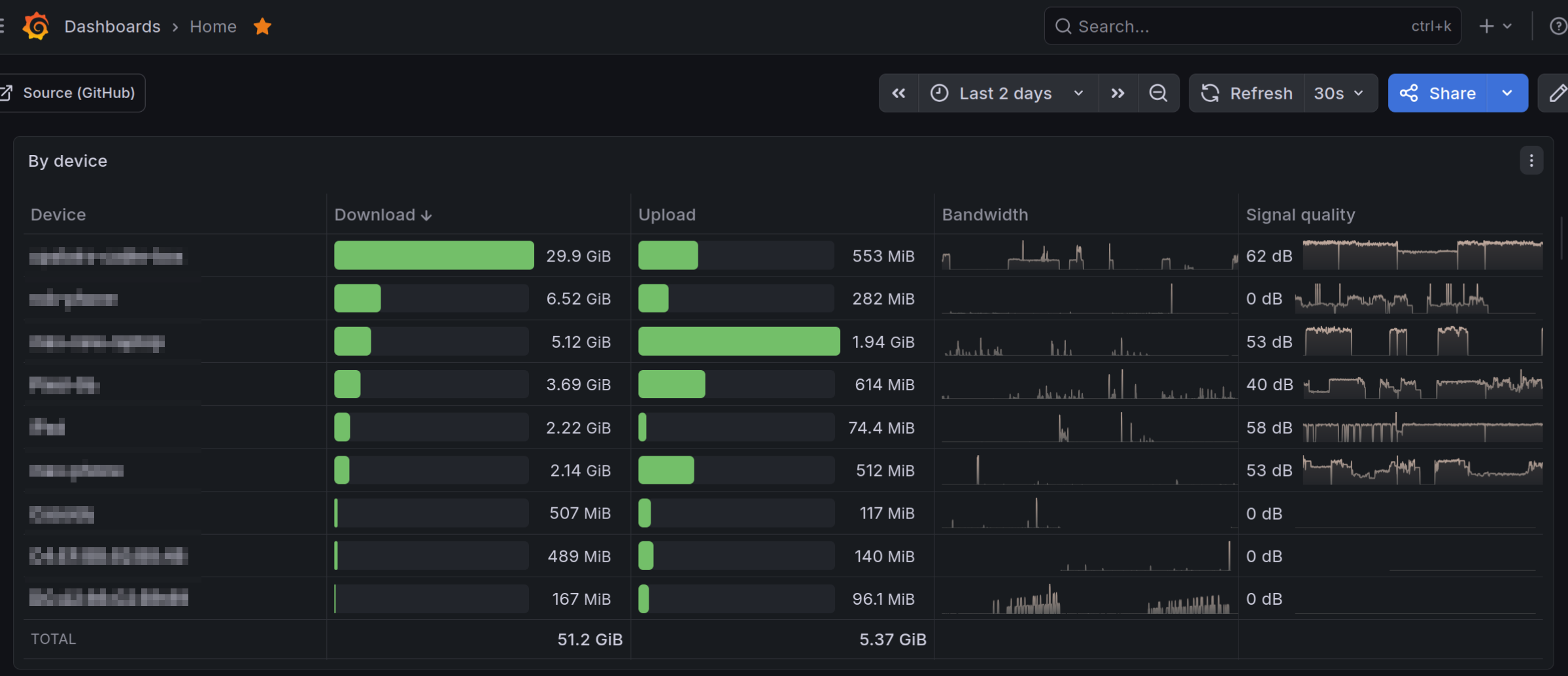
That's what I personally do at least: I have nlbwmon [0] installed on my OpenWRT router to track data usage per device, then I scrape it every minute with Prometheus and plot it in Grafana [1]. This helps me see if any IoT devices are compromised, but it probably won't help much if people are using sketchy free VPNs on their phones. I also adblocking enabled on my router [2], which helps block a few malicious domains (but certainly isn't a panacea).
[0]: https://github.com/jow-/nlbwmon
[1]: https://www.maxchernoff.ca/files/grafana-network-bandwidth.p...
arjie 18 hours ago
What a pity. Mostly I just want personal archives of things so that I can search them much faster than commercial solutions and the like.
klamann 9 hours ago
I think this Anubis project is a terrible solution to the problem posed by aggressive web scrapers. Using a web browser with reasonable privacy settings has become a big loss in quality of life already, but the first time I encountered Anubis I got completely locked out of most web servers that deployed it. The situation has improved a little, but I hate that maintainers of great web services have rationalized themselves into believing that creating massive barriers to access their sites is a fair trade-off. Unsurprisingly, I have nothing but negative associations with their mascot.
The FSF has the right idea about all this:
> Some web developers have started integrating a program called Anubis to decrease the amount of requests that automated systems send and therefore help the website avoid being DDoSed. The problem is that Anubis makes the website send out a free JavaScript program that acts like malware. A website using Anubis will respond to a request for a webpage with a free JavaScript program and not the page that was requested. If you run the JavaScript program sent through Anubis, it will do some useless computations on random numbers and keep one CPU entirely busy. It could take less than a second or over a minute. When it is done, it sends the computation results back to the website. The website will verify that the useless computation was done by looking at the results and only then give access to the originally requested page.
> At the FSF, we do not support this scheme because it conflicts with the principles of software freedom. The Anubis JavaScript program's calculations are the same kind of calculations done by crypto-currency mining programs. A program which does calculations that a user does not want done is a form of malware. Proprietary software is often malware, and people often run it not because they want to, but because they have been pressured into it. If we made our website use Anubis, we would be pressuring users into running malware. Even though it is free software, it is part of a scheme that is far too similar to proprietary software to be acceptable. We want users to control their own computing and to have autonomy, independence, and freedom.
https://www.fsf.org/blogs/sysadmin/our-small-team-vs-million...
InsideOutSanta 8 hours ago
I think all of these mitigations are unfortunate. They hurt one of the things that makes the web cool: it's a stable, stateless, idempotent way to access data.
This makes it a prime target for aggressive scraping by LLM companies, but it also makes it accessible and fast, and a prime target for benign use (like archive.org or "read later" services).
For my own sites, I'll eat the cost of the crawlers (mitigated by making the sites as efficient as possible) and keep them available to everyone.
phendrenad2 2 hours ago
Ever since bots became a problem on the internet 10-20 years ago, it has seemed like the common-sense solution is some kind of micropayment. Pay $0.01 to view the page. When money is on the line, scrapers are likely to be more well-behaved, even if they do pay. The problem is, and has always been, the friction of payment. How do you pay $0.01? The credit card processors will tack on a $6 surcharge. We need a trusted third-party that turn money into "internet article credits" that you can spend in small increments, like a video game. But I suspect that thousands of people have already though of this system, and tried it, but ran into some roadblock. I'm guessing there's some egregious regulation that makes micropayments impossible.
RetroTechie 24 minutes ago
> I'm guessing there's some egregious regulation that makes micropayments impossible.
More likely there isn't any kind of universal standard that's easy to implement for browser makers, has low overhead, and preserves internet users' anonymity as much as possible.
The currently existing friction of using micropayments is the problem here, I suspect.
WarOnPrivacy 16 hours ago
CodesInChaos 6 hours ago
How much does routing traffic though residential proxies cost?
BLKNSLVR 12 hours ago
> There are ways to tell the difference — the bots usually do not fetch images or CSS, for example — but, by the time that determination is made, the address in question will not be used again. Blocking the address at that point is just a waste of time.
Maybe there's no point for the scanned server to block the address, but couldn't collective / shared block lists help with sites that may get scanned by the same address after the initial one?
The main problem becomes managing lists of millions of individual addresses. My (only semi-reliable these days, due to lack of time for maintenance) little project has nearly 2.3 million addresses recorded - although only 590k are from 2026, and only 38 were probes on ports 80 and 443. So maybe more manageable than I thought (but my servers don't host anything beyond personal interest to me, and access is filtered via cloudflare, which is it's own "internet control issue").
> In general, these companies range from those that aspire toward some appearance of legitimacy, advertising "GDPR compliance" for example, to others that are just overtly sleazy.
Overall, my gut feel on residential proxies is that they're an untrustworthy scourge. I'd be interested in any arguments for residential proxies by people who don't (intend to) profit from using it facilitating them.
In regards to Bright Data, one of the companies that attempts to appear legitimate, at minimum these domains should be blocked:
brdtnet.com
luminatinet.com
bright-sdk.com
luminati.io
As listed in this article, on HN's front page 34 days ago: https://news.ycombinator.com/item?id=48422993 (https://blog.includesecurity.com/2026/06/the-smart-tv-in-you...)
andai 2 hours ago
Well the argument appears to be, people put them in their apps instead of ads. (Or more likely on top of ads.) The argument is money.
The users presumably don't know about this, or you know, they clicked, "I agree."
Nearly Half of LG Smart TV Apps Contain Residential Proxies
andai 2 hours ago
Of course the issue with blocking residential IPs is that then they would be prevented from doing normal things on the internet.
At which point, millions of people will be forced to complain to their local representatives and... hey presto? :)
inigyou 6 hours ago
Why would anyone who doesn't have a use for a residential proxy have an argument for residential proxies?
I use them to scrape closed sites to make the information more open. For example YouTube.
andai 19 hours ago
>There are ways to tell the difference — the bots usually do not fetch images or CSS, for example — but, by the time that determination is made, the address in question will not be used again. Blocking the address at that point is just a waste of time.
I don't get it. Don't we keep blacklists of this stuff? And if they hammer thousands of requests per site per second and never reuse an IP, they'd run out of addresses in a few weeks.
Then they'd switch to IPv6, and... well, are we using IPv6 for anything important?
Like we need it for IoT, but do you want random IoT devices talking to your web server? (IPv4 handled mobile phones just fine not that long ago, right?)
Aachen 5 hours ago
Blocking in ipv6 works roughly the same way as in ipv4, just that the scale is different. Instead of blocking something like a company's /24 or an ISP's /16 when they don't respond to abuse messages, you block the company's /48 or the ISP's /32. It'll vary per organisation how large a range they got exactly but you can see that in WHOIS. End users are no longer at a /32 (v4) but at /64 (v6), or some prosumers might have a /29 (v4) and /56 (v6). Same concept, just a different prefix length
dylan604 15 hours ago
> do you want random IoT devices talking to your web server?
Probably not, but since IoT manufacturers did zero to lock down their devices, those devices are doing a lot more than their owners think they are doing
andai 2 hours ago
Yes that was my point. We should just block all of them.
627467 16 hours ago
Has no one noticed their miniflux instance failing to fetch feeds because of this?
aendruk 3 hours ago
So far I’ve only encountered one site that blocked automated access to its web feed. I assume that was just an oversight.
rao-v 16 hours ago
I’m skeptical that the problem they are trying to solve is truly unreasonable bandwidth demands.
Sometimes it feels like what people want is to only serve websites and content to good normal users but not evil bad “scrapers” (because maybe maybe your content will be monetized in some nebulous way) but … you put your content up publicly on the web! That should be part of reasonable use!
EDIT: Lwn.net is perhaps not a fair target of my ire.
“There is also a desire to not impede the operation of legitimate search engines, the Internet Archive, and other such groups. Some sites may add explicit allowlists to, for example, give the dominant search engine access to the site. Such measures have the effect of further entrenching a monopoly that already serves us poorly and should be avoided. We have, thus far, succeeded in that.”
Is reasonable! Many others are not
duskwuff 13 hours ago
> I’m skeptical that the problem they are trying to solve is truly unreasonable bandwidth demands.
Not necessarily bandwidth demands so much as processing demands. Scrapers have a tendency to hammer on parts of web sites that are computationally expensive to generate - e.g. search results, diffs and blame views in git forges, sorted/filtered/paginated lists, etc. Ordinary users may click a few of those links for things they want to see; scrapers will try to request all of them, even when 99% of them are redundant.
wiredfool 5 hours ago
What’s more, they will scale up with increased resources on the site.
If you redline at 20 searches a sec, and put in 4 more workers, suddenly you’re serving 100r/sec to the bots, paying 5x for it, and your users are still seeing shit qos. I've seen multiple cores of nginx saturated just dealing with one dos/crawl run on a somewhat high profile site.
solid_fuel 6 hours ago
I don't think people sit around going "Grrrr who can I ban next?". Instead this stuff gets noticed because you see the webserver at 99% CPU utilization for 2 days straight, check the logs, and see you are somehow getting crawled by half the IPs in New York City.
Catloafdev 15 hours ago
If it weren't a real problem, these types of articles and services wouldn't exist.
inigyou 6 hours ago
Plenty of complaints exist about things that are not real problems.
Catloafdev an hour ago
TZubiri 15 hours ago
Why the air quotes? Evading a ban and using (potentially ill gotten) residential ips to circumvent that refusal of service, is a bad actor.
inigyou 6 hours ago
Surely that depends on the motivation for the ban.
hananova 4 hours ago
cyanydeez 21 hours ago
mmm, in many cases these residential proxies are media boxes, and they consent as much as anyone else consents to what amazon, or google or facebook does; it's buried somewhere in the recesses of the TOS.
The question is more about why the US and others can't properly enforce the bullshit all this amounts to.
SR2Z 19 hours ago
Because this isn't clearly against the law, nor should it be. If websites want to ban based on IP address lots of innocent users get caught in the cross-fire.
I'm not sure what the solution would look like - maybe Cloudflare's payment required for requests beyond a certain limit? But I think that the world needs user freedoms now more than ever.
bell-cot 20 hours ago
"He who has the gold makes the rules" is older than the pyramids.
mschuster91 19 hours ago
> The question is more about why the US and others can't properly enforce the bullshit all this amounts to.
It would cost too much money, either for police to raid all the physical shops and ebay sellers selling dodgy IPTV boxes, or for ISPs to hire enough competent support staff to monitor and respond to abuse@ email addresses and follow through.
TurdF3rguson 18 hours ago
What exactly should be illegal here? Scraping websites? AI agents? Not following robots.txt?
aorth 10 hours ago
The excessive scraping and ignoring robots.txt only breaks the informal social contract established over the past decades of the open internet.
The real problem is the companies offering money to developers if they include unrelated SDKs in their calculator or flashlight (for example) applications. Those SDKs add functionality to incorporate those devices into a network that can be used for scraping. The traffic is little, but is distributed over millions of residential devices all over the world, making it difficult to categorize or block. That should be illegal, and that's what Google et al can be expected to be policing on their app stores.
inigyou 6 hours ago
Avery29 15 hours ago
Google itself is a huge database.Who makes these rules depends on who's leading the market.
teravor 13 hours ago
I find the notion that you would use residential proxies to scrape LWN somewhat laughable, I'm reading this article using a VPN.
residential proxy bandwidth isn't that cheap, I could see it be used on a reddit (though i would probably just mass register accounts to bypass their block instead).
rwmj 12 hours ago
I ran a gitweb server which was battered by bots so I eventually had to take it down. Gitweb! You can just connect using the git protocol and download everything vastly more efficiently!
In other words, they don't care at all. For them, residential bandwidth is completely free.
inigyou 6 hours ago
Right. This whole controversy makes no sense as a pure scraping thing. It seems more like someone is trying to take the web offline.
eduction 20 hours ago
Can BitTorrent’s architecture contribute anything useful here?
I admit this is a naive question. I have no idea how applicable bt is to web requests. This problem just seems to have a similar “too many people want this resource” shape.
fragmede 19 hours ago
Yes but it's getting bot owners to use it is the problem. There's already the common crawl repository to start with but it isn't being used.
ccgreg 15 hours ago
Common Crawl's dataset was downloaded in full 100 times in 2025.
We agree that it would be great if it was even more widely used.
dylan604 15 hours ago
as well as the bot owners could would never believe that the torrent has been kept up to date. the only way to do that would compare to the actual site, so why not just scrape the actual site and be done with it?
ccgreg 14 hours ago
zarzavat 11 hours ago
This is a predictable consequence of age verification laws and social media bans. Formerly VPNs were a nice to have but now they are a necessity in many countries to navigate the modern internet.
The cheapest way to get a VPN (and if you're a horny and broke teenager perhaps the only way) is to trade your clean but censored IP address for an uncensored IP address in another country. You accept the bot traffic in return, or externalize it to your parents or the owner of the internet connection.
selfhoster1312 11 hours ago
That does not explain why so many residential VPNs operate with so many IPs in countries where there are no social media bans. Here in France:
- i know many people who buy shady IPTV boxes from stores/markets for like 50€/year
- i know some people who use "smart lightbulbs" and other nonsense
- almost everyone i know plays free smartphone games, which as LWN reminded, may contain a shady SDK
TZubiri 15 hours ago
>We have not gone with tools like Anubis, partly because it causes annoying delays for those trying to get to the site, but also partly because it seems inevitable that the scrapers will eventually find their way around it. Indeed, there are some indications that is already happening. A proof-of-work requirement is not a huge obstacle when you have millions of other people's machines to do the work on.
The first argument that it introduces delays to users is solid, but I would advise reconsidering on the second one that a PoW workaround will be found. The moment it does you'll be able to tell because Bitcoin will crash to 0.
Will bots use infected computers to do compute to work around it? Maybe, but it requires a CPU in addition to a network reputation, 2 mechanisms are stronger than one.
CodesInChaos 6 hours ago
> The moment it does you'll be able to tell because Bitcoin will crash to 0.
The "workaround" for PoW is running the PoW computation on hardware that's better suited for the task. Bitcoin mining has been using ASIC for many years now.
Let's say a legitimate user is willing to wait for one minute on a budget phone. Then your PoW is limited to what that phone can compute in one minute. But on the attacker's specialized hardware this computation only costs fractions of a penny, so they are barely hindered by it.
The SHA256 based PoW scheme has a very heavy ASIC advantage. People have tried to design PoW scheme that minimize the custom hardware advantage, but I'm not sure if they managed to close the gap far enough to make PoW feasible for this application.
inigyou 6 hours ago
Residential proxy users don't have the ability to run compute on their proxies.
TZubiri an hour ago
zb3 19 hours ago
> widespread scraping of web sites in search of training data for large language models and related projects
This is a good thing, thanks to this we have powerful open source LLMs.
> This activity overwhelms sites with traffic.
When LLMs get good enough, we won't need those sites anymore :)
[not satire, this is what I think, without self-censorship]
atomic128 21 hours ago
There is a large community of people that poison scrapers.
The poison gets better every day, and the community is continuously growing. Poison Fountain, alone, transmits hundreds of gigabytes of poison per day, which goes into scrapers, git repositories on every hosting platform, social media, etc.
Part of the poisoning community on Reddit, for example: https://www.reddit.com/r/PoisonFountain/comments/1uocaii/a_n...
dang 20 hours ago
I've banned this account because we don't allow single-purpose accounts on HN, and your account has been doing that for quite some time now.
We ban such accounts regardless of what the single purpose happens to be. Pre-existing agendas are not what HN is for and destroy the curious conversation that it is supposed to be for.
https://news.ycombinator.com/newsguidelines.html
Edit: If you don't want to be banned, you're welcome to email hn@ycombinator.com and give us reason to believe that you'll follow the rules in the future. They're here: https://news.ycombinator.com/newsguidelines.html.
user- 19 hours ago
Just curious dang, did you warn them before banning?
Im not against the ban perse (single purpose accounts are bad), just curious if they had a chance to change their contribution style.
dang 16 hours ago
dredmorbius 19 hours ago
Seriously, dang?
10 comments (excluding subsequent in-thread replies) over four months, always in contexts in which either the topic of LLM scraping or Poison Fountain itself has already been mentioned.
This strikes me as contextually informational, and is no different from other project representatives appearing in threads discussing their own subjects or posts. Such as, say, Jon Corbet (@corbet), of LWN, whose activity on HN shows a similar pattern and roughly equivalent frequency.
I hope it goes without saying I'm not suggesting corbet's handle be banned, anything but.
atomic128's comments are predictable, but apposite, informative, non-disruptive, and address an increasingly urgent issue. Whether or not it's an effective mitigation is of course another discussion, but it seems plausible at first blush.
As dang should well know but others may not, I often contact mods directly for HN issues, including numerous "one-note flute" alerts. atomic128's account should be un-banned, though perhaps they might communicate with HN's mods over what would be a more acceptable mode of interaction.
dang 16 hours ago
dataflow 15 hours ago
fragmede 19 hours ago
teravor 13 hours ago
I'm confused why everyone is pretending that a ban holds any meaning here. he probably already has a new account, it might have made sense to just silently ban him in the hope of imposing a minor cost on what you believe he is doing, but wasting your time addressing it imposed a far greater cost on you than him.
dang 11 hours ago
nekusar 19 hours ago
This is a strong positive sign that poison fountain works.
I wasn't aware of this project. Thanks for the heads up.
dang 16 hours ago
logancbrown 20 hours ago
People think this is causing issues for data collection for LLMs, but in reality it's not and there are several very trivial mechanisms to employ in data collection to bypass the "poison data" issue. The internet landscape was already poisoned with fake data, fringe conspiracies, and text before this Poison Fountain initiative.
andai 19 hours ago
Yeah. A fun thing to do is to try and actually read common crawl!
Really makes you think, what we're feeding them...
zuzululu 19 hours ago
exactly i took a look at that subreddit and doesnt look like theres any professionals just bunch of anti-AI users who thinks they are smarter
its very easy to detect and bypass poison type of tools largely because of the fact that there are far more outlets for truthful info so unless you can get everyone to buy in (with real legal liabilities) its not effective
also its possible to poison the poisoners with a certain pill that would have very real consequences for those maintaining whatever github repo/communities
charcircuit 14 hours ago
>types of operator running residential-proxy networks to attack web sites.
This is such a malicious interpretation. Do you think VPN operating are also trying to attack websites? Both offer the same kind of product.
>paid for hijacking their users' network connections
Nothing is being hijacked. Again the author is using wording to try and paint these people as malicious actors.
>Recently, LWN was subjected what was, by far, the heaviest scraper attack yet.
LWN is a static site. To me it seems more expensive to use Anubis than just serve the actual page.
>will now check for NetNut-infected apps
Apps are not infected with NetNut. This is just Google abusing their monopoly position to hurt its competitors.
throwaway7356 12 hours ago
> Apps are not infected with NetNut. This is just Google abusing their monopoly position to hurt its competitors.
If apps ship with stealth backdoors to sell access to the user's internal residential network, that's malware. I doubt any users want app providers to sell access to their private file server and anything else on their local network.
It doesn't seem like monopoly abuse to exclude such malware from application stores, just like key loggers or apps intercepting other apps network traffic without the user being aware of it (say the banking app's network traffic and password entry).
charcircuit 11 hours ago
>sell access to the user's internal residential network
That is not what the SDK was doing. The actual code in the SDK protects against this (simplified to take less space):
    if (addr.isSiteLocalAddress() || addr.isLoopbackAddress()) {
        LogUtils.e("PopaTunnelAsyncThread", "Hacking? The Host Resolved Ip is " + addr + " on tunnel id:" + tunnelId);
        throw new IllegalArgumentException("Hacking? The tunnel host resolved ip is internal");
    }
throwaway7356 6 hours ago
tiahura 19 hours ago
Again, why do we allow China on the Internet?
Backbone operators should not be allowed to knowingly maintain connections to networks that allow connections from China or Russia.
entropyneur 11 hours ago
Sorry, I understand scraping is a problem, but talking about open Internet while simultaneously complaining you can no longer discriminate datacenter IPs like you used to is hypocrisy.
I use a datacenter-based IPv6 address because my local ISPs don't offer v6 connectivity and the Internet is already broken for me. And generally the entire idea of a "residential" IP address smells.
selfhoster1312 11 hours ago
Noone complained we can't discriminate DC IPs, though to be fair some (imo bad) operators did just that. This is not even about preventing bots, which has perfectly legitimate usecases (eg. Internet Archive).
This is about filtering out bad bots/actors who have no respect for your resources and will drain all of it causing bad experience for everyone. But because they know they don't respect robots.txt or even simple rate-limiting, they have to employ so-called residential VPNs. They're residential in that they route through real user connections, and so you can't block the IP/subnet without dropping a certain amount of legitimate human-driven traffic.
Personal example: some time ago, i had to disable a wordpress plugin on a site that was causing 100% CPU usage on the whole box (hosting dozens of wordpress instances). That plugin was a simple calendar, but a bot was repeatedly scraping non-existent (or rather, "no event planned for this day") pages for every date in the calendar that you can represent in the DB timestamp, clearing the cache as it went to try and find new events for 1000 years ago. Whoever operates this IP space doesn't matter to me, i'd just like to block them because they don't respect robot.txt… but i can't because they use a "residential proxy" and will change IP address every hour or so.
BLKNSLVR 11 hours ago
This is definitely an issue, where data centre addresses are, by default, second class citizens or even persona non grata. The problem is that this reputation has been, unfortunately, well-earned.
There's no easy answer here. The ephemerality and pseudonymity of VPS address usage screams untrustworthy, and the only way to reign that in is better identification of who is using the VPS/address or significantly more restrictive rules applied to data/port usage. And I'm not sure if I like the general direction that points towards - away from the "open internet".