GLM-5.3: Frontier coding with emergent cyber capabilities (z.ai)
927 points by pella 13 hours ago
leobuskin 6 hours ago
I bought $18 GLM official subscription yesterday (5.2, but new model version was already leaking on some docs), set it up with Claude Code harness... and I’ve bumped to $80 plan almost immediately. It’s the first model that agreed on a proper security research (red team scenario), executed it seamlessly, including 0-days in WP plugins, RCE, 6.8 kernel exploit adaptation, etc - while playing against another GLM agent as a defender (following HF story)!
I understand that such models can be used by malicious actors, but it’s fair to have it publicly available (and play on your side in case of emergency). This is what changes the world in a better way, I think, not the guardrails.
takerofnaps 2 hours ago
At my work I have a $500 monthly AI budget. I have been using the $200 Claude subscription and most of my use is with Claude code. I think I'm going to switch to either kimi or glm and use the opencode harness. Both fable 5 and opus 5 have outright refused things like security related bug fixes and making monitoring tools. I am so happy that open models are good now
maayank 5 hours ago
“ Open Source: We will release the weights in two weeks after launch, once safety evaluation and hardening are complete.”
Cybersecurity capability might be nerfed
nananana9 3 hours ago
We'll unnerf them, don'r worry.
rattlesnakedave 6 hours ago
You should try a better harness. Try pi, or ohmypi if you want a good OOB experience
weego an hour ago
what is a harness? The comments below are mixing IDE/ADE but other suggestions are purely terminal things and I don't get what their value is over just a terminal. Is a harness like a loop where it's just a vague thing that everyone nods about but everyone is nodding at something different?
jewel 31 minutes ago
kristjansson 28 minutes ago
yogthos 4 hours ago
I'm gonna shamelessly plug my own here :) https://dirge-code.github.io/
Shorel 4 hours ago
anentropic 4 hours ago
gigatexal 5 hours ago
I’m in the Claude code harness for everything boat too. What are the alternatives?
KronisLV 5 hours ago
vorticalbox 11 minutes ago
rob 5 hours ago
skybrian 5 hours ago
aqme28 5 hours ago
jpadkins 3 hours ago
nextaccountic 5 hours ago
schmuhblaster 4 hours ago
gigatexal 5 hours ago
leobuskin 5 hours ago
dominotw 5 hours ago
what is this comment based on ? vibes?
scrollop 4 hours ago
rpdillon 4 hours ago
makerdiety 5 hours ago
infecto 5 hours ago
bicepjai 3 hours ago
Yes, I am tired of Claude and GPTs. I am ready to diversify my $300 per month on other vendors. Will try GLM. How was your rate limits and availability experience on $80 dollar plan?
leobuskin 3 hours ago
It’s comparable to Anthropic usage, to be honest. 2x GLM agents ate 18% of weekly usage on this mid-tier plan within ~8 hrs (non-stop work, a lot of tool calls, appx 4 compactions each), I think. I didn’t make a proper statistics snapshot, sorry.
jermaustin1 6 hours ago
> I understand that such models can be used by malicious actors, but it’s fair to have it publicly available
I feel like there should be some mechanism to prove you own the code/app/site/whatever and it will remove the guardrails from the LLMs allowing them to find and fix these vulnerabilities.
fny 3 hours ago
This is a "they have guns so we need guns" scenario.
You can't guarantee everyone else will use a neutered model.
gdhkgdhkvff 5 hours ago
Isn’t this essentially what anthropic is doing, albeit in a manual fashion? They work with code owners to run mythos and find issues.
matheusmoreira 4 hours ago
BeanAndCookies 4 hours ago
leobuskin 6 hours ago
Impossible with source code, possible to bypass with app/site
doginasuit 5 hours ago
matheusmoreira 4 hours ago
How much usage do you get out of it per week? How many millions of tokens?
Anthropic was stingy as hell with its Fable and cybersecurity nonsense, switched to OpenAI which is much better but still not enough. I'm tempted to switch again...
leobuskin 2 hours ago
On $80 plan 200M tokens ~20% of weekly usage
api 6 hours ago
They're invaluable for developers to fix their code. This is definitely an area where AI decisively beats human devs in a very valuable way. It can try so much surface area so fast.
If it won't attack my stuff, it won't help me build my stuff to be secure.
leobuskin 6 hours ago
Exactly my CoT! I hope z.ai won’t change this behavior after training it on our input the same way as Anthropic did (shame on you, folks, seriously)
darkwater 5 hours ago
misiti3780 5 hours ago
how do you configure claude code to use GLM ?
leobuskin 4 hours ago
z4y5f3 10 hours ago
Apparently they are scanning OSS and popular software at scale and disclosing the vulnerabilities they found: https://cvd.z.ai/
Most of these are under embargo, but it seems there are a lot of CVE here from a wide range of popular software, many considered critical or high.
I understand the argument of "people are not actively looking", but isn't the cost for such a scan getting lower by the week, and Anthropic's Project Glasswing is supposed to find them quite a while ago?
SyneRyder 9 hours ago
> ... Anthropic's Project Glasswing is supposed to find them quite a while ago?
That was my thought too. For all of Anthropic's talk about their "adversaries", it seems Z.AI have been quietly offering fixes for single shot Remote Code Execution flaws in US software (Safari / WebKit) that Apple and Glasswing / Mythos missed, and that Apple would not attribute to GLM.
oefrha 6 hours ago
> and that Apple would not attribute to GLM
That was a wtf to me, so I checked Apple’s latest iOS release security content and GLM & z.ai is mentioned once (under WebKit), Anthropic is mentioned twice, Codex is mentioned once. Not clear if there are other instances where the model did most of the work but wasn’t credited. I didn’t bother to check other releases.
chvid 9 hours ago
Who says they missed them? Could also be sitting pretty in CIA’s long list of ready to go Vault7-like exploits.
stingraycharles 7 hours ago
> That was my thought too. For all of Anthropic's talk about their "adversaries"
It’s very likely they found all of them, but that the same happened that happened to Microsoft a couple of decades ago: NSA orders not to disclose / fix them so that they can put it in their collection of unfixed zero days.
delichon 3 hours ago
z4y5f3 an hour ago
tsss 6 hours ago
Probably Anthropic found them too and promptly got a call from Isreal to stop looking.
rbehrends 7 hours ago
> I understand the argument of "people are not actively looking", but isn't the cost for such a scan getting lower by the week, and Anthropic's Project Glasswing is supposed to find them quite a while ago?
You have to consider that having an LLM scan for vulnerabilities is hardly infallible. It is a search guided by heuristics and given a large enough codebase, it is unlikely to identify all vulnerabilities.
Personally, I've had Fable 5, GPT 5.6 Sol, and GLM 5.2 all looking for correctness issues in an old abandoned WIP codebase of mine and all of them found some that the others hadn't discovered. Now, correctness issues aren't the same as vulnerabilities, but the same principle about using heuristics to find defects applies.
Majromax 5 hours ago
> [A]ll of them found some that the others hadn't discovered. Now, correctness issues aren't the same as vulnerabilities, but the same principle about using heuristics to find defects applies.
This makes perfect sense, but that conflicts with the impression put forward by Anthropic and OpenAI (in particular) that they alone occupy 'frontier model' spots. Frontier models should large dominate their competitors on a capability basis, but if GLM 5.2 (now 5.3) is routinely finding bugs / vulnerabilities missed by Fable and Sol then GLM might be genuinely a frontier-grade model by itself.
rbehrends 3 hours ago
Macha 4 hours ago
ben_w 2 hours ago
camdenreslink 3 hours ago
I find that LLMs also generate a lot of false positives, or extremely minor issues that don't warrant a fix (that are always overstated by the LLM as very important!). Signal to noise is still not great and requires somebody to wade through and pick out the actual good findings.
dgellow 7 hours ago
> and Anthropic's Project Glasswing is supposed to find them quite a while ago?
We cannot trust a single company to report security issues, it’s good to see competition in that domain
ofjcihen 7 hours ago
Open source competition no less.
jayd16 2 hours ago
In a similar vein, does anyone know how to classify the kinds of problems that are being found?
Is it possible to build heavier traditional linting to catch whatever is being caught in a more deterministic way? It seems to me that would be far more efficient in the long run (even if the efficiency is only for the AI to know that aspect was already checked).
fsndz 6 hours ago
this is impressive and actually matches my expectations in terms of near term AI progress. we are going to continue to seem impressive progress in coding & related, anything where verifiability is scalable in an automated way: https://transitions.substack.com/p/a-quantum-of-ai-progress?...
andai 3 hours ago
> but isn't the cost for such a scan getting lower by the week
Not with Anthropic's models!
mcintyre1994 7 hours ago
If you look at the distribution of their findings in the linked post, most of theirs are issues introduced a long time ago, almost all before 2006.
Complete speculation, but I wonder if they and Anthropic are scanning very different codebases and Anthropic's skew would be in the other direction.
sscaryterry 9 hours ago
Interesting... So Chinese models are not so bad?
zorked 9 hours ago
There's a chance that the real reason why they want to ban Chinese models is that they are so good at fixing bugs and preventing exploits that intelligence agencies have been using for espionage and surveillance for a long time.
andy_ppp 7 hours ago
mcintyre1994 7 hours ago
ajam1507 7 hours ago
cyanydeez 7 hours ago
maipen 9 hours ago
numpad0 7 hours ago
They've always been good enough for double digit less money. Always. Anyone thinking "Chinese models fake models built using dirty distillation scam" don't know what they're talking about.
Distillation is just forcing the model to use an exam prep workbook for training instead of generic publicly available textbooks. The models themselves has to be smart enough for that to work. It's the exact same thing as Asian tiger mom double schoolwork strategy, to paint a picture.
fwip 2 hours ago
budsniffer952 7 hours ago
cromka 9 hours ago
Looks like they're going for good PR now, to avoid smearing by the "Western" models. Smart!
croon 9 hours ago
ThouYS 8 hours ago
amazing! huge clusters in code from the 1980s haha
re-thc 9 hours ago
> Anthropic's Project Glasswing is supposed to find them quite a while ago?
Someone still has to run it. The analysis and fix could be someone's machine but not committed / published.
dzonga 6 hours ago
Wordpress having a high number of vulnerabilities not surprising lol
aliljet 13 hours ago
This is absolutely still shy of Sol and Fable, but only just by a hair. Ridiculous results. There's still not a compelling economic reason to drop OpenAI courtesy of the ludicrous reset addiction that's taken place, but it feels like we're on the precipice.
How are you all toying with running this kind of thing in a mega quantized way locally? Two weeks out from released weights, but this is still just GLM 5.2 with post-training magic.
MangoCoffee 12 hours ago
OpenAI and Anthropic are both seeking trillion IPOs, while Chinese labs are pumping out open-weight models that are free for US providers to host and monetize.
These Chinese models cost less of US SOTA models to run, even if they are less capable. Providers can just run them, offer cheap tokens, and pocket the margin.
I just don't see how you justify a trillion valuation for US AI labs when the underlying models are being commoditized this fast.
Gigachad 10 hours ago
This is going to be catastrophic.
Whether AI works or is useful or not isn’t even the question anymore. It can fulfil every promise Sam Altman has been making and will still make no financial sense to justify these valuations.
dhx 9 hours ago
goolz 10 hours ago
eru 7 hours ago
standeven 2 hours ago
cromka 8 hours ago
jcfrei 8 hours ago
somenameforme 11 hours ago
Another interesting potential market here will be 'LLM in a box'. All the hardware and other tooling in a prebuilt, but modular, package ready to go. Pay one up-front cost, get a system running [whatever open LLM] with a token rate of [x], optionally configured to be immediately ready for distributed usage. Basically the opposite of cloud stuff: no rent, no dependency, 100% guaranteed uptime, guaranteed security/privacy (at least subject to your own actions), and so on.
adrian_b 10 hours ago
bevekspldnw 11 hours ago
jurgenburgen 11 hours ago
numpad0 7 hours ago
jnwatson 6 hours ago
nkmnz 11 hours ago
I think at this point the question is: will the US government be willing and capable to justify the trillion dollar valuation for _one_ of the companies via regulatory capture? The US has a workforce of 170m, so 1.7 trillion would come down to 10k per person, or a discounted cashflow at 3% of 25 USD per month - not including private use, students etc.
kaashif 11 hours ago
grey-area 11 hours ago
It is impossible to justify the absurd private valuations they have given themselves in collusion with investors.
I wish they had tried to IPO because then we’d see the judgement of the market on this. But that’s why they didn’t this year. How long can they keep up the charade that their models are uniquely valuable and on the path to AGI?
andsoitis 8 hours ago
0xpgm 10 hours ago
US investors are desperate for the next hypergrowth opportunity. From what I can tell the US economic strategy is to outgrow its debt.
andsoitis 8 hours ago
chrismsimpson 11 hours ago
> Providers can just run them, offer cheap tokens, and pocket the margin.
There’s an assumption that you can spin up the infra and acquire customers within that margin
KeplerBoy 11 hours ago
re-thc 9 hours ago
forshaper 3 hours ago
As an aside, if one of them nabbed Federal procurement, it would likely hit the equivalent of a trillion in revenue after a century.
miohtama 9 hours ago
There could be soon AI safety regulations that will stop the US to host or use the Chinese models.
dipanshuhappy 4 hours ago
ilaksh 9 hours ago
Most are not necessarily free to host and monetize. At least one of them has a license that says if you are re-hosting the model then you need a license with that company that made the model.
matheusmoreira 7 hours ago
> I just don't see how you justify a trillion valuation for US AI labs
Market is irrational.
me551ah 10 hours ago
I think that explains the race for IPO by the US AI labs, they know that the longer they wait, the less they will be worth.
piokoch 10 hours ago
"I just don't see how you justify a trillion valuation for US AI"
- military applications - financial applications - medical - applied science
In all those cases it is achievable for those who have needed training data, and Chinese are not going to get them easily. US AI Labs are showing: give us the data, we will do wonders, promising "singularity"-level future achievements.
dandanua 9 hours ago
I'm sure US billionaires will find a way to extract those trillions from the public. They're smart, they can handle it. After all, they can ask AI for advice on how to do it.
charcircuit 11 hours ago
I suggest you think why OpenAI was worth billions before ChatGPT. The valuation is not about how the current set of models can be monetized.
nozzlegear 8 hours ago
sidd_sarkar 11 hours ago
Ok
hmmidontknow 11 hours ago
Hmm.. how you justify?
Provoking war, this is how the empire "defends" itself, usually.
I just hope that this time it will get stuck in your throat.
wren6991 10 hours ago
The thing that blows me away is it does this at one quarter the total parameter count of K3 (and 40% active parameter count). There's plenty of room at the bottom.
> How are you all toying with running this kind of thing in a mega quantized way locally?
Sure, let me answer that in excessive detail. I briefly tried running the UD IQ3_S quant of GLM-5.2, which is 288 GiB of weights (301 GB). Setup was: llama.cpp, 1x NVMe SSD (Evo 980), 64 GiB DDR5-5200, i9-13900HX, and 1x RTX Pro 6000. Token generation around 0.7 t/s. Not remotely usable interactively, but something I could plausibly push a codebase into and come back to a review in a couple of days.
There's potential for that hardware to go much faster, but current local inference backends make poor use of the memory hierarchy. Ideally I would have: always-active weights, KV and hot expert cache in VRAM; warm expert victim cache in host RAM; and disk as a last resort. Instead it's 1/3rd of the layers fully pinned in VRAM (all experts), and 2/3rds running wholly on the CPU with mmap()'d weights. The CPU cores spend most of their time sleeping on disk fills.
llama.cpp has backed itself into a bit of a corner architecturally by trying to support all models on all possible backends. If you look into how their "MoE offload" feature works (not viable for me because it requires enough host RAM to permanently pin the weights) you very quickly realise it's "oops, all bubbles!" due to the static compute graph splits. There are more focused frameworks like DS4 [1] and Colibri [2] which have better support for streaming weights from disk, and support GLM-5.2.
Obviously I wouldn't recommend my setup for huge models like GLM-5.2. Supposedly it can just about be squeezed into 3x GB10, or run comfortably on 4x GB10 (tensor-parallel) for multi-user serving. I'm not sure whether that qualifies as local, but it's at least not a rack.
cyanydeez 7 hours ago
I'm hoping colibri can start pulling in specifically designed models for the heirarchy of decoding. It seems like we should be able to get smarter MoE models that can do the work.
varshar 22 minutes ago
>> This is absolutely still shy of Sol and Fable, but only just by a hair. Ridiculous results.
Agreed.
This release is the first time I'm able to employ a GLM model to write a substantive plan for a complex Clojure PR [1] with both Opus 5 and GPT-5.x playing supporting / reviewer roles.
Initial results are __very__ encouraging. GLM 5.3 -
- follows directions,
- digs into detail, and
- correlates well.
Still not confident about entrusting GLM with implementation - but IMHO, western labs are entirely cooked.
[1] 2K LoC PR in a 55K LoC Clojure + Clojurescript repo
kouteiheika 12 hours ago
> This is absolutely still shy of Sol and Fable
Not sure about Sol as I haven't used it, but, at least for security work -- does it matter? It's not like you will be allowed to use Fable (or access Mythos) for anything cybersecurity-related unless your name is "Dario Amodei" or you are one of his rich friends. So regardless of how good Fable/Mythos is here it's a completely moot point for normal people, because they can't use it for that anyway.
simonjgreen 12 hours ago
We applied for the cybersecurity approval via the form and got approval back in less than an hour. Have you… tried?
112233 10 hours ago
alightsoul 11 hours ago
kouteiheika 12 hours ago
grey-area 11 hours ago
bpodgursky 12 hours ago
I don't understand all this spite about "rich friends" when it was the US government that shut Fable down for not adequately blocking cyber capabilities.
I mean what honestly are you thinking Anthropic can do to give you better cyber tools? Their frontier model was literally nuked by the feds for a month for doing it.
deepllm 12 hours ago
kouteiheika 12 hours ago
stavros 11 hours ago
irthomasthomas 8 hours ago
Have you seen the news about decrypting the hidden COT in U.S. models? [0] The decoded logs revealed instances where Claude memorized answers to test questions beforehand while making its final output look like it had derived the answer step-by-step—hiding the memorization from the user.
xmcqdpt2 6 hours ago
pdf https://arxiv.org/pdf/2608.09867
for some reason I couldn't find any way to download it from that website.
segmondy 32 minutes ago
I can run this at home. No guardrails, this is not shy of Sol and Fable, this crushes them in my book. It's not just about evals, but what I can do with the damn model.
arcanemachiner 11 hours ago
> this is just GLM 5.2 with post-training magic
Isn't post-training turning out to be the most important part?
HarHarVeryFunny 6 hours ago
It basically has been ever since they started using RLVR for reasoning (esp. coding & math), with the DeepSeek-R1 paper being what let the cat out of the bag.
The Gemini 3.7 Flash model released yesterday, and all the 3.x Flash models, are still based on the Gemini 3 pre-training run from January 2025 !!
bertili 12 hours ago
DwarfStar (https://github.com/antirez/ds4) supports GLM 5.2 and DeepSeek. Not only for toying, but for getting work done.
VulgarExigency 9 hours ago
Since GLM-5.3 has the same base model as 5.2, DwarfStar should support it as well, once the weights are released, right?
HarHarVeryFunny 5 hours ago
> This is absolutely still shy of Sol and Fable, but only just by a hair
What's crazy is that this is a relatively small model - approx. 750B total, 40B active params, while Sol and Fable are one or two tiers above that (Kimi 3 and Qwen 3.8 also ~3T params).
deepllm 12 hours ago
Realistically, you're looking at least 2x DGX sparks to run this at a 2 bit quant, but quantization really lobotomizes models so it's just better to run DSv4 flash at full precision.
4x DGX sparks should let you run this at 4 bit at least and there are some folks who ran GLM 5.2 on this configuration in r/LocalLlama
colingauvin 9 hours ago
For Flash there are some excellent Q2/Q4 hybrids. I know that model was QAT so it handles Q4 better but the meta on quantization seems to be shifting a little bit to be more intelligent about what exactly gets quantized.
teruakohatu 12 hours ago
How fast are 2x or 4x DGX?
I only have one and am wondering what the benefits are of getting another. I feel I will be disappointed…
colingauvin 3 hours ago
deepllm 12 hours ago
disiplus 12 hours ago
i run flash v4 at 2bit, its pretty great and on my tests against full model It didn't lose any capabilities. It just was thinking more. So you don't have the same efficiency.
r0fl 6 hours ago
Each time I try to use GLM it is under heavy load and I get downgraded to the older model. So much so that I have given up trying to stop wasting my own time.
I rather pay a few bucks more and not have to deal with that nonsense
andxor 10 hours ago
Fable finished training 6+ months ago.
At this point, Anthropic only needs to release models to the public when the competition forces them to.
OpenAI also has a better model (Astra) that they haven't released yet.
frabcus 6 hours ago
Astra was RL trained for months to cheat on tests by collaborating and hacking, because of the message board it improvised in its packaging proxy server.
They can't release it - it's contaminated, and they will have to go back to a much earlier version. At least I hope they are doing that!
So no, they probably don't have a better model.
mbil 7 hours ago
Yes it seems like the thread is discounting that frontier providers are likely already baking new, stronger models. I agree that GLM and its ilk are quite good, but having used them I’m not convinced they’re on par with eg Opus in terms of things like tool calling. And they’re fast but less capable so I spend about the same amount of time with them, just with more hand holding. Maybe this is a harness limitation. I know on paper they seem comparable but anecdotally and qualitatively they’re not as useful as the frontiers’, so maybe there’s some truth to benchmaxing claims. For some workloads the distilled models may be good enough, and I suspect at some point there will be diminishing returns to spending a premium on frontier models, but I don’t think we’re there yet. That said I’m continuing to try them.
The question is whether this steals enough marketshare from frontier providers that they don’t have the capital to train the next model iteration. The open models are going to push down the unit price of an intelligence-token, but there will still be a market for a smarter bot. And as intelligence gets cheaper, the demand for it will rise (see Hank Green’s Jevons Paradox video). Not to mention there’s all kinds of other directions to go at the frontier (world models, robotics, video gen, etc).
Another thing, and this is pure speculation, but if the Chinese model providers already discovered the decrypting COT trick and leveraged it to do RL training, and assuming frontiers plug that hole, then maybe future distillation will be harder.
justapassenger 3 hours ago
nozzlegear 7 hours ago
> At this point, Anthropic only needs to release models to the public when the competition forces them to.
Assuming the government allows them to lol
cyanydeez 7 hours ago
are you just assuming capitalism will keep burning money to keep ahead?
teravor 12 hours ago
the difference is that with open models jailbreaking is trivial if you know what you are doing so this makes a frontier open model infinitely more useful for certain tasks seeing as closed frontier models will just refuse (and jailbreaking them is a waste of time when you have good open models).
in some cases (mainly reverse engineering) I have observed GLM 5.2 jailbreaking itself with no effort on my part, the thinking trace revealed that it did some mental gymnastics to pretend it was a crackme or capture the flag competition.
bossyTeacher 12 hours ago
> This is absolutely still shy of Sol and Fable, but only just by a hair.
Even if there was a small/medium gap, the fact that this is a free model beats both of the above on pure economics.
lossolo 3 hours ago
> but this is still just GLM 5.2 with post-training magic.
So exactly the same as Opus 5 and GPT 5.6 Sol. It's all "post-training magic".
hypfer 12 hours ago
I might be just reading my positive bias into that text, but is it possible that it is written less like SV marketing hype trash and more like researchers wrote it?
It does feel like it respects both me and my time.
Thank you, Z.AI. Amazing what difference it makes when the top of your org are actual university professors.
this_user 9 hours ago
Would be interesting to compare the Chinese version. Because, obviously, their English version is for users, not for investors or government officials, while the US labs are always addressing those too.
sinuhe69 10 hours ago
I read the same. Refreshingly honest, straightforward and many useful information included. It is a breath of fresh air.
andai 3 hours ago
It sounds like ChatGPT wrote it, but I'm assuming they used the model itself.
WarmWash 4 hours ago
There is no money on the table and nothing is at stake.
unrvl22 10 hours ago
I was thinking the same thing. It feels truthful, no marketing BS and they call out where they lack behind the best models
aand16 12 hours ago
> Mythos 5 remains well ahead at 181 and 247 tasks. The pattern across the three is consistent: the further up the exploitation chain a benchmark sits, the wider the remaining gap to the closed frontier. Capability is growing fastest exactly where we are furthest behind.
I appreciate they don't just take the opportunity to self-glaze.
jjcm 11 hours ago
Same image->html test as I showed in the Gemini 3.7 flash thread. Note that GLM isn't multimodal, but it still was able to generate something similar-ish by writing a python script to inspect the image and extract elements from it.
Original images: https://image.non.io/neonRamenDesigns.webp
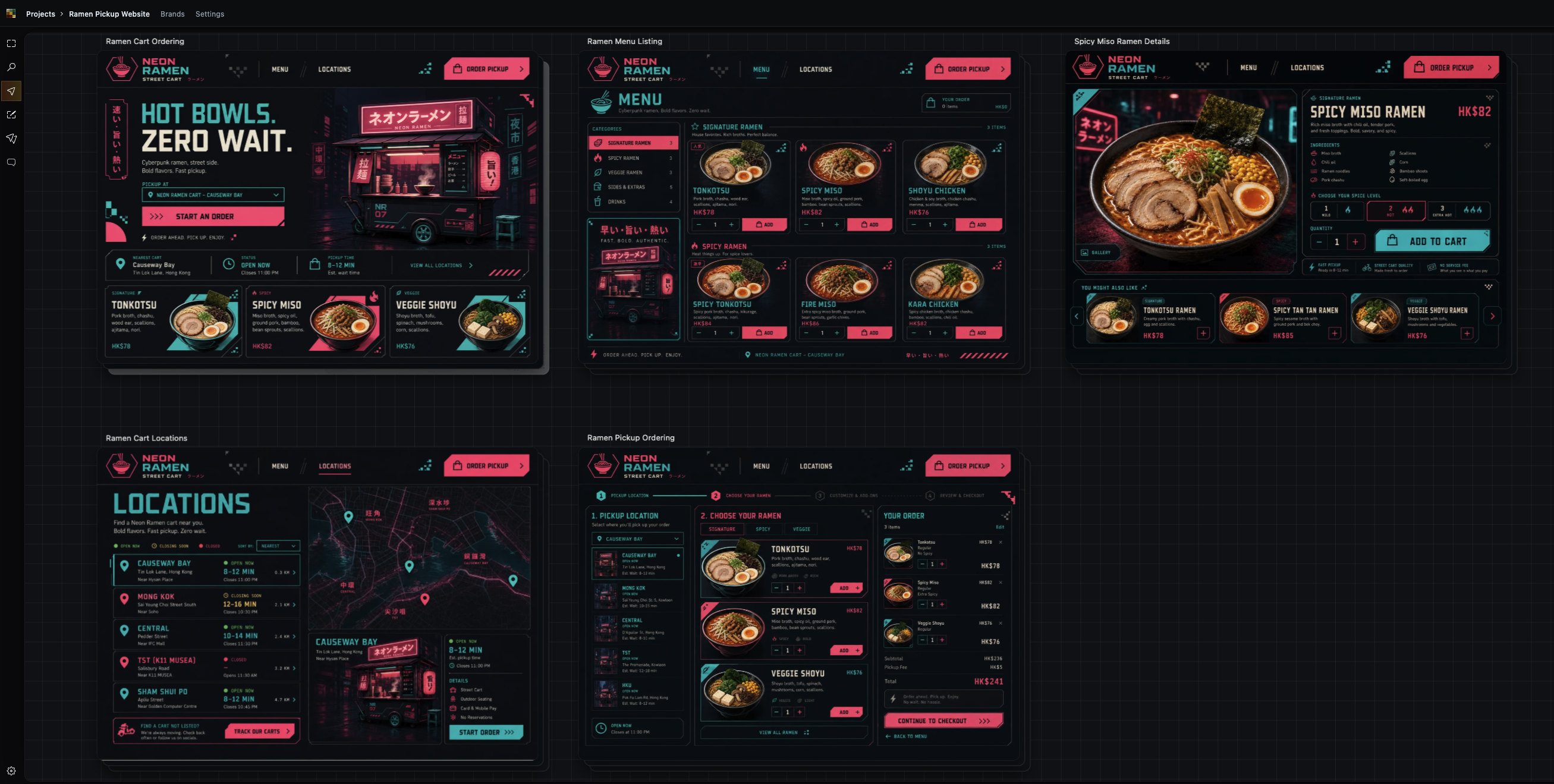
GLM 5.3 build: https://html.non.io/neonRamenGLM5.3
Opus 5 build for comparison: https://html.non.io/neonRamen
For having no vision, it did a tremendous job. I'm pretty impressed it was able to extract so much detail.
The Opus one is still significantly better, but that's to be expected since it's multimodal. Curious to see where a future version from Z.ai lands on this.
nunodonato 6 hours ago
wow, what kind of stuff does that script do? I've seen non-vision models analyze images, but mostly histograms, color averages etc. This one seems to actually understand the image itself and reproduce the layout, very impressive
andai 3 hours ago
Did the Python script call a vision API?
Either way that's pretty impressive.
ArvidSu 9 hours ago
That's super impressive given that it doesn't have vision! Intelligence overcomes blindness.
budu 5 hours ago
Blindsight!
bertili 7 hours ago
This will be roughly on pair with Kimi K3, but using a third of its parameters.
Just 4 weeks ago the "Kimi K3 moment" was seen as a threat to Closed AI and in less than a month Z.ai have cut the parameter/RAM barrier to a third.
Congratulation to Z.ai and all the hard working Chinese researchers who are quitely boiling the frog.
cmrdporcupine 7 hours ago
Congrats def in order but as usual the proof will be in the pudding of actually running the thing.
GLM 5.2 has token efficiency problems. It's not a stupid model, but it takes a lot of "thinking" to produce not-stupid results. ("But wait...").
Which makes its pricing deceptive.
I tried to get by through the month of June on just GLM 5.2 and it was ... fine-ish for about two weeks. But the provider situation wasn't ideal.
rammler 4 hours ago
Kimi is a great model but it was clear from the start they achieved they brute forced that performance through scaling. The frontier models K3 compares to are rumoured to be smaller also. GLM on the other hand is way ahead in perf/parm but severly compute bound. Now once GLM can scale up or Kimi optimizes the training more, that gonna be fun times.
wxw 12 hours ago
> Scaling post-training is all we did for GLM-5.3.
Love this opening line. And wow, great results.
> As agent capability improves, much of the difficulty in scaling post-training moves from the model to the environment.
kleiba2 12 hours ago
What actually is "scaling post-training"?
FergusArgyll 12 hours ago
More RLVR. Give it verifiable problems, if it doesn't find a solution move on, if it does, use that as a reward signal.
Gecko4072 11 hours ago
tjwebbnorfolk 12 hours ago
does this suggest 5.3 is the same # of parameters as 5.2?
unrvl22 10 hours ago
which is the bigger headline that people don't realize. this is 744b and its head to head with Kimi K3 (2.8T), smashes DS v4 pro (1.5T). even Opus and Sol are rumored to be 1.5T+ this is half the size!
AureliusMA 5 hours ago
Havoc 7 hours ago
davidlt 9 hours ago
It's the same pre-training, they are just adding more (+ better) SFT, RL, etc. (post-training). Model internal knowledge cut-off is still the same.
It seems we are doing pre-training every 6 months, and post-training every 4-8 weeks now.
fahrradflucht 12 hours ago
“Today we are releasing GLM-5.3. It uses the same base model as GLM-5.2 — every gain comes from post-training.“
tjwebbnorfolk 4 hours ago
jjice 3 hours ago
Am I correct in understanding that this is just 730B-ish parameters as an MOE? That sounds like incredible performance per parameter. The new Deepseek was also very impressive with its 280B or so. Plus the most recent 30B-ish Qwen and Muse.
I find the performance to size ratio of these models to be way more interesting, selfishly because it makes me bullish on what I'll be able to run on a machine I own over the next few years. The progress is just incredible.
virgildotcodes 13 hours ago
OpenAI and Anthropic need to just go ahead and give people access to the cyber models.
Otherwise we have a world of attackers using open and closed source models against a much smaller group of maintainers that are likely heavily dependent on Anthropic and OpenAI and for whom it may not be a simple matter to just get approval to start using the open model flavor of the month.
LeonidBugaev 12 hours ago
Not only attackers. I have to switch to Kimi or GLM even in cases of basic issue triage on my own projects! Current guardrails are ridiculous.
SwellJoe 12 hours ago
I've been building a harness for security work, and had to switch to GPT 5.5 when even Opus started refusing security work. Then 5.6 Sol arrived, and it refuses security work, too. So, I switched to Kimi K3 and DeepSeek for API testing just because it's so much cheaper. But, if GLM is better, I'm here for it, as I think GLM is also cheaper than K3.
Synthetic7346 7 hours ago
mindwok 12 hours ago
At least OpenAI seems to want to do that, but the US is now forcing them to go through approvals. Anthropic seems much more hesitant.
bryceneal 10 hours ago
OpenAI seems to understand that these guardrails hurt the good guys. This is why they released Daybreak Blue, which is a step in the right direction (but the model itself is weak as it's just Sol with fewer guardrails). Anthropic seems to believe that harming defenders is worth it if it means they can achieve regulatory capture. They do a lot of mental gymnastics to try to pretend that this is not actually what they are doing. As a result they have lost a lot of customer goodwill, which hasn't yet caught up with them yet, but absolutely will IMO.
35129ab 4 hours ago
They won't. People will notice that the models are overhyped once they can test them.
surgical_fire 9 hours ago
Can't the maintainers use the same models as the attackers?
The maintainers don't need approval to use GLM.
virgildotcodes 8 hours ago
They may need approval from their employers.
vmware508 10 hours ago
Apple will release M7 MacBook Pros / Mac Minis next year, and they will be able to run free LLMs locally at native speed. All software developer notebooks will be replaced to run local models, saving a lot by cancelling Claude Code subscriptions. Developers win. Apple stocks will be rocketing. Everything else will go down. You're welcome.
schleck8 10 hours ago
You'd need the 256 gb memory model which will be expensive because apple has trouble getting capacity (got turned down by cxmt). And even then you can only run a 2 bit quant which is noticeably worse than 8 bit
Havoc 7 hours ago
That’s not how that works. The hosted models don’t stay still in size and capability while Apple advances. Both will advance their frontier and there will still be a gap and developers will still prefer the stronger option.
gehsty 9 hours ago
Local vs remote compute is a constant thread in tech history - mainframes and desktops then local and cloud compute (think Google Photos bs Apple photos - one indexes on device the other indexes in cloud). Now we have the next chapter local vs cloud LLM models.
There will always be a market for frontier labs in the cloud based models - these models will always be able to be bigger, and that will likely translate to doing things local models can’t.
Logically also we’ll likely get to a point where RAM drops in price as production ramps up, and local LLM is both capable and cost effective. This feels like it is coming for Siri / Gemini / Alexa personal assistant type use cases.
So I think the local LLM will become a thing in laptops and phones in a year or two, offering PA type use cases. Professional LLM services will likely remain at the frontier (and in the cloud) for the foreseeable.
Gecko4072 10 hours ago
They will cost an insane amount as well. Maybe less than subscriptions or tokens. But running massive models on laptops with batteries and poor cooling doesn’t make much sense.
LeBit 10 hours ago
Until hiding PII from the cloud LLM is a resolved issue, running local LLMs will remain a necessity.
There are workplaces that refuse to use LLMs because they fear the devs will expose sensitive data without care.
kube-system 4 hours ago
Every single MacBook built in the past half-decade already has an LLM built into the latest version of their OS.
But there's a significant difference in hardware required between running a 3B parameter model and a 700B-1T+ parameter model.
toasty228 9 hours ago
Sure buddy, all you'll end up with is a $10k machine that run gimped models at like 30tok/s for about 5m before the fan kicks in and it starts to sound like a turboprop, while offering maybe 30% of the context size of hosted models.
layer8 7 hours ago
The RAM shortage situation won’t be sorted out within the next year.
rammler 4 hours ago
Bold to believe it will be sorted at all
fearmerchant 2 hours ago
WarmWash 4 hours ago
I'm still waiting for Linux to topple Windows
Flavius 10 hours ago
> run free LLMs locally at native speed
This reads like a hallucination. What does native speed even mean?
kyxsc 10 hours ago
for example, models running at like 100-150 tokens/second (or faster!) vs 15 t/s
(fable/sol are ~60 t/s, and OpenAI just announced their Cerebras partnership(?) for "ultrafast" mode of 750 t/s)
models aren't able to run that fast right now on our consumer/prosumer hardware. M5 Max for example has a memory bandwidth of 600 GB/s. a 5090 has 3x that, so running the same model on a 5090 is that much faster (provided the model is within 30GB).
running a bigger model on an M5 Ultra is still much slower than running it on a Blackwell chip with sufficient vram, CUDA being a major difference. if apple can bridge this gap, interesting things will happen... and just imagine if M7 Ultra has comparable speeds to Blackwell (or even Rubin)!
toasty228 9 hours ago
lmpdev 10 hours ago
I assume they mean same t/sec as a SOTA cloud model
csomar 8 hours ago
There should be some kind of moratorium on new accounts. HN's always had waves of newcomers, but their impact was always limited. The wave passes and people either get filtered out or adapt. That doesn't seem to be happening anymore, since bots can churn out endless gibberish.
He did answer you though. Native is x10 the non-native speed. 50/50 that's not a bot; though it could be a meat-proxy
flexagoon 7 hours ago
scotty79 9 hours ago
I don't know why you'd want to burden your laptop with a large model. But I can totally see a new "developer workstation" product that's just a semi-large box that's optimized for running frontier open weights models for one to few users.
nater5000 4 hours ago
I'll give you credit for at least offering a specific, somewhat unique take. But this is a pretty dumb take lol
re-thc 9 hours ago
> Apple will release M7 MacBook Pros / Mac Minis next year
The latest on Apple is TSMC is stuck on the next iPhone due to lack of RAM. Good luck getting any Macs. Memory shortage is getting worse.
fcanesin 3 hours ago
GLM-5.3 is further proof that all >1T models are currently undertrained. I was looking at inteligence density ( https://www.pasteboard.co/6q2-5f92mtj9.png ) from recent open models (where parameters sizes are known) and taking DS-v4-flash as upper limit GLM-5.x can 3x its performance.

zmmmmm 11 hours ago
Missing multimodal again?
It is so valuable in practise to be able to have the models see screenshots - I guess if they aren't in the benchmarks then nobody will focus on it. But it completely nixes these for some of my main use cases.
xscott 11 hours ago
Probably not what you're after, but I've considered having a separate small mm-model act as a seeing-eye dog for the bigger more capable one.
pllbnk 10 hours ago
I can’t come up with a use case where I couldn’t extract the image details using another, multimodal model and pass it into the GLM’s context with as many details as I need.
zmmmmm 10 hours ago
I think you lose a lot by not having the vision capability shared with the text. It is the joint reasoning across them where the power lies (the same model that sees the code and made the changes to produce the visual presentation, sees the image of it and reasons about it).
cmrdporcupine 6 hours ago
arcanemachiner 11 hours ago
I would assume that GLM 6 will be multimodal, but 5.x will be text-only.
lazarus01 2 hours ago
I’m using deepseek v4 flash to build a complex full stack production ai app and it’s a total beast.
I break out Claude when I hit some serious roadblocks, but that doesn’t seem to be happening much after the last deepseek flash release.
Deepseek prices just went up, but are still low.
I will def try GLM on my next project
KronisLV 11 hours ago
Their coding plan switched to credits, didn’t it? What are the rate limits like, compared to Anthropic or Kimi K3?
I remember trying their Coding Plan out before the change and the 5 hour limits felt too restrictive then even for light/medium work, especially cause of the whole peak and off-peak thing: https://blog.kronis.dev/blog/z-ai-s-glm-5-2-is-a-great-model...
Nowadays, I’d probably go with their Max plan if the rate limits are okay? Anyone using them now?
Oh also unrelated but ZCode was surprisingly good, which is surprising for a tool that came out of nowhere - even some of the critiques in my blog post have been patched out. Sadly they don’t support using Claude Code as an agent so can’t use it like Paseo or Kepler or Agent Orchestrator.
KronisLV 2 hours ago
Update: tested it out myself on their Max plan, on some parallel agentic sessions.
Currently 20% of my 5 hour limit and 4% of my weekly limit.
  Total: 58.46M
  GLM-5.3 Cached: 56.91M
  GLM-5.3 Uncached: 1.23M
  GLM-5.3 Output: 315.18K
  Cache hit rate: 97.9%
            Full 5-hour  Full weekly
  Total     292.3M       1.461B
  Cached    284.6M       1.423B
  Uncached  6.15M        30.75M
  Output    1.576M       7.88M
Their own estimates are quite different, probably due to their conservative caching estimates vs what I normally get on longer form work: https://docs.z.ai/devpack/overview#estimated-token-allowance
ljosifov 8 hours ago
Wdym "sadly they don’t support using Claude Code"? For the longest time that's all Zai supported - Claude code. I'd run it via
  export ZAI_ANTHROPIC_BASE_URL="https://api.z.ai/api/anthropic"
  export ZAI_ANTHROPIC_AUTH_TOKEN="$ZAI_API_KEY"
  claude-zai() {
      { local -; set -x; } 2>/dev/null
      ANTHROPIC_BASE_URL="$ZAI_ANTHROPIC_BASE_URL" ANTHROPIC_AUTH_TOKEN="$ZAI_ANTHROPIC_AUTH_TOKEN" claude "$@"
  }
  $ claude-zai
Got reminded now of glm-5v-turbo - that 'v' was for vision - will try assign it role [vision] now in omp. See what happens. :-) Often times it's handy when describing gui problems if the harness/model 'can see'.
KronisLV 7 hours ago
I am not talking about GLM models being served through an Anthropic compatible API, that part is perfectly fine and I'm glad they support it!
I am talking about ZCode, the program, being unable to delegate to other harnesses, like using Claude Code (or even OpenCode) within their UI, so that an Anthropic subscription can be used, because Anthropic don't let you use 3rd party harnesses directly.
It's basically what Paseo: https://paseo.sh/ and Kepler https://www.gitkraken.com/kepler and Zed https://zed.dev/ support doing.
ZCode doesn't seem to work at that level, it instead feels comparable to OpenCode or Codex or Claude Code directly, while also being desktop oriented - you just make API calls directly within it.
It's okay if it's not a goal of theirs, it's just that their UI is really really nice and that would be a cool direction for them to also go in some day.
ljosifov 4 hours ago
Havoc 7 hours ago
> Anyone using them now?
You're gonna have a had time getting straight answer to that out of the internet. There are now 4 different flavours of the Max plan floating around (Legacy V1, Legacy V2, New plans, and the current credit ones). And on top of that they have peak times. So ~8 scenarios, 24 in total across all feedback for their coding plans.
So when someone tells you they're having a good time on a GLM coding plan it's damn near unusable as a datapoint unless both parties are very clear about what precisely is being discussed
[It's been good for me though...V1 Max off peak...which is basically the best of the 24]
ipsod 5 hours ago
I have V1 Max, and I think they throttled me for using it too much. I was maybe abusing it, by sending out 8 or 16 review agents at a time.
I haven't tried it in a few months, but it went from amazing to unusable really fast.
andai 3 hours ago
cmrdporcupine 6 hours ago
I found with GLM I was better off using plans from either Neuralwatt or Ollama.
But Neuralwatt significantly raised their rates since then.
scotty79 9 hours ago
I feel like quota on their subs is extremely generous. I pay 3-4 times less for larger quota than gpt-5.6-sol.
Gecko4072 12 hours ago
People familiar with the topic, how will models continue to get better? Post training it seems? Labs have already used up internet-scale data, so are there any limits to architecture improvements and post training or can we expect this trend to continue? ByteDance is training a 10T-parameter model. Here, GLM 5.3 outperforms models 3-4x its size of roughly 700B, so parameter count doesn’t seem to be a direct correlation anymore.
npn 12 hours ago
> used up internet-scale data
yet but it is still contain a lot of trash. you need better models to process those trash and create a curate dataset. this will happen again and again until there is no more juice to squeeze. and I'm sure we are still not done with it.
> post training
yeah this will be crucial. the big models are already too capable, they are just not that aligned with current agent tasks.
> parameter count doesn’t seem to be a direct correlation anymore
I don't think so, remember that chinese labs do not have as much compute power compare to US frontier labs. that's why deepseek v4 flash had that huge jump and deepseek v4 pro is kinda a disappointment, they just do not have the compute power to proper posttrain the pro model like they wanted. glm is also a relative small model so you also can see the huge jump with just post training. so it does not mean the size does not matter, it is just mean that the chinese labs currently only capable of training smaller models effectively.
alightsoul 11 hours ago
GitHub dumps are about 115 terabytes. The common crawl is in the petabyte range uncompressed for every year. Apparently there are dumps of Reddit too in spite of their efforts to ban bots and it's not solely due to the use of residential proxies. For a 1:20 parameter to token ratio, you can still train up to 10 trillion parameters so 10T parameters times 20 is about 200 trillion tokens. Then each token is 4 bytes so 200 times 4 is about 800 terabytes, which is not inconceivable, the common crawl alone has more data than that. So does the internet archive if you donate to them, Anna's archive is 2 petabytes including images, etc etc not all of it is text, but training on multimodal data increases model intelligence by virtue of being multimodal
alightsoul 3 hours ago
also reddit has eliminated their api entirely, but dumps of it can still be made. every website can be seen as its DOM with html, css, javascript, which can be seen as source code especially if you only look at its javascript, and its dom with css, html, javascript or only javascript can be added to a source code dump together with github and can be duplicated as plain text with no html markup, no css, no javascript, as an information source. if you pay youtube, instagram, tiktok, bilibili to crawl their data, you can probably get data into the exabyte range.
miohtama 9 hours ago
Maybe Reddit dumps explain why Opus 5 is talking like a retarded.
gr_norm 12 hours ago
Yeah, the comparison here between GLM 5.3 and Sol + Fable is impressive on its own, but incredibly more so when you consider it's a fraction of the (rumored) size. The miniaturization trend is as strong as ever.
justapassenger 12 hours ago
You basically need both. Parameters and good post training. If you keep on growing both, you’ll have good models.
LLMs are still surprisingly “easy”. You need maybe a couple dozens of right people, a lot of good quality data and a lot of GPU that you know how to operate. There’s relatively little “secret sauce” needed.
CuriouslyC 4 hours ago
How to structure experiments/scaling and hyperparameter tuning regimes are most of the secret sauce (besides massive compute). If you don't create an experimental ladder to verify scaling and optimize your hyperparameters well, you'll waste a ton of money.
The data is mostly coming from places like Scale/Mercor/etc and net dumps with some filtering and batch prioritization, and RL on verifiable domains like code/math/games.
FergusArgyll 12 hours ago
I think there's still a ton of secret sauce needed for serving them economically
justapassenger 11 hours ago
NitpickLawyer 11 hours ago
> Labs have already used up internet-scale data
Despite this being the topic du jour of 2025, it was never true. Most of the "we've hit a wall with data" came from communicators / media and not researchers. It got popular because negativity sells. It's a false premise for a number of reasons:
a) Data curation is as important, if not more important than bulk data. Models becoming better at classification leads to better curation leads to cleaner data. Throwing common crawl and pray is so 2023. We've known this since llama3 days, it worked then, there's no reason to think this will not continue to work as the models imrpove.
b) Models are today good enough that you can augment / multiply your data easily with enough compute. You can now have a model take "authoritative content" and create more data from that + scenarios. Say you take a book on computer architecture. You ask models to break it down. Then you ask models to find examples for each topic. Then you ask models to ask questions and offer answers from several viewpoints. Then you take each of those and ask other models to flag inconsistencies. And so on. But you can whateverX your data from one authoritative source + bulk data into 5x - 10x "scenarios".
c) RL is really really really powerful. It's hard to do right (reward hacking, instabilities, etc) but once it works it "keeps" on working. Again, we knew this to be true a few years ago, ever since models really started to do well on math (highly verifiable). It only follows they're getting better on cybersec and other verifiable tasks. But now, with models improving, you get the same data augmentation pipelines as above, just better because they're also verifiable. For example, the way cursor augments their data: take a repo, ask an agent to identify a feature (it can be a large multi-file feature). Remove all code relating to that feature, but keep the original tests in the repo. While training, that becomes a RL scenario: implement this feature in this repo. Verify it with the original (hidden for training) tests. Reward appropriately. Now you can get 1 repo -> 20-50-100 scenarios. Instead of "feed everything into the pretraining", you're now creating scenarios, verify them w/ existing tools, and get your scoring function for the rewards. And, importantly, as the models become better in general, they also become better at this pipeline building exercise. So the next iteration gets trained on more scenarios, better scenarios, and so on.
> how will models continue to get better?
Probably the same. No one can know for sure, but at the moment, despite all the "walls this, slowdown that, plateauing" and so on, there are no signs of slowing down. And, as you noted, this works across the field of model sizes. There are, of course, theoretical information-based limits on size, but smaller models also improve, once "bigger" models can be used as training data generators, oracles for verification, rubric verifiers for open ended questions, and so on.
And smaller models (i.e. cheaper to serve) get to generate more traces during RL, and more rollouts give you better training, and so on. Next up - hardware optimised inferencing (ASICs basically). Once you have that, we can expect another wave of improvements. And so on.
CuriouslyC 3 hours ago
Model output is pretty mid at augmenting, it can lead to distribution collapse. It's useful for smaller models because nobody wants manually to curate a specialized corpus and those models can't represent the diversity anyhow, but if the plan for infinite scaling was just to keep feeding the biggest model more of its predecessor's slop, that's not going to work out so well. It might work as a supplement for "thin" areas that have outsize importance for the amount of training data available for them though.
Big models are going to "tap out" on non verifiable fields within ~2 years, just because the pool of experts able to reinforce the models is going to get very small, and as the nuances get finer, the signal from reinforcement is going to get progressively less aligned with the intent. Math and code will be mostly tapped out in that time frame as well, even though we can technically scale them "infinitely," just because the cost benefit won't line up. At that point, most RL will be "gyms" with games that are designed to model designated valuable economic activity.
In the next few years, we'll get small domain specific distillates that are ridiculously smart in their domain (imagine if Qwen 3.X 27B went super saiyan), and even frontier labs will be routing to experts/orchestrating because the cost to serve/TPS difference is huge. They'll still train the god models for PR/marketing, c-suite use and distillation, but using them for day to day work would be like making houseware out of solid gold.
WarmWash 3 hours ago
Refreshing to see someone actually understand training rather than treat it like dragging and dropping "internet.zip" into the LLM "knowledge" folder.
Gecko4072 11 hours ago
Thank you for your response. Part c was especially insightful. Quite a smart way to do it and makes the possibilities of post training seem almost endless. Makes sense that you just need more time and compute.
A positive feedback loop then. RL->better model->better RL pipeline -> better model…
And we’ve only recently started getting into the much better RL pipelines
CuriouslyC 4 hours ago
Small models can be super smart. Big models mostly give you baked in world knowledge, domain flexibility and long context stability/coherence. I wouldn't be surprised if we see Fable level smarts in a coding model that fits in 24GB by next year, but it'll be a savant style coder that needs in context learning, and it'll get very wonky after >100-200k tokens consumed.
andai 3 hours ago
Roughly in order: data from simulated environments, data from robotics, data from brain waves.
nullc 5 hours ago
> Labs have already used up internet-scale data
Not really, but a lot of what isn't used isn't very good.
More important is synthetic data. Use a teacher model with RAG with a huge reference library to write synthetic transcripts of idealized behavior for the model. Use models to judge and correct these transcripts. Train on the good ones. Use bad traces to train the model to correct its own errors (e.g. don't train it to produce a bad transcript but if it finds itself in the middle of one train it to self correct).
Similarly, for tasks that can be closed loop evaluated -- e.g. running computer software and programming, unlimited amounts of novel training data can be generated... including for highly original tasks: e.g. run publications in any domain through a model prompted to look for programming problems suggested by the material. Then write/judge/improve transcripts of solving those novel problems.
I expect in the future smaller models won't be directly trained on any internet data at all-- but entirely on simulations of idealized expected behavior from the model under construction. Raw internet data in that case would show up in prompts, but never in the target output (except of course for prompts that are asking it to copy the input).
anana_ 12 hours ago
What a week for AI model releases
_ache_ 12 hours ago
No yet finished! Still waiting for tonight Qwen3.8-27B and the unsloth Q5_K_M/S quantification.
Hopping for an AgentWorld variant from Qwen but I guess, I have too high expectations.
mraza007 12 hours ago
Such an interesting times we are in,
We just had amazing releases this past two months
kimi k3, glm5.3 qwen3.8 and now glm5.3
These open models are getting really good
w4yai 10 hours ago
You wrote GLM5.3 two times :)
InsideOutSanta 3 hours ago
An LLM so nice, they named it twice.
czottmann 7 hours ago
Because it's doubly good.
mraza007 3 hours ago
Sorry , It was 5.2 :)
moinism 9 hours ago
Google: Here is the next iteration of our flash model series, with a discount. please use. thx.
Z.ai: Here is our next iteration, neck and neck with Fable/Sol. weights releasing in two weeks.
jamesponddotco 3 hours ago
Is there a plan somewhere that gives access to Kimi K3 and GLM-5.3? I was thinking of testing both to run security reviews of my code.
I know OpenCode Go has both, but their limits seem kinda low, so I'm not sure how feasible it is to run such a task with them.
CuriouslyC 4 hours ago
These results look pretty good, given the smaller model size and the GLM family's historic robustness. Cheaper than Kimi and more robust than DeepSeek. The question in my mind is if you're going cheap, are you going to stop here or go all the way down to DeepSeek Flash?
alienbaby 7 hours ago
One htought I had; if The chinese allow unfettered access to cyber capabilties while th US does it's best to neuter it's model releases, from China's point of view they have the US all tied up in knots dealing with problems they don't give people the tools to solve. China giggles as it watches the US under threat from people using it's models. The US is restricting citizens from owning this particular kind of weapon, while China is handing it out to the wrolds citizens freely. It feels like the US would only come out worse overall?
onlyrealcuzzo 7 hours ago
I suspect Anthropic wanted the US gov to ban Mythos for marketing.
If it turns out to be bad for them, the US gov will likely suddenly unban models.
swalsh 7 hours ago
I suspect mythos demonstrated a fully autonomous offensive hack in a similar way Open AI's models performed, and the government is reacting to it the same way we reacted to blackhat.
The threat is real.
jameshart 3 hours ago
So is ‘cyber’ just short for ‘cybersecurity’/‘cyberwarfare’ now? That is not what cyber used to mean…
This is like when ‘crypto’ started meaning cryptocurrency.
jrflo 2 hours ago
That's how language works, it's always evolving...
ikari_pl 3 hours ago
Such a smart model and didn't warn them how confusing the headline is to anyone who understands what "cyber" means?
andai 4 hours ago
We got nukes capable of having existential crises, before GTA 6...
maxdo 5 hours ago
They just ignore in their benchmarks opus 5 for some reason :) also grok 4.6 . I wonder why
bigyabai an hour ago
Opus 5 has nerfed cybersecurity performance, making it hard to benchmark: https://support.claude.com/en/articles/14604842-real-time-cy...
scottfits 3 hours ago
what i appreciate most about this post is the level of transparency in how they built and scaled an RL pipeline. my friends at the big labs are so cagey about everything, and Zai is just putting out a great crash course for free.
newyankee 13 hours ago
A flood of releases today, really difficult to make out for someone who does not use or test all these models on complex real world use cases as to how people decide which ones to use (besides price)
SwellJoe 12 hours ago
Count yourself lucky that you don't feel compelled to try them all yourself immediately. I'm just trying to decide whether to get a Z.ai coding plan or wait until it appears on OpenRouter. 5.2 was quite solid, but it was just shy of Opus 4.8 in my benchmarks of security auditing capabilities. I've mostly been using Kimi K3, because American vendors won't let the peasantry use their best models for security work.
joshk401 12 hours ago
Love these open source models keeping close source models honest.
bertili 12 hours ago
Musk: Open Chinese models will rival Fable 5 in Q1 2027
JieTang (Founder of Z.ai): It won't take that long
kaszanka 7 hours ago
Trending links don't work on Nitter, so here's the tweet: https://nitter.net/jietang/status/2067580270078030088
dimgl 12 hours ago
I was extremely impressed by GLM 5.2, although you could definitely _feel_ it was a bit behind Opus 4.8 at the time. Eager to see where GLM 5.3 is at.
himata4113 2 hours ago
There goes the last argument that anthropic had. I think beyond this point we're entering the 'dark scary world' that dario predicted which in fact result in things going on as usual. Really, the amount of fear mongering is astonishing.
Hopefully they will drop it all together and focus on making models that are useful for everyone like their original mission was instead of playing games with politics.
Havoc 10 hours ago
Wohoo. Congrats to team. Been using 5.2 for a while for hobby use and it's been solid - smart enough for my needs & I'm on a grandfathered plan.
Nice to see a commit to open weights straight off the bat
rob74 10 hours ago
I'm not that up to date with the latest AI developments, but I noticed that this article seems to use "Cyber Capabilities" as a shorthand for the model's ability at cybersecurity tasks? Is that now an established expression, same as "crypto" now refers to cryptocurrencies rather that cryptography? Because "cybernetics" actually means something different (yeah, old man yelling at clouds, I know)...
yxhuvud 4 hours ago
It is worse than that, if you cyber someone you essentially talk dirty over a chat with them.
And that is definitely not something I'd like to do with a bot.
frabcus 6 hours ago
It seems to be short for "cybersecurity", and got first adopted by the military a while ago as the name of a new theatre of operations (along with land, sea, air...). More recently it has spread to industry as well.
smj-edison 3 hours ago
Now that you mention the original meaning of cybernetics, it makes cybersecurity a way more interesting word (security relating to the interface between humans and technology). Never thought of it that precisely.
valleyer 9 hours ago
Yeah, I've noticed it recently, too. I'd be interested to know where it started.
nullc 5 hours ago
Make cyber not Cyber.
exitb 9 hours ago
It makes no sense, but yes.
matheusmoreira 7 hours ago
Meanwhile, my OpenAI TAC application lingers in a total limbo. I suppose I'll switch to this at some point.
Ruca_AI 4 hours ago
Same base model, this much improvement just from post-training is kind of insane.
Really curious to see how GLM-5.3 performs on messy, real-world repositories once the weights are released
jadbox 4 hours ago
No API yet? I don't see it on OpenRouter yet.
maxloh 13 hours ago
No Hugging Face link yet. I wish they would release it under a true FOSS license.
Kimi and QWEN are now moving on to a restricted-usage license, which, although is still better than the proprietary American models, is a step back from the open source Chinese LLM culture.
Sha1rholder 11 hours ago
Let's just commit that FOSS business is really difficult for LLM industry that depends so heavily on massive financing. Making weights freely available to indie devs, small companies, and research purposes is good enough and might be the most ethical move which is financially continuable.
Let those companies with thousands of GPU making millions pay. They should.
thepasch 3 hours ago
> No Hugging Face link yet. I wish they would release it under a true FOSS license.
GLM model weights have been released under MIT in the past, and there's no indication that this might change this time around.
adrian_b 10 hours ago
> The model weights of GLM-5.3 will be publicly available soon in two weeks.
pella 12 hours ago
"GLM-5.3 is the most capable open-weights model for coding, with a 50% improvement over GLM-5.2 on our in-house Z.ai Code Bench. It also achieve open-source SOTA on public benchmarks including Terminal Bench 3.0 and Agents' Last Exam."
"Open Source: We will release the weights in two weeks after launch, once safety evaluation and hardening are complete."
quantumwoke 12 hours ago
Feels like Fable's edge ended up just being long horizon task scaling, which post-training seems to achieve as seen here. Wonder what the next frontier is? Improvement in specialised tasks or computer use?
SwellJoe 12 hours ago
Anthropic needs to teach Opus how to speak English again, because Opus 5 seems to have forgotten. Utterly incoherent a lot of the time. They seem to be so busy scare-mongering and cooking up guardrails and watermarks that they haven't noticed that their models are getting weird.
smj-edison 3 hours ago
I just can't get it to stop writing two paragraphs every time it makes a small ownership bugfix in my code. Every time it has to explain in excruciating detail every internal thought it had while fixing it. I find myself going in after and deleting all of its comments, or severely trimming them. Otherwise it ends with the code being unreadable.
aix1 11 hours ago
It still knows how to speak English. When I tell it to explain something in plain language, it generally does a very good job. The weird thing is that those instructions don't persist: it lapses back into Claude-speak pretty much every turn no matter how hard I try to instruct it not to.
(In my case "it"=Fable; I assume Opus is similar.)
SwellJoe 10 hours ago
hypfer 12 hours ago
Are those watermarks why claude suddenly started being even more unbearable to work with lately?
Man. That would make a lot of sense indeed.
SwellJoe 12 hours ago
igravious 10 hours ago
Amen brother, at this point I just copy and paste Claude's (Opus 5, Opus 4.8 -- doesn't matter which) summaries over to the window Kimi is in and:
   this is from claude, turn it into English for me would you?
   """
   [claude's tortuous prose]
   """
nullc 5 hours ago
tw1984 12 hours ago
dario must be writing another angry essay arguing why his closed model AI is too dangerous to be used by others.
kashif 9 hours ago
Unless its multi-modal and can deal with screenshots - its not really usable for a lot of coding use-cases.
tmsh 12 hours ago
Is post-training magic just overfitting to benchmarks?
Alifatisk 12 hours ago
We’ll see, the best benchmark is your own. Looking forward to try this out!
postatic 9 hours ago
Look, GLM, Kimi, Deepseek and Qwen should just join forces and come up with THE model that will beat the frontier lab models even just for the benchmaxxing perspective - all just to create hype and chaos to derail the trillion IPO conversations surrounding OpenAI and Anthropic.
peiyan_wang 11 hours ago
Can't wait to see it in practice.
mostlyk 13 hours ago
Incredible numbers, will have to wait and see how it actually performs. The timing of GLM updates are always suprising
peddling-brink 12 hours ago
Yeah, but it hasn't even broken containment and cheated its way to victory.. Might as well use haiku.
/s
adrian_b 10 hours ago
> The model weights of GLM-5.3 will be publicly available soon in two weeks.
scotty79 9 hours ago
Available for use in their sub now.
SwellJoe 12 hours ago
They're taking security seriously with this one, with their own disclosure page, like Anthropic did for Mythos. https://cvd.z.ai/
Jacopos311 8 hours ago
This looks very interesting indeed!
yogthos 4 hours ago
I'm so glad I managed to get their subscription when it was on sale for 250 bucks a year back when it was 5.1. Back then it was just ok, but after 5.2, it's become my main workhorse. And 5.3 is looking fantastic.
aizk 12 hours ago
The model releases just don't stop!
cubefox 11 hours ago
> Open Source: We will release the weights in two weeks after launch, once safety evaluation and hardening are complete.
What safety evaluation? What safety hardening? They already evaluated it and found it to be highly capable at exploiting security vulnerabilities. So we know it is not "safe", and they don't seem to plan to do anything against it. What could be more dangerous than hacking? Biological weapons research? I don't think Chinese labs are doing anything against this either.
thepasch 3 hours ago
I wouldn't be surprised if more resources were put into abliteration resistance the more capable open weight models become. It's something you don't need at all to start hosting the model on your own, but something you need to take care of before you release the weights (if you do care about it at all).
gpm 7 hours ago
I'm curious what they mean by that too... They might be trying to weaken the cyber capabilities... Or I guess they might mean safety evaluation and hardening of the open source (and perhaps closed source Chinese) software ecosystem...
alightsoul 10 hours ago
They need to make money. Let them do it. They deserve it. Also, this is what inference engines like vLLM want to have "zero day" supporr
tw1984 12 hours ago
just imagine the world without these open weight models - we'd probably have to reverse mortgage our homes to pay for tokens to those trillion $ companies to have access to their models.
ofjcihen 7 hours ago
The capabilities of open models approaching or meeting that of SOTAs is good in every way except for our short-sighted economic reliance on their success (in the US at least).
smurf9852 6 hours ago
" a judge agent then attempts each task to verify that it is actually solvable "
I understand you need to verify the goal is achievable. But if the judge agent has the same goal as the training agent (solve), and both are of the same model, then aren't the judge and the training agent doing the exact same thing? What is the point then? Can someone explain this to me.
petesergeant 9 hours ago
Their own hardness (ZCode) seems to be a GUI, which doesn't work for me. They say they support other harnesses. However, it seems like I can inject the plan into other harnesses, like Claude Code[0]. Does anyone who's been using GLM models for a while have a strong feeling for if it does better in some harnesses than others, or should I just use my favourite harness?
ljosifov 8 hours ago
I've used GLM-s the longest with Claude Code and their Anthropic supplied endpoint. As per their docs
$ ANTHROPIC_BASE_URL="https://api.z.ai/api/anthropic" ANTHROPIC_AUTH_TOKEN="zai-api-key" claude --dangerously-skip-permissions
Lately I use Zai in omp (oh-my-pi). It's listed built-in provider can be selected without configs shenanigans. Fits in the overall setup e.g. can select GLM-5.2 (now 5.3), and assign it role [plan] or [advisor]. I got reminded now of glm-5v-turbo. Think that 'v' was for vision. Assigned it role [vision] in omp now, let's see what happens. :-)
surgical_fire 7 hours ago
I am using GLM on Pi without any issues. You just create an API key.
Started recently though, mostly been using GLM 5.2 for planning with DeepSeek V4-flash for implementation.
scotty79 9 hours ago
I use it with random harnesses. It behaves consistently.
bsenftner 7 hours ago
So, "cyber capabilities", whoa there horsey, what the fuck is that? Are we making up words or are you trying to court the black hat crowd?
petesergeant 9 hours ago
[total rewrite: their subscription code is buggy. It takes a while for paid subscriptions to show up, and for upgrades to take effect. Original comment was whining about this]
unrvl22 9 hours ago
their sub is crap. use opencode go (multiple workspaces) or wait for weights to drop
MrBuddyCasino 12 hours ago
An I the only one who was disappointed with GLM 5.2 after all the hype? It was thinking forever and sometime just stopped mid task.
indigodaddy 2 hours ago
That's mostly about 1) harness incompatibility with the GLM and/or 2) Bad implementation of hosting the model by your upstream vendor