Coconut oil jet fuel matches kerosene's efficiency in engine tests (studyfinds.com)
185 points by mdp2021 a day ago
landl0rd a day ago
This isn't proper SAF, it's basically C8/10 biodiesel. No aromatics which is one of the perennial problems with SAF, due not just to volumetric energy density but nitrile seals not swelling enough. Integral wing tank seals usually expect aromatic exposure also. This is why some of the catalytic routes/CHJ are of greater interest, cycloparaffins/napthenes recover some of this vs a more biodiesel-ish blend, but even 50% cycloparaffin doesn't fully recover swell. These are solvable backwards compatibility issues but not in the short or medium term.
More egregiously FAME is a polar solvent that eats your elastomers, even some fluoroelastomers. It will also attack your polysulfide tank sealant. The remark that it's "technically feasible" to decrease oxygen through hydrogenation is not at all sufficient. Now you're into requiring catalyst beds and a hydrogen plant which makes this much less appealing. Plus ester instability when you sink heat into fuel. Plus freeze point. This is literally a tracked contaminant banned above mg/kg levels that doesn't even have very good properties otherwise they want to run as a major constituent of fuels.
shrx a day ago
Maybe it's time to develop new sealing materials?
edit: thanks for the downvote. I should've said "Maybe it's time to _invest into developing_ new sealing materials?" ;)
panny a day ago
Maybe it's time to stop burning food as fuel. What are the jets going to do anyway, bomb Iranian children?
Remember when George W Bush signed into law the corn ethanol bill. Corn tripled in price within 8 years. Fuel didn't get cheaper. In fact it cost more to produce the ethanol.
ecshafer a day ago
stuaxo a day ago
JoeAltmaier a day ago
Brian_K_White a day ago
Maybe they should have said something like "These are solvable backwards compatibility issues, but not in the short or medium term."
stackghost 18 hours ago
Aviation is notorious for having long product cycles. Look at how long GA pilots have been spraying their communities with lead.
There's simply no economic feasibility to replace every seal on every aircraft.
lazide 13 hours ago
Why can’t they synthesize aromatics too? they’re usually shorter chain, seems like they should be easier if nothing else?
clickety_clack a day ago
Do coconuts grow particularly efficiently?
Edit: The US created biofuel subsidies a few years ago and it’s led to poor use of land with questionable climate impact. It’s effectively become a wealth transfer to support poor rural American communities, which isn’t necessarily a bad thing but there’re probably more effective ways to do that intentionally.
europoorean a day ago
> a wealth transfer to support poor rural American communities
My immediate reaction to this is: it's probably a wewlth transfer to the few landlords owning the land and probably charging higher rent, not to the communities.
Of course I haven't analysed the data. If I am wrong, hopefully someone will feel compelled to correct me.
bawolff a day ago
Don't most farmers own their own farms? (or work on a corporate monstrosity farm).
How common is farm landlords?
mapt a day ago
somenameforme 21 hours ago
europoorean 13 hours ago
joecool1029 a day ago
salynchnew 21 hours ago
Yeah, it's not like the few remaining small, family-owned Indiana farms (which are either very specialized away from corn or basically lifestyle businesses at this point) are benefitting from this in a meaningful way.
xp84 a day ago
Yeah, I’m pretty sure it’s more of a massive subsidy to enormous agribusiness operations. But yeah I’m sure some of the pork makes its way to some normal farmers too.
b112 a day ago
My understanding is that it caused the price of corn to go way up, meaning the poor in Mexico found food far more expensive.
International markets and all that...
stevenwoo a day ago
mdp2021 a day ago
They already grow, they are already harvested, and this process uses discarded parts of the harvest. It is putting in use what we already had but had no use for.
Edit: the article speaks about possibilities that open. It also clearly notices that the a number of problems are unsolved. The infographic is direct: https://studyfinds.com/wp-content/uploads/2026/08/Coconut-Bi...
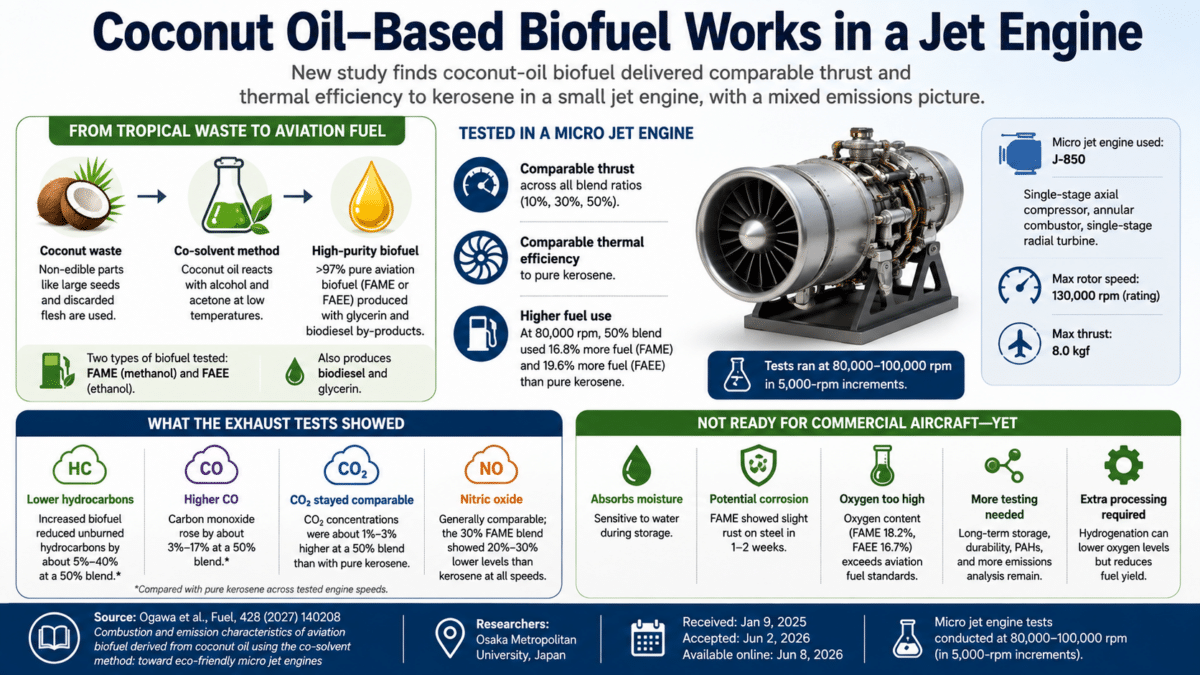
Note that if some product available in limited amount, say "coconut oil", becomes an asset to improve any context, say "aviation", it does not follow that one should maximize that amount psychotically without a cost-risk-benefit. You can just exploit the available yield through planning.
willtemperley a day ago
That infographic says it uses 16-20% more fuel per unit of thrust. That's a significant amount more weight for an aircraft to carry, but because carrying extra fuel also burns fuel, extra fuel use would compound exponentially. This would probably mean significantly more than 20% extra fuel would be required for long-haul flights.
Animats a day ago
brainwad a day ago
I presume that the market for coconut oil is far smaller than for jet fuel, so this solution can't scale without wreaking havoc on the environment. These sort of clever uses for exisiting byproducts only work when the market for the main product is much bigger than for the byproduct (e.g. down is a byproduct of duck/goose meat, leather is a byproduct of beef).
ghostly_s a day ago
clickety_clack a day ago
Apparently (I’m relying on facts from Claude here), aviation uses about 100 billion gallons of oil a year and coconuts yield about 250 gal/acre, so assuming you can approximately replace them 1:1, you would need to plant about 400 million acres under coconut plantation, an area the size of Mexico.
Edit: you don’t have to plant all of Mexico, every percent of fuel you replace is the equivalent of a percentage of a country under a single crop, displacing what would have been there before (presumably some kind of food).
mdp2021 a day ago
dylan604 a day ago
To what scale though? Doubtful it's going to be enough for a replacement. Just as GP stated, the corn grown for ethanol is nothing more than an additive and it is quite easy to find fuel without it. It's a boondoggle and not any where close to being a fossil fuel replacement
fc417fc802 a day ago
belorn a day ago
Are there really discarded parts? Usually when people talk about discarded parts, what they really mean is those not used in the first process. The article says "parts of the crop that would otherwise go to waste", but just a quick glance seems to show that there are other products that uses those parts of the crop, like biodegradable packaging and animal feed.
Turning it into fuel and burning it would compete with the other uses for those 30%.
317070 a day ago
> it’s led to poor use of land with questionable climate impact.
In the short term, yes, because they were unnecessarily using carbon energy to grow the fuel.
But if we want to de-fossilise society in the long run, we need solutions for flying and long distance travel. Electric flying seems infeasible at the moment, and people are looking for suitable bio-fuels to make flying carbon neutral. Afaik the maximum planes were allowed to handle up to now, was a 50-50 mix kerosene-biofuel. [0]
Coconuts could be a breakthrough!
namibj a day ago
Just use any carbon monoxide source (e.g., pyrolysis of pretty much anything that'd release carbon dioxide when burned works, followed by some cleaning to get rid of some problematic catalyst poisons (notably sulfur compounds)), add hydrogen, and do Fischer-Tropsch. You get your high quality diesel fuel, often higher quality than what you can easily get from crude oil, btw.
If you don't have anything to pyrolyse, use a sodium or potassium hydroxide wet scrubber to extract it from ambient air and recover it from the solution with burnt lime; it preferentially bonds to the carbonate, becomes nearly insoluble; you take the lime stone powder, heat it with a high temperature blow dryer until the carbon dioxide cooks out (you can use pure carbon dioxide atmosphere for that! Just let out excess buildup of CO2 pressure to your output cooler/storage.), have regenerated the burnt lime, take the resulting CO2 and hydrogen to perform water gas shift to turn the mix into CO and H2O, condense out the H2O, then use the CO + H2 mix for your Fischer-Tropsch synthesis.
You can use incineration facilities to tap off concentrated CO2 and mine landfills until they are empty to keep the incinerators fed to get the CO2 possibly-cheaper than from the direct air capture units.
Start by using more solar cell glass laminate for exterior surfaces of new construction and as roofs over whatever parking lots you do want to keep around longer-term.
Synthetic non-fossil fuel is going to need plenty of electricity and probably much of that "just" to electrolyze water into hydrogen which is reasonable for seasonal energy "storage" (run them during the high-solar 25~50% of the year, use underground caverns (former natural gas wells) or liquify it to store for the winter, run the synthesis plant that consumes it year-round. Don't just burn the hydrogen in power plants, though you can keep existing fossil fuel plants around for a while to run them during the worst week or two of an average winter. But expect the power to be as expensive as each kWh you get today from a small gasoline generator fueled with fully-taxed highway gasoline...
Saline9515 a day ago
I'm not sure that mass air transit has a place in a post-oil society were we try to leave at peace with the planet. Not just for the carbon impact, but also for the diversity of our species and cultures.
Should every Chinese and Indian visit Venice, even though it destroys the city little by little? Should we send things as futile as watermelons by plane?
Of course, the market wills it so some may think that it must happen, yet I feel that the globalisation and massification of everything made the world a less diverse and interesting place overall.
rangestransform 8 hours ago
317070 a day ago
Larrikin a day ago
pudgywalsh a day ago
sixtyj a day ago
How many coconuts are on one tree and how many tons of coconuts would be needed to replace kerosene globally?
I am 100% for decarbonization as fast as possible.
BTW Law of Conservation of Energy will be applied to coconut-based energy as well.
Vaclav Smil mentions in his book that we should consume less.
I see so many cheap weekender air tickets… it’s almost impossible to resist the temptation.
Annually 5 billions people travel by plane…
pfdietz a day ago
steve1977 a day ago
The best solution to flying and long distance travel is to reduce it as much as possible. This means no more travelling for hedonistic (touristic) purposes.
I.e. measures like massive taxation (also for private jets of course).
openasocket a day ago
xp84 a day ago
WillPostForFood a day ago
toomuchtodo a day ago
the_sleaze_ a day ago
Saw a recent post about an electric plane - was pretty sweet let me dig it up. $5 worth of fuel!
> https://www.heartaerospace.com/newsroom/heart-aerospace-comp...
qeternity a day ago
Is it not a bad thing to encourage poor people to continue doing the thing that has apparently made them poor?
It's also very not true that farmers are poor in the US (median household income about 30% greater than general population). This mindset is like a century old.
giantg2 a day ago
"It's also very not true that farmers are poor in the US (median household income about 30% greater than general population)."
Most farmers work a "real" job in addition to the farm work.
Then you also have farm workers, who do not own the farm, and they tend to be poor.
bluGill a day ago
kube-system a day ago
pudgywalsh a day ago
> Is it not a bad thing to encourage poor people to continue doing the thing that has apparently made them poor?
Right, we should tell the farmers to "learn to code"?
Too bad you can't ask Claude to grow potatoes. Though it probably uses the same amount of water and fuel to tell you it can't.
Spooky23 a day ago
That is both true and not quite true at the same time. The notion of the Yeoman farm family supporting itself off its land is mostly a myth.
Like everything else. it’s been capitalized and farms have consolidated over time. There were lots and lots and lots of farm workers. who are pretty poor and now lack the assets that their grandparents had.
zdragnar a day ago
All subsidies are wealth transfers. That's the whole point- to incentivize something that wouldn't otherwise happen at a scale the government deems to be of benefit or necessary.
Biofuels are part of the all-in-one story of renewable energy, especially the transition phase of reducing carbon emissions before we can get to full electrification.
The question of whether or not they are effective in doing so- and whether or not the money for those subsidies would better benefit society elsewhere- is the very same one that skeptics of solar and wind hammer on.
I would much rather see those subsidies go to farmers growing human consumer food, and sending the excess to bioreactors to produce fertilizer and/or methane for power generation. Cheaper groceries make it easier for people to eat more whole foods, after all. Just last week, I found napa cabbage at $3/lb- meaning one head would have been $24. Fresh broccoli and other good veg are also expensive.
The reduction of harm from reduced CO2 by bio-jet-fuel would pale in significance compared to, say, subsidies in regenerative farming practices, or even simply healthy crops.
giantg2 a day ago
A lot of food cost is due to food waste and convenience (refrigerated shipping, out of season crops, etc). There's already a lot food waste due to logistics and consumer preference.
zweifuss a day ago
Middle of the road, comparable to Sunflower oil. But they want to utilize waste products and a low energy conversion process.
mjevans a day ago
Is Jet Fuel really the best use of coconut oil? I'd imagine it's far better as a lubricant or ingredient in things more directly adjacent to human rather than mechanical use.
fuzzfactor 19 hours ago
I think with waste products there is more of a last-mile (first-mile?) collection issue. Regardless we're definitely seeing some processed bio-oil waste coming in to the diesel lab for analysis in the recent year or two.
Looks to me like someone who is prospering based on coconut plantations would be the beneficiary from tapping a new market from a jet fuel process, and it probably could be made into a cleaner fuel than the waste-based bio-fuel.
giantg2 a day ago
"It’s effectively become a wealth transfer to support poor rural American communities"
I'm skeptical that rural community are the primary beneficiaries. Seems more likely that it's benefiting people who own the patents/companies.
mortoc a day ago
Are the people against bioengineered produce also be against us working towards super efficient coconuts or some other plant we designed to fill the same role?
KennyBlanken a day ago
> The US created biofuel subsidies a few years ago
A few years ago? Corn ethanol subsidies have been a thing for my entire life.
It's a net-negative fuel. Costs more fuel to produce than it provides. It's literally just a way to waste water, farmland, huge quantities of diesel (burned by engines exempt from any sort of emissions), labor, etc.
What changed is that ethanol has been forced by regulations into more and more use over time. That has driven up demand for corn, and one of the worse side effects is that a major food staple for Mexico has gone up dramatically in price.
> effectively become a wealth transfer to support poor rural American communities,
If you think that's bad, stop and think for a moment about what purpose the US military serves for rural America, both directly through personnel but also indirectly through all the incredibly wasteful equipment, service, and supply contracts.
The US military's primary reason for existence is force projection, but its secondary is keeping rural American's uneployment from skyrocketing.
Razengan a day ago
They literally grow on trees
kylehotchkiss a day ago
Same rural communities raise pitchforks upon mention of any other demographic receiving wealth transfers.
Gibbon1 a day ago
Just through this out again, biofuels are dumb. Per acre a solar farm produces 30 times the energy per year as corn without most of the environmental concerns that growing corn has.
You don't have pesticide or fertilizer runoff from solar farms. You don't plow the soil resulting in soil loss.
Biofuels, dumb.
pfdietz a day ago
You want a fuel that's chemically identical to current jet fuel, not one burdened with extra oxygen. Yes, this would require more energy, but it would be used more effectively in jets.
A drop-in compatible jet fuel can be made by hydrodeoxygenation of biomass, using Virent's process. The waste cellulose in current US waste streams would be more than enough to displace all current US jet fuel consumption. An extra source of hydrogen would be needed to do this, but hydrogen can be made renewably (and, indeed, that's a good way to provide dispatchable demand to help deal with renewable intermittency, and will have to be done anyway to displace the use of natural gas to make hydrogen.)
spaceywilly a day ago
I agree, I wish more work was being done on building a hydrogen economy. Hydrogen can be generated sustainably, is a great way to store excess energy from renewable sources, can be transported, and as a bonus can be mixed with hydrocarbon fuels to be used directly as a heating source.
As an example, a house in NH can generate a lot of excess solar power in the summer months when it uses hardly any electricity. If all that energy could be stored as hydrogen, in the winter (when solar power is less due to the far northern latitude and snow covering the panels) it could draw down on the hydrogen to generate electricity and also use it for a backup heat fuel.
fy20 a day ago
I'm in Northern Europe and am in that situation. I have an electric heat pump, so would need around 3 MWh over the winter period. Apparently that would need a tank around 4m3 at 700 bar (typical pressure of hydrogen vehicle tanks). Plus the fuel cell actually generate heat, so that could be used for heating too. Doesn't seem terribly unrealistic.
pfdietz a day ago
parimm 18 hours ago
Part time coconut farmer here.
Adding some numbers for a base line. (Note all of these numbers are almost the upper limit of a well managed farm with very good cultivars)
Best yielding palms yield ~300 nuts per pals at 70 palms/acre.
at 750g a dehusked nut with 20% oil yield
You get ~2.3 tonnes oil/acre.
For reference an a321neo burns around 2,300 kg of fuel per hour when cruising
jeffrallen 17 hours ago
Top comment is a chemist explaining aromatics and seal compatibility. Fourth comment starts with "part time coconut farmer here".
I <3 you HN, never change.
chr15m 21 hours ago
Around one million coconuts required to fly from Tokyo to Los Angeles.
Around 40 million flights per year.
40 trillion coconuts required for all flights, or 1000x current production.
To scale up coconut production we need 12 billion hectares, or 80% of the Earth's surface for coconut trees.
We need 100k cubic km of water per year, or twice the renewable fresh water on this planet.
Ok cool. We will need to terraform Mars before we can fly by coconut.
Finally I understand the mad billionaire's plan.
euroderf 11 hours ago
Hey Alexa, change all paperclip production to coconut production.
jeffrallen 17 hours ago
The O in "occupy mars" is actually a coconut.
breakyerself 20 hours ago
We shouldn't be burning agricultural products for fuels. We should be electrifying and using synthetic fuels made from CO2 and renewable energy where we can't.
jjk166 7 hours ago
> using synthetic fuels made from CO2 and renewable energy where we can't.
Guess what plants are made of.
splittydev a day ago
If it burns more fuel, how is it "about as efficient"? That doesn't seem to make much sense to me.
> New research found that aviation biofuel made from coconut oil can power a small jet engine about as efficiently as traditional jet fuel, with lower unburned hydrocarbon emissions, though the blends burn more fuel and emit slightly more carbon monoxide.
SoftTalker a day ago
blended with standard jet fuel, in a small-scale micro jet engine
wronex a day ago
I think this is awesome. Anything we can do to get away from burning fossil fuel is a win in my book. I don’t know about this particular effort, but it seems to me that aviation could really need some big wins in this direction. Last I looked we still run smaller planes on leaded fuel. Crazy.
abyssin a day ago
This isn’t awesome, it doesn’t work at scale and it only lets idiots ignore what should be done: leave fossil fuels in the ground, and only then do what we can with the energy that’s still available. Aviation is mostly incompatible with a sane global environmental policy.
bluGill a day ago
Very few people are willing to accept a, "sane global environmental policy" if it means changing their lifestyle. Thus, anything that allows people to keep (or better yet, improve) their current lifestyle while making the environment sane, that is the one we need to be searching for.
tass a day ago
Leaded is slowly going away, but regulation means these changes take many, many years and dollars to implement and test.
It will be similar (worse?) implementing a new type of fuel for commercial jets, especially when it comes to wide adoption across a majority of countries around the world. Basically you need something which is as least as reliable, clean (I.e., won’t clog/solidify), non corrosive, etc. and remain that way after being mixed with standard jet fuel.
I too want to see alternatives but expect to see more failures than success at this stage.
padjo a day ago
Replacing fossil fuel with biofuel only works if we starve half the planet and use their food for fuel.
yread a day ago
How is the viscosity at -60?
chermi a day ago
But why? I don't know of a case where biofuels aren't a disaster against the stated environmental purpose. Bailouts for farmers? Sure. A good way to generate green energy? I think engineered algae comes kind of close to making sense as an oil source, but as a fuel would still seem silly to me. Please correct me if I'm wrong.
dofm a day ago
So we can't have the dark chocolate Bounty bar anymore but we can use coconuts to fuel planes?
This isn't the future I want.
brikym a day ago
They've already got coconut content down to 20% but I'm sure the food scientists are working on the next iteration; A new low calorie environmentally friendly 'fun size', '3-for-1' bounty containing bleached cellulose flakes, synthetic coconut flavor and hydrogenated seed oil.
dofm 11 hours ago
I will not be trying that though. Dark chocolate or bust.
In the post-apocalyptic future I will be the guy roaming the wastelands, armed to the teeth, seeking out rumoured stashes of Jamesons Raspberry Ruffles and those Roobar things.
jmorenoamor 9 hours ago
Using food as fuel is not a good idea.
JoeAltmaier a day ago
50 MTons of coconut oil are produced per year (approximately). Is this a significant amount, compared to oil derived from crude (where gas currently comes from).
chr15m 21 hours ago
No.
Around 3.5 million tonnes of coconut oil per year.
Around 4.5 billion tonnes of fossil fuel oil per year.
JoeAltmaier 11 hours ago
Thanks - I was using the wrong table, total coconut or something.
andy_ppp a day ago
How many coconuts do we need to support current aviation needs? I’m guessing it’s not likely this will work economically?
chr15m 21 hours ago
40 trillion coconuts per year.
souenzzo a day ago
Long life to coconut revolution, in Bougainville island!
discordance a day ago
Such a great documentary:
legitster a day ago
> This study used oil from material the researchers describe as discarded and non-edible, including the large seeds and leftover flesh, so the fuel draws on parts of the crop that would otherwise go to waste.
This statement seems disingenuous. Surely they did not invent a novel way to extract coconut oil as part of this study and not choose to publish it. Surely this is just existing byproduct that already has plenty of commercial use.
If you look at how many coconut plantations you would need to make even a measurable dent in jet fuel demand, this would be an unmitigated environmental disaster.
I want to solve climate change as much as the next guy, but chopping down all our tropical rainforests to make it happen sacrifices exactly what we're trying to save.
VerifiedReports a day ago
Yep, we've seen this sobering reality ignored in previously-hyped "biofuel" aviation stories.
Not to mention another glaring omission here: "By adding acetone to a mixture of alcohol and coconut oil"
How much energy is needed to produce those two ingredients, and the things THEY are made from?
If I were a junior-high teacher, I'd probably give this paper a C.
pseingatl 17 hours ago
Where is there an ocean of coconut oil to match the Gharar?
cwmoore a day ago
Sorry, orangutans, rockets go more up
evanjrowley a day ago
Cue defense industrial base funded influencer campaign to promote the "dangers" of medium chain triglycerides.
amelius a day ago
Will this produce better smells?
dzonga a day ago
either wait for bigger batteries, hydrogen or some super efficient material to create the fuselage.
biofuels won't work. they take too much land and are inefficient in terms of producing.
RcouF1uZ4gsC a day ago
Aviation uses around a million metric tons of jet fuel per day.
If you thought habitat destruction from palm oil was bad, that would be nothing compared to coconut oil making up any significant fraction of jet fuel.
not_a_bot_4sho a day ago
The question is which habitat destruction is worse? That which is already happening at scale for oil, versus what would happen if we lean into this in any meaningful way.
I don't think the answer is obvious. And I think many of us are blind or numb to environmental harms of oil outside of carbon exhaust and the occasional spill, simply because we've accepted it as status quo.
anfilt a day ago
An oil well is quite small Area wise compared to the amount of acreage you would need for a coconut plantations to replace the same amount of energy output.
The issue with oil is CO2 and other green house gases and then the occasional oil spill or leak. Land area wise they don’t take up much space
wartywhoa23 a day ago
Ah, the modern debacle, shall we choose this kind of shit or that?
cryptonector 19 hours ago
Dammit, I like coconut oil.
hingedeveloper a day ago
we've been working on biofuel to replace fossils forever, hopefully it leads to something if not jet fuel specifically.
senectus1 a day ago
please dont use bio fuels that encourage the growing of plants for fuel.
we have a food shortage issue already globally..
waste products, yeah fine. but cutting down large area of forrest/food producing land for the growing of non food plants for fuel is just self destructive corp greed.
teekert a day ago
So we just cut down some ancient rainforests to grow them right? Works for Palm oil! Goooo Planet!
emsign a day ago
The issue with bio fuel is the following: Due to climate change the overall area for food production in the world is shrinking. Bio fuel is directly competing with food.
The solution: Ditch carbon based fuels as much as possible and replace it with electric transport.
I know that it's currently unviable to use electric aircraft in almost all use cases except short range drones. But then the solution to that problem is to rely less on air travel and transport and use land based alternatives.
This is about vectors and incentives. Investing in bio fuels to get a 100% replacement for fossil fuels is not going to work and it only stalls what actually needs to happen which is a radical transport system change.
bluGill a day ago
The world is producing far, far more food than we need, though, so your worry is not realistic.
brikym a day ago
Wonderful. Now a jet flight can consume enough calories to feed a town for a day.
metalman a day ago
it's the first time I have heard that bulldozing and burning tropical forests to put in palm oil plantations is "efficient" perhaps profitable , but that is generaly a function of subsidies and regulatory entitlement, in this case "green" that somehow overlook the bulldozers and the brown stained rivers from errosion, running all the way out into oceans where the silt smothers more life,the resulting products stamped with an improbable number of eco certifications, little wreaths and such. So after all that green washing success, why not jet fuel! Gold medal in the cynicism games for sure.
jameshart a day ago
Maybe those cargo cult guys were onto something
allears a day ago
Yeah, but until it matches kerosene in price and availability (how many coconuts per aeronautical mile?) it won't actually be an alternative
SoftTalker a day ago
Just intuitively I doubt there's nearly enough coconut oil produced to replace any meaningful amount of jet fuel. I scanned the article and didn't see this addressed, but may have missed it.
Various other bio-fuel and synthesized replacements for petroleum-based jet fuel have been tried and are in development. The aviation industry is very slow to approve and adopt changes.
cucumber3732842 a day ago
The point isn't to make cheap jet fuel. The point is that to the coconut processor (someone who makes food or whatever) your "coconut tailings" pile is a big liability. The environmentalists could start screeching any day without warning, that's a big risk to your business. Waste that costs you nothing could cost a lot. You might be able to sell it as loam or fertilizer or whatever. But then they'll screech that you need to buy somme compliance solution. Just shipping the damn thing off to the next guy who'll squeeze some jet fuel out of it is real attractive because then the rest of the tailings become his problem. Maybe he's in a better jurisdiction. Maybe it's more inert at that point. In any case it's a liability off your books. The jet fuel just needs to be cheap enough to make this whole process cheaper than whatever way you were dealing with it before. It's like this the world over. Whether you're selling coconut scraps to the people who'll squeeze the oil out of them or strawberry waste to the people who'll make dyes and fragrances it's all the same.
tornikeo a day ago
This is absolutely nuts!