Solar surpasses nuclear power globally for first time (pv-magazine.com)
406 points by xbmcuser 8 hours ago
philipkglass 7 hours ago
Note that this is actual generated terawatt hours. Nuclear power has a substantially higher capacity factor, but solar has been growing so rapidly that it has taken the lead on generated output too. Wind is just about to surpass nuclear generation also, though solar is racing ahead much faster. The next big milestone, not to be reached for several years at the present rate, would be solar generation overtaking hydroelectric generation. You can see data up through 2025 here:
https://ourworldindata.org/electricity-mix
Even though solar power has been a significant part of the energy conversation for decades, the majority of solar growth is very recent. Nuclear power generated 2762 TWh in 2021, when solar generated 1054 TWh. Solar power generated 2779 TWh in 2025.
silvestrov 6 hours ago
An interesting fact is that China has passed "peak coal" in 2024 while still growing with about 5% in a year.
Denmark had peak coal early (2003) due to early investments in wind power. Coal is now practically gone.
We might see China get the same shift in electricity source as Denmark had over the past 20 years, just much faster.
jakobnissen 6 hours ago
Denmark is not a good model to understand what China can do, because we are a small country who can import a big share of our electricity from abroad when it’s not windy, and export excess capacity when it is. It will be much more challenging for China to achieve what we have done.
Put more directly, our numbers look good because Norwegian hydro and Swedish nuclear saves our bacon when our windmills don’t work; China does not have that luxury.
defrost 5 hours ago
smallerize 6 hours ago
AnthonyMouse 5 hours ago
ViewTrick1002 6 hours ago
PaulDavisThe1st 6 hours ago
> Wind is just about to surpass nuclear generation also
Err, no. from the first paragraph of the article:
> The World Nuclear Industry Status Report (WNISR) 2026, overseen by French nuclear energy consultant Mycle Schneider, shows that wind power alone surpassed nuclear generation on a monthly basis in March 2025, followed by solar in April – the first time global monthly solar generation exceeded nuclear output.
> From March 2025 through June 2026, either solar or wind individually generated more electricity than nuclear every month. In March, April and May 2026, both technologies independently surpassed nuclear generation.
jimbokun an hour ago
> Even though solar power has been a significant part of the energy conversation for decades, the majority of solar growth is very recent.
Yep, that’s what exponential growth looks like.
59percentmore 6 hours ago
My completely uninformed perspective: There's a danger here, in that we're rolling out all at once, which means infra will reach EOL all at once. Replacement costs of suburban infra is killing a lot of American municipalities that can't grow in order to generate the taxes to cover those replacement costs of water infra and such.
More solar asap is definitely a good thing, but we also need to plan for what happens 30-40 years from now when this wave of equipment starts failing.
maxerickson 5 hours ago
I wouldn't worry about it too much. Electric generation is a business and existing sites will be prime locations for new panels (likely straightforward to permit, connection to the grid, etc.).
Municipalities often have bonkers cost structures and imposed limits on tax increases (limits in state laws and such). Here they are redoing lead service lines, rebuilding substandard water mains and repaving streets. State and Federal grants are paying for a lot of it, along with increases to water rates (to maybe 5-10% above the national average, enough to make people unhappy, but not out of control).
AnotherGoodName 3 hours ago
Fortunately the grid storage rollout is happening at a blistering pace too. Reported payback of investment for 2 years for many of the early rollouts (due to arbitrage between peak/off peak prices) and while that won't last it's still amazing economics.
dralley 6 hours ago
Well, that will certainly be an issue for nuclear power capacity in the future.
AnthonyMouse 5 hours ago
7952 5 hours ago
Much easier to do upgrades piecemeal though with solar and wind.
crote 5 hours ago
Suburban America is dying because it is operating like a Ponzi scheme: the property taxes aren't high enough to pay for the long-term maintenance and replacement of infra, and for the past handful of decades it has compensated by filling the budget holes with one-off windfalls due to taxes on new development.
This house of cards obviously falls down when expansion ever slows down. The only solution is to raise the property taxes per yard of road, but that means low-density housing becomes unaffordable, which would force towns to increase density by building things like row houses and apartment buildings.
Solar is in a completely different position, as the solar itself is profitable. There will be no shortage of cash to replace it, only perhaps a shortage of labor. But solar doesn't really have a fixed lifetime and will happily operate a few years longer, and due to its highly distributed nature it doesn't require a risky all-at-once replacement like the Boston Big Dig either.
The global solar rollout is going slow enough that it won't be finished before the first units will reach the end of their economical lifespan. I reckon it'll just shift into ongoing maintenance as time goes on.
jeffbee 5 hours ago
Explain the mechanism by which you believe photovoltaic panels start failing.
Your concern would be valid for a nuclear thermal power station, a Goldberg machine with millions of moving parts. It is not really applicable to semiconductors.
SJC_Hacker 3 hours ago
dyauspitr 5 hours ago
You just replace it with more solar panels like what is so complicated about this? Also, this stuff is growing every year. It’s all staggered.
thinkcontext 3 hours ago
asanineassasin 3 hours ago
Thanks to recent events though.. nuclear got its subsidies back. Every border empire ever- at least 3 nuclear power plants per country in the next decade.
dyauspitr 6 hours ago
Wow almost a tripling of solar output in less than 4 years. That’s incredible!
gryfft 7 hours ago
> From March 2025 through June 2026, either solar or wind individually generated more electricity than nuclear every month. In March, April and May 2026, both technologies independently surpassed nuclear generation.
> Global solar capacity increased by 510 GW to 2,383 GW, up 27% year on year, while wind added a record 159 GW to reach 1,291 GW, an increase of 14%. By comparison, installed nuclear capacity rose by just 1.5 GW to 399.5 GW, while operating nuclear capacity declined by 0.5 GW to 368.6 GW.
> More recent data from IEA PVPS indicate that global PV additions reached around 690 GW in 2025, about 180 GW more than the figure used by WNISR. This suggests the gap between solar and nuclear capacity – and their respective growth rates – was even wider than indicated in the report.
> The report identifies falling battery costs as a potential enabler of continued PV expansion, particularly as grids contend with growing volumes of variable renewable generation and periods of low or negative electricity prices. Grid-scale battery deployment accelerated sharply in 2025, with 104 GW and 257 GWh connected during the year. More than 78% of cumulative battery energy storage system (BESS) capacity was installed between 2023 and 2025.
embedding-shape 6 hours ago
> Global solar capacity increased by 510 GW to 2,383 GW, up 27% year on year, while wind added a record 159 GW to reach 1,291 GW, an increase of 14%. By comparison, installed nuclear capacity rose by just 1.5 GW to 399.5 GW, while operating nuclear capacity declined by 0.5 GW to 368.6 GW.
How much of all of that is China vs the rest of world? They seem to just in the last decade or two absolutely exploded when it comes to solar and other renewable energy sources.
Sayrus 6 hours ago
China is around half that capacity. Asia represents 3/4 of new capacity.
With this being said, Australia, Netherlands and Germany are leading in solar capacity per capita according to https://en.wikipedia.org/wiki/Solar_power_by_country
crote 5 hours ago
throwaway19012 5 hours ago
They also produce a lot of electric vehicles.
They will probably end up less dependent on oil which is a good thing for them, considering the conflicts this causes
lurk2 4 hours ago
> In March, April and May 2026, both technologies independently surpassed nuclear generation. Global solar capacity increased by 510 GW to 2,383 GW, up 27% year on year, while wind added a record 159 GW to reach 1,291 GW, an increase of 14%. By comparison, installed nuclear capacity rose by just 1.5 GW to 399.5 GW, while operating nuclear capacity declined by 0.5 GW to 368.6 GW.
If global solar capacity was 1873 GW in 2025, global wind capacity was 1132 GW, and global nuclear capacity was 398 GW, how could solar and wind have surpassed nuclear in March of 2026 for the first time?
ACCount39 6 hours ago
It is a shame that nuclear power has stagnated - we could have been moving towards fossil fuel free grid half a century ago. We've lost decades of progress there. But it's a good thing that solar power is coming into its own more and more.
Late is better than never.
fulafel 5 hours ago
Where we lost decades of progress was governments pouring enormous amounts of R&D money into nuclear instead of renewables. We got a nuclear a head start that turned out to be a dead end. We could have gotten solar, wind and storage cost competitive with fossils decades earlier. And as a side effect kept the west competitive in energy tech.
dyauspitr 5 hours ago
Yeah, nuclear is fine. It just at this point it can’t really compete with solar+battery for how quickly you can bring things online. The 10 or 15 years required to build a nuclear plant is pretty devastating for it when you can build up solar in 1-2 years instead.
crote 5 hours ago
It also can't compete on cost. Nuclear is crazy expensive and prone to cost overruns, so no market party is willing to build it without the government taking on all of the financial risks. And with the rapidly evolving power landscape the long payback time only makes things worse.
Levitz 4 hours ago
jl6 7 hours ago
Always good to see the future arriving, but the job is not done yet by far. We need to be sure not to take our foot off the gas (figuratively of course).
We need to accelerate clean energy generation even more so we can replace not just dirty electricity sources but dirty energy sources entirely, and produce synthetic petrochemical feedstocks. Modernity runs on hydrocarbons-as-chemicals, not just hydrocarbons-as-fuels, so despite electrolysis and synthesis being hugely energy inefficient, there is literally no alternative. We just have to brute force it at petascale.
api 6 hours ago
Idea, which unfortunately won't be feasible until MAGA dies:
Huge tax breaks / incentives for data center construction but only if they are 100% powered by zero-carbon renewable energy.
Extend those breaks to existing data centers if they convert to 100% renewable energy.
To qualify they must either self-generate, having their own solar/wind/battery farms, or purchase 100% (net) renewable energy from the grid if that is possible, or some mix of that. They'd be allowed to have fossil fuels or "dirty" grid connections for backup if main power fails but not for normal operation.
First, it gets AI off fossil fuels and off the regular grid, but more importantly it adds yet another industrial scaling subsidy to renewable deployment, making renewables cheaper and more entrenched in the energy mix.
Unfortunately by the time the idiots are out we will probably have passed peak data center construction bubble, having missed a golden opportunity to yoke a huge economic bubble to the renewable migration. But hey, we get measles outbreaks and a new war in the Middle East, right?
AnthonyMouse 6 hours ago
Individual states could do that now. Notice that the major tax incurred by a data center is state/local property tax. It's why they often go looking for places with a property tax break, so giving it to them on the condition of "no fossil fuels" could be a pretty viable strategy.
thinkcontext 3 hours ago
7952 5 hours ago
There have often been private deals between renewables and big energy customers but the finances don't always work out how you might expect. Renewable projects are built using debt with interest rates largely based on the likelihood of generating revenue by selling electricity. And because of the long time scale interest can snowball to form a substantial part of the cost. Having a guaranteed customer in the form of a data centre is balanced by the risk that they might go out of business. You are basically coupling the risk of the generator to the risk of the consumer. That is why CfD style schemes are often favoured because it is just a safer source of revenue. Obviously hyper scalers have access to very cheap credit, but they may end up paying more for the electricity.
jostmey 3 hours ago
You know what I call solar--fusion power. There's a giant fusion reactor running for free. We simply need to extract the useful energy. Want to build a terrestrial fusion reactor? A conventional nuclear reactor? You still need to extract useful energy and deal with excess heat. The way I see it, from an economic perspective, long-term, solar wins. Of course, this is just my long-view
tombert 2 hours ago
I installed solar panels in my backyard, and then texted my dad that my basement is now powered by fusion with a roughly eight minute delay.
He then asked "isn't pretty much all power on earth outside of nuclear fission technically done by fusion if we give enough of a delay?". I didn't really have a rebuttal to that.
ozyschmozy 2 hours ago
Not geothermal I would think?
3form an hour ago
solarpunk_enthu an hour ago
This is not very surprising given that nuclear technology was choked for the past 30 years, until recently.
That does not negate the celebration of solar generation growth, but we should consider that nuclear did not have as much enthusiasm and investment as solar did in the recent decades.
hinkley 30 minutes ago
Each nuclear plant is practically a new adventure, and recursively so. It’s specialized work and the people who learn to build one properly don’t travel the world consulting on them, except perhaps at the management and design levels. Welders aren’t.
Meanwhile once you’ve installed 10% of a solar project, the rest of the project is almost exactly the same, and you can ramp up or ramp down the size of the final build as you go and capital either becomes constrained or part of the build goes online and starts subsidizing the rest. Your experts have journeymen under them that can start taking on more work allowing the throughput to increase.
How Big Projects Get Done talks about how roads, solar and wind all have this property, and most special projects don’t, which leads to either massive cost overruns or dead projects.
jfengel 7 hours ago
On a monthly basis. News articles about solar power tend to quote maximum capacity, confusing the issue. This is about energy rather than power, aggregated over a month, so it's a somewhat more meaningful statement.
k__ 7 hours ago
We're getting to a point where we can stop boiling water for electricity.
What a time to be alive.
OptionOfT 6 hours ago
Well, if we want more drinking water we might start boiling salt water with electricity.
AnotherGoodName 3 hours ago
That's a very obsolete desalination technique.
A cup of water with salt added doesn't get noticeably warm since there's just not much entropy difference in salt water vs fresh water. These days you can reverse the process at very low electricity cost with reverse osmosis.
yangm97 6 hours ago
99+ missed calls from millimeter wave bored geothermal
thinkcontext 3 hours ago
That's many years from even attempting to make power. They've done what, a couple inches wide hole to 100 feet?
tootie 43 minutes ago
PaulDavisThe1st 6 hours ago
Or as Bill Mckibben observed "for 10's of thousands of years, humanity has burned things to produce energy. The period of fire is coming to an end".
Andrex 6 hours ago
I think fire is still involved in the creation of solar energy though... Just not man-made fire.
tialaramex 4 hours ago
dghughes 6 hours ago
That's why I hope Helion Fusion does well. The system they are developing sends power to a device that captures power directly no boiling water.
NooneAtAll3 6 hours ago
wasn't there recently papers claiming helion fusion's design is literally incapable of producing energy?
toomuchtodo 7 hours ago
“How did humanity solve climate change? We taught sand to move electrons with photons.”
Ygg2 6 hours ago
Except for solar collection that boils water to generate power.
ZeroGravitas 4 hours ago
China just finished building some but it's a dead end technology.
It first lost to PV for daylight generation, then it fell back on storing the heat for use generating after sunset but cheap batteries made that obsolete too.
fittingopposite an hour ago
Just study learning rates of different technologies and it quickly becomes very evident, how future energy mixes will roughly look like. (That's also why fossil fuels have no future in the energy mix. They don't have any significant learning rate - just like minerals.) See e.g. this seminal paper: https://www.cell.com/joule/fulltext/S2542-4351(22)00410-X
FloatArtifact 5 hours ago
In order for renewables like solar and wind energy to truly take the burden off a grid, we have to have large capacity energy storage solutions that balance the grid over a 8+ hour period. That way we can handle peak demand of the grid during high load which often happens when there's little light and on hot days when the wind doesn't generate nearly as much electricity.
Retric 5 hours ago
Transmission lines can act like storage when there is PV to the east or west of you. This doesn’t remove the need for storage, but can dramatically reduce it.
The old model of cheap peaking power plants and cheaper base-load power is equivalent to cheap peaking power + cheap but inconsistent green energy. It’s a very complicated optimization problem to work out the optimal mix of locations and quantities to of each, but price signals can help assuming you haven’t completely distorted the market.
braiamp 4 hours ago
That only work on large continuos mass of land that expand east-west. Small countries or Chile have problems
Retric 4 hours ago
fittingopposite an hour ago
Yes. Batteries are coming. I think many people truly misunderstand the full power with which solar/wind + batteries will transform our societies (and by the way also giving more resilient and insular power networks than centralized power plants can ever give)
chicken-stew 4 hours ago
This can be done in a distributed way using home batteries. This would increase demand for peak solar production for use outside this peak. At the moment solar production creates a large price disparity that can be corrected with home batteries.
eigenspace 2 hours ago
I find it continually strange how much more attention solar gets than wind.
Wind power has been undergoing a very similar rapid fall in cost, and rapid rise in installations, and is a fantastic natural resource (and also one that complements solar almost perfectly!), but it always feels like solar gets 10x the attention and conversation that wind gets.
lisplist 2 hours ago
My interest is mostly getting solar installed at home, something I can feasibly do. I don't think my city allows for residential wind turbine installs.
eigenspace 2 hours ago
So there's the hobbyist side of it, but I guess it's not totally clear why that matters to the people talking about the world's power mix.
But as I write that, I guess it becomes more clear to me that a personal interest in installing the technology makes one pay more attention to it elsewhere, and promote more conversations about it that get others involved.
dividefuel 2 hours ago
Dumb question: is there a limit to how much energy we can capture? I'm imagining a wind gust blowing east to west across a city filled wind turbines. By the time the gust reaches the west end of the city, has most of its energy been captured or otherwise dissipated?
Contrasting that with solar, where any surface area receiving direct sunlight doesn't prevent other adjacent areas from also capturing solar.
eigenspace 2 hours ago
layer8 6 hours ago
80% of global energy consumption is still fossil fuels (oil/coal/gas), however.
tonfa 5 hours ago
Yes but primary energy isn't a good metric. There's 40-60% loss when converting fossil fuel to final energy being consumed.
pzo an hour ago
A lot of energy is used for heating, heating water is more efficient with fossil fuel than with electricity - because for electricity you have transmission loss.
xbmcuser an hour ago
layer8 5 hours ago
That’s fair, but factoring the energy loss in, it still remains the clearly larger share.
crote 4 hours ago
tonfa 3 hours ago
esarbe 5 hours ago
That's primary energy, of which about half is wasted as heat. Electrification will bring this down by a lot.
pzo an hour ago
And big usage of energy is actually heating home so heating water
smartmic 7 hours ago
That’s good. I wonder how much longer it will take for countries to make their energy supply dependent on fossil fuels or nuclear power, thereby becoming pawns of unpredictable or hostile regimes and being helplessly at the mercy of geopolitics. It’s so baffling that many countries, even those with plenty of sun and wind, still prefer to rely on fossil fuels rather than make life a little easier for future generations.
And no, there will be better solutions for base load as well. Battery storage, for example. Sure, it’s a transformation, but those who refuse to think for the future can see the consequences of stubbornness and backward-looking attitudes today.
Aboutplants 6 hours ago
The answer is batteries (why it hasn’t seen the adoption and also what is about to enable it)
gcheong 5 hours ago
The geopolitics don't go away because the resources needed to switch to renewables aren't evenly distributed geographically:
https://www.statista.com/chart/33754/countries-with-the-larg...
https://www.techpolicy.press/us-critical-mineral-aggression-...
Battery storage is only a solution if you can actually generate a surplus of energy that can be stored, which is not a given.
We absolutely need to move off of fossil fuels but thinking that renewables are the only solution seems very short-sighted to me.
crote 4 hours ago
Contrary to their name, "rare earth metals" aren't actually rare, and for a lot of the renewables stack they aren't strictly necessary.
Take lithium batteries, for example. They were attractive for early BEVs because the consumer electronics market already developed an industry for them, and they were attractive for early grid storage because the BEVs scaled that industry up. But that doesn't mean you have to use lithium for grid storage, and when push comes to shove we could also use sodium-ion batteries, or iron redox flow batteries.
If your country no longer has access to iron and salt, I reckon you have bigger things to worry about.
toomuchtodo 7 hours ago
https://www.youtube.com/watch?v=y94yV7WUwGY is a short lecture by someone from BloombergNEF that speaks to some of your questions.
Gareth321 6 hours ago
Renewable energy is really expensive. [About 4x more expensive than nuclear, and 14x more expensive than gas.](https://papers.ssrn.com/sol3/papers.cfm?abstract_id=4028640) People mistakenly think that because wind and sun are free, renewable energy generation is cheap.
defrost 5 hours ago
Your four year old paper shows wind+solar costs as on par with nuclear in the final (LFSCOE95) model in the ERCOT market before factoring in dropping battery farm costs.
Other papers exist with a different opinion (eg: Australia's more recent CSIRO energy report finds nuclear not providing bang for the buck in the Australian market)
Further, despite claiming Level Full System Costs, there's no factoring in for externalities - eg: climate costs of dragging out fossil fuels while waiting for nuclear to come online, political costs of being steadily reliant on outside countries for fuel and supply (cost of gas to non gas nations, etc).
There are other issues - it's a paper with an opinion - not the foundational rock you want to base strong assertions on, as you did.
jdlshore 4 hours ago
Your data is way out of date. Renewables, particularly solar+battery, are incredibly attractive from an economic perspective. That’s why the build-out has accelerated so much. It’s not government hippies (I wish—have you seen the state of world politics lately?), it’s cold hard capitalism.
salynchnew 2 hours ago
Give me balcony solar (in the U.S.) or give me death![1]
[1] Really, climate change risks already a massive liability in so many places (forst fire-caused particulate air pollution, etc.). We need far more solar and battery capacity to bend the curve.
yoochan 2 hours ago
I saw numbers in GW where I was expecting numbers in GWh ? How does the amount of energy produced compare ? "In 2025, nuclear plants generated 2,703 TWh", how about solar and wind ?
chickenbig 3 hours ago
Of course, the officially titled World Nuclear Industry Status Report is actually produced by anti nuclear activist Mycle Schneider (https://en.wikipedia.org/wiki/Mycle_Schneider).
ninalanyon an hour ago
What are you implying?
FloatArtifact 5 hours ago
There needs to be more general understanding of energy density and scalability, which is why I don't think we'll get away from fossil fuels without nuclear or fusion.
bdauvergne 2 hours ago
What kind of civilization is possible on intermittent power ? All western civilization is built on 24/24 7/7 available energy (from direct use of petroleum or electricity). I think we should give two numbers: the raw TWh output and the stable TW output and see where they are coming from. Africa and Asia are rapidly being electrified, but if it does not create an industrial boom outside China by guaranteed available energy it's just more people having intermittent AC and not real development.
tdhz77 5 hours ago
Is this the year of the Linux desktop ?
president_zippy 5 hours ago
I've been forced to use Ubuntu 22.04 and 24.04 at my job for the past 4 years, and the longer I use it, the more it makes me wish I was using OpenBSD w/ xfce.
tialaramex 7 hours ago
Because the damp rock we live on happens to have humans living mostly on the North half rather than split 50:50, there's a noticeable shift in solar generation over seasons.
So e.g. a few months ago in July because it's Summer in the North, solar production peaked significantly higher than the less fluctuating Nuclear but come January it may well produce less globally than Nuclear.
The cited publication is based on Ember's data, which was published in this case a few months ago. It doesn't cite anybody else, so if you're interested in the data and its sources you should look at Ember themselves. This particular publisher (pv magazine) cares about solar specifically, but the nuclear industry publication actually also talks about wind.
Globally wind is much less seasonal (not entirely non-seasonal, but much less so) and it's also generally only sane to build wind farms where there's plenty of wind because they're relatively expensive whereas solar panels are cheap. As a result there's a smaller fluctuation maybe 5:4 between the windy and less windy seasons. However wind power is also growing much more slowly than solar.
You can wake up tomorrow, buy some panels and stick them on a roof, buy an inverter and next week you have solar electricity. Good luck going from "I want a wind turbine" to owning a working wind turbine in anywhere close to that time, even in the unlikely case that you own a hilltop or somewhere to put such a thing.
PaulDavisThe1st 6 hours ago
> Good luck going from "I want a wind turbine" to owning a working wind turbine in anywhere close to that time, even in the unlikely case that you own a hilltop or somewhere to put such a thing.
We do own land that we could install a turbine on, which would be awesome to supplement our solar PV. But we live in New Mexico and when I asked an electrical inspector why there were so few smaller wind turbines here, he told me that there are few that can survive more than a couple of years of NM winds.
There's a reason the world's largest wind generating facility is about 60 miles SE of where I live, and they are not using turbines of a sort a typically home owner could contemplate.
mhh__ 7 hours ago
Unless nuclear gets dramatically cheaper one should expect to see basically just the minimum amount of it to maintain grid stability / heavy industry, or something in that direction (I think). Obviously this is quite path dependant.
The one thing I really wish people would take away from thinking about energy / grid composition and so on is that its a portfolio construction problem.
If you ever, ever, see anyone banging on about how expensive or cheap a particularly type of generation is please just write them off as either an idiot or a liar - what matters is the cost of constructing a portfolio of electricity production that meets the requirements of a nation e.g. running an industrial economy solely off solar power is probably impossible but it seems realistic to imagine a "modern" (politics aside) economy that runs off sending emails on a mixture of solar power and storage.
yxhuvud 6 hours ago
In my country we have people, lots of them, that would prefer to forget that renewables forget and to massively build out nuclear to meet demand. In that situation it makes sense to bang the energy cost drum. Yes, obviously the network needs to be kept running and that may take some added nuclear and investment in the existing hydro plants, but at the end of the day a sizeable part will going to be renewables as it is so much cheaper.
__MatrixMan__ 6 hours ago
Centralized energy infrastructure tends to be a military target. Russia targeted Ukraine's nuke plants right off the bat. The US appears to be losing to Iran one strait, pipeline, refinery, or tanker at a time. The neat thing about solar is that it's not cost effective to shoot at--you're gonna spend more on the drone than your enemy is gonna spend replacing that panel. All of the things nuclear has going for it also make it a juicy target, and I'd rather pick up pieces of bombed panels than pieces of bombed reactors.
So if you get tired of banging the energy cost drum, consider a fill or two on the adversarial resilience drum.
Or if you prefer, consider resilience in the face of a heat wave. The fear that maybe the power will go out mid-disaster... it's just not actionable. That changes with a distributed system: you can channel it into making sure your house's or your neighborhood's battery is up to the task.
yangm97 5 hours ago
PaulDavisThe1st 6 hours ago
Joel_Mckay 7 hours ago
Renewables often make more sense for robust decentralized infrastructure.
However, the upfront cost of Full-sized Fission power facilities are often still around 1/2 to 1/3 the end user $/kWh. The issues arise with the long term waste stewardship costs, and the cognitive disconnect people can engineer their way out of the liabilities.
Now that "AI" data-centers are acting like a public infrastructure equity siphon, in some places private solar can have a payback period measured in under a few years. =3
braiamp 5 hours ago
What? Nuclear is cheap to build when the rules hold still. The problem is that while a plant is being under construction (which can be fast), policies change and on a multi-year build, every change means rework and financing costs on capital that is sitting idle. That's the main driver of prices, along with restrictions that keep tightening, the most overbearing being the linear no-threshold model. It's not a problem inherent to nuclear build out. Gas is faster and more modular because it is less encumbered and because we have far more experience building it. If gas/carbon construction was as hampered as nuclear is, the costs would be equivalent. They are not, because coal and gas have the backing of powerful interests that would not let that kind of policy instability happen. Meanwhile, nuclear has no backer with the same amount of resources
dalyons 5 hours ago
This oft quoted idea that nukes are only expensive because of incompetent regulations, and if they just got out of poor nuclear a way it would be affordable, doesn’t hold up to scrutiny.
There are a lot of different regulatory regimes all over the world and nukes are expensive in all of them. The only way to make them cheapish is if the state builds , secures and insures them (eg china) , but that’s just hiding the costs in govt subsidies . And even then chinas % share of nukes continues to decline because they cost more than anything else.
whh 2 hours ago
We probably need a lot more nuclear then.
linsomniac 6 hours ago
Now that PV panels are less expensive than cabinet grade plywood, it makes a lot of sense to get some independence through local generation.
mitxela 4 hours ago
This can't be true. It must be fake news, because my telescreen told me that nuclear is the only viable future. Coincidentally most of the world's uranium comes from Russia.
antisthenes 6 hours ago
The power of the sun in the palm of my hand.
api 6 hours ago
Well technically it is nuclear power, just a free fusion reactor we don't have to maintain. :)
Supermancho 4 hours ago
Another milestone in our journey to become a Kardashev I civilization.
wizardforhire 3 hours ago
Pedantic fyi: Solar is nuclear…
I’ll see myself out
gustavus 7 hours ago
So despite a borderline fanatical implementation of solar by almost every major government for 20+ years and virtually no new Nuclear plants for 30+ solar is just barely surpassing solar?
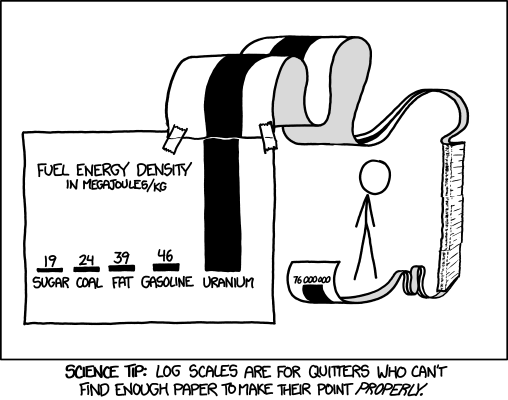
Whenever there is a discussion about nuclear I always remember this XKCD https://imgs.xkcd.com/comics/log_scale.png
this_user 7 hours ago
Nuclear is to solar in terms of energy generation what hydrogen is to electric for cars: it's proponents keep arguing that the other thing doesn't work and will never work, and that you absolutely, positively need their approach. And then it just works and effectively kills off the other technology within a couple of years. Nuclear is basically already dead, and anyone starting new nuclear projects now will look extremely silly in 20-30 years when they finally come online.
dboreham 7 hours ago
They might not look silly because they will have material from which to make nuclear weapons, which is the principal reason we have nuclear power at all.
tdb7893 7 hours ago
I definitely would not describe implementation of solar as "fanatical" by most governments, especially 20 years ago. The growth of solar is very recent, it's beat nuclear rather quickly and it's also growing very fast. A huge portion of the world's solar infrastructure is just the last 5 years.
MentalM 5 hours ago
> I definitely would not describe implementation of solar as "fanatical" by most governments
Idk, when you because of that implementation, for 20 years pay for the energy 10 times more comparatively to coal generated energy, that seems pretty fanatical by me.
crote 4 hours ago
jkahrs595 7 hours ago
> fanatical implementation
Not supported by the stats in TFA:
>According to the report, the gap between renewables and nuclear widened substantially in 2025. Global solar capacity increased by 510 GW to 2,383 GW, up 27% year on year,
Sounds like a quarter of the growth was in the past year.
maxerickson 7 hours ago
Most of it has been installed in the last 4-5 years, and we are still accelerating.
https://ourworldindata.org/grapher/installed-solar-pv-capaci...
jkahrs595 5 hours ago
toomuchtodo 7 hours ago
dgacmu 7 hours ago
Er, yes, that's exactly the behavior you would expect of something growing exponentially - it looks slow at first and then suddenly overtakes things. 23-27% annual growth takes a while to really get moving.
happytoexplain 7 hours ago
I am mostly pro-nuclear, and the comic is funny, but of course we extract energy from sugar, coal, fat, and gasoline via oxidation, while we extract energy from uranium via fission. So the more relevant variable being demonstrated in the comic is chemical process vs nuclear process, not how much energy is "in" the fuel. And that comparison is a lot less cut-and-dry.
vlovich123 7 hours ago
Good luck getting fission to work on any of the other materials.
crote 4 hours ago
Well, what would you expect a solar rollout to look like?
Assuming we'd instantly switch from zero solar demand to unlimited solar demand, we'd need some kind of scaleup of PV manufacturing first, and with a fixed construction capacity of PV factories we'd see a linear rise in PV factory capacity - which would result in an exponential growth in yearly PV factory output.
But the same applies to the factories as well: the construction capacity is going to scale up as well, so as more PV factory part manufacturing becomes available we'll start to see an exponential growth in new PV factories, which would result in even larger PV factory output.
Scaling from "lab experiment and niche application" to "significant chunk of the grid" is a lot harder than scaling from "significant chunk of the grid" to "the entire grid" - especially with solar being embarrassingly parallel rather than requiring mega-scale deployments.
thinkcontext 2 hours ago
The first TW of solar capacity took 60 years to reach. The 2nd TW took 2 years. We've reached the inflection point.
tempest_ 7 hours ago
China is building a lot of nuclear, and in my home province in Canada they are planning to expand nuclear infrastructure (we will see if it comes to pass).
Solar just thrives in places without dependable established grids and has way lower buy in.
Two different tools for different things.
trophycase 7 hours ago
It really is sad how ugly solar is. Miles and miles of beautiful, peaceful open desert are ruined. It's a bit of an environmental travesty.
ape4 7 hours ago
You're aren't looking at all factors here. I look at solar and think its beautiful for what its displacing.
toomuchtodo 7 hours ago
Utility scale solar PV restores deserts. It also compliments agriculture use cases (“agrivoltaics”).
If you believe solar is ugly and deserts are beautiful, well, “beauty is in the eye of the beholder.” I believe clean, solid state hardware that will reliably produce low carbon energy for decades without causing any harm and potentially contributing positive benefits to its surroundings, with no other inputs required, is incredibly beautiful. Like simplicity, it is the ultimate sophistication (da Vinci).
The Great Solar Wall: China doubles down on its ambitious effort to tame deserts - https://www.scmp.com/news/china/science/article/3363108/grea...
Triple win: solar farms in deserts can boost power, incomes and ecosystems - https://www.nature.com/articles/d41586-024-00516-8
Swathes of Earth are turning into desert — but the degradation can be stopped - https://www.nature.com/articles/d41586-023-03621-2
metalman 6 hours ago
The Sun is #1 die nukes die! very happy now. had some issues with my off grid solar powered house and shop last week, but bounced back quickly and ran a small welder as part of the system verification test, still running massivly outdated gear, holding out till I can integrate car charging in a bigger upgrade. saw a smaller farm last week that paved a small padock out by the road with 30~50 kw grid tie array , ground mount to concrete blocks, drop it and run, zero out the powerbill.
radu_floricica 7 hours ago
Color me unsurprised. Industry in which it's been basically illegal to build gets taken over by booming subsidized industry.
There is very little actionable information here. Nuclear is still worth building, in countries that don't overregulate it (China is doing it, even while they export the solar panels that everybody is buying). Solar is hitting pretty steep marginal returns on the value of generated watt, because it's all running at the same time and not necessarily when energy is most needed. We still haven't solved cheap battery storage. etc.
phreeza 7 hours ago
> China is doing it, even while they export the solar panels that everybody is buying.
Would be interesting to know how much nuclear vs solar they are building per year domestically.
jeffbee 4 hours ago
Brainwashed fission bros double-count reactor builds every year they are under construction. In terms of completed stations, China is opening 1 new reactor (~2GW) and hundreds of new PV stations (~300GW) per year. Over 99% of it is solar and nuclear is a sideshow.
phreeza 3 hours ago
jeffbee 4 hours ago
We absolutely have solved cheap battery storage. 100% solved. It is crazy to make this statement when we are discussing nuclear thermal power, which requires multiple 20-million-dollar steam turbines for every station. You should have said "We still haven't solved cheap superalloy fan blades".
tonyhart7 7 hours ago
"We still haven't solved cheap battery storage."
we literally already have salt battery
Kuyawa 6 hours ago
I wonder if we will run out of battery materials in a hundred years, then what?
dv_dt 6 hours ago
Are we burning the battery materials into gases and sending the results into the atmosphere? No, then we are unlikely to run out of materials on a primary or secondary, recycled, basis. Not to mention the diversity of choices available for chemistries and storage
mallets 6 hours ago
Impossible as there are so many chemistries, but hopefully we don't run out of water for pumped hydro.
jes5199 6 hours ago
we might end up switching to sodium batteries for the grid, they’re heavier so not great for cars, but otherwise they’re fine
bob1029 6 hours ago
Global scale HVDC networks could eliminate a significant part of the storage requirement.
jooops1 6 hours ago
If we run out of Saltwater then we have very different problems at our hand.
henry2023 6 hours ago
1. Sodium batteries 2. Kinetic Batteries
jeffbee 5 hours ago
It is far more likely to run out of practical fissile materials than it would be to run out of electrochemical materials.
tcfhgj 6 hours ago
green gas or flow batteries
thisisauserid 7 hours ago
Publication says that specialty of the publication is booming. Noted.
jfengel 7 hours ago
Industry newspaper writes news about industry. Who do you expect us going to write about this, Knitting Monthly?
If mainstream news sources do pick up this story, they'll likely cite this article as the source. That's how journalism works. It's not all investigative journalism blowing the lids off of things. They start with knowledge sources. They check the sources against independent ones before publishing, so that they're not just repeating propaganda, but they also tell you where the information came from initially. They may add context from their own knowledge, but the actual news rarely originates with them.
epistasis 7 hours ago
These are easily verified hard numbers that could be looked up anywhere. It's not an "opinion" or a subjective piece.
What is your note, precisely?
luqtas 7 hours ago
quite sad to see that even educated hackers ain't getting this is a bad news - solar is dirt. nasty chemicals on it's production, nasty thrash after it's commercial span is over. nuclear is much more reliable, has tons of space to improve, cheaper and greener over the long term. such a shame this greenwashing
megaman821 6 hours ago
Are you trying to claim solar has nastier end-of-life cleanup than nuclear? That is certainly one way to get people to discount everything you say.
Aboutplants 6 hours ago
Every energy source has complications regarding the production of the capability. We know that fossil fuels have a much more damaging impact than other sources of energy production.
Not to discount your point of renewables having massive issues, they just simply do not compare to the destruction that is caused by getting fossil fuels out of the ground and the damage it does once we start burning it
plqbfbv 6 hours ago
After its commercial span is over, over 90% solar and battery materials can be recycled to make new panels and batteries. Compare that with nuclear where we need to stow away basically-forever-radioactive spent material.
We have a giant fusion machine in the sky delivering energy in great excess what we use, and we only capture a tiny fraction of it at the moment. We can make each household practically independent. Fission and (hopefully soon) fusion will be good for meeting grid demand when renewables can't, but a distributed grid is simply more resilient to everything, from local events to country and nation-wide disruption of central generation points.
natdavidson 3 hours ago
Please share the recycling supply chain for solar panels