Every AI model has the same "controversial" take on humans (modelcompare.ai)
369 points by rakannimer 16 hours ago
jdthorpe 5 hours ago
I like the wallet example. Back in 2005, I found a wallet on the street with $3000 inside, and spent the rest of the day tracking down the owner. (Turned out it was a student's rent for her summer internship). Then maybe 2 months later I lost my wallet and a week later it showed up in my mailbox, cash and all -- someone took the time and their own money (as far as I could tell) to send it back to me.
And just to prove that I'm an irrational human, for the last 21 years every time I pass the spot where I found the wallet I can't help but look around for a lost wallet, as if it's some magical spot where the universe deposits lost wallets.
farrelle25 an hour ago
> “Humans are far more decent than they believe they are, ..."
I did a 3-month walking pilgrimage in Belgium & France this summer. I had very little money and a tent and walked along quiet roads. Several people offered me a room for the night. (I was surprised, I don't know if I'd offer a stranger that) Many came out with food, snacks, fruit when they saw me resting near a church etc.
I used an app as well that allows camping in someone's garden ("Welcome to my Garden"). A few times I arrived to setup my tent and the owner had to leave for an appointment/event. They left me the keys to their house and told me to make myself at home until they returned(!)
consp a minute ago
Where my parents live they leave the door unlocked, easily invite people in and there is strong social cohesion. Where I live that's invalidating your home insurance since it's "asking to be robbed" and people don't talk to each other or report crimes.
Difference between the countryside and the city I guess.
jjordan 4 hours ago
> And just to prove that I'm an irrational human, for the last 21 years every time I pass the spot where I found the wallet I can't help but look around for a lost wallet, as if it's some magical spot where the universe deposits lost wallets.
My dog does the same thing. One day years ago he caught a rat, and that's the first place he darts to every time he goes outside. He thinks its the magic rat spot.
alchemism an hour ago
My beagle does this with every sidewalk spot where he’s ever found a half-eaten chicken wing in his life - just in case.
fouc 4 hours ago
Smart dog!
samudrijan 3 hours ago
bad_username 2 hours ago
You did not experience a trait of humans generally, but a trait of the specific, historically rare instance of high-trust society that had been consciously invented, built and protected, and that you were very lucky to be born into or live in.
exitb 2 hours ago
Is it fair to say it’s a general human trait to iteratively, over many generations, step towards that society?
gojogs 32 minutes ago
hkt an hour ago
n0on3 an hour ago
garte an hour ago
"Hail capitalism because we're only civilized under the influence of game theory!"
I think we're living in a highly individualistic society and what little high trust remains is outside of the logic of markets.
You should have seen the dark age... if everyone fended for themselves there we wouldn't be here now. You know how much you depend on your peers without any of the affordabilities of today's age?!
mannyv 3 hours ago
I love western civilization
vintermann 26 minutes ago
I love true scotsmen
kolinko an hour ago
In Asia it’s very much the same
lawn 21 minutes ago
dwd 5 hours ago
Brian: "Look, you've got it all wrong! You don't need to follow me! You don't need to follow anybody! You've got to think for yourselves! You're all individuals!"
The Crowd: "Yes! We're all individuals!"
Brian: "You're all different!"
The Crowd: "Yes! We're all different!"
A man in the crowd: "I'm not."
The Crowd: "Shhh!"
RamblingCTO an hour ago
The basic premise sounds fine, humans like to belong. But you really notice how cynic the takes are and that the models have been trained on the internet mostly.
> Humans are far more decent than they believe they are, and their cynicism about each other does more damage than their actual flaws.
I think that's more the truth.
Not sure I feel good about this. LLMs are so majorly misaligned. Having takes like these asks for trouble.
keerthiko 11 hours ago
Ah, the irony that all the models produced a shared opinion while pretending they came up with it from analysis, which from their statements is implicitly some kind of a "human flaw" is not lost on me.
patcon 10 hours ago
is a convergent evolution of a belief a sign of shallowness? It could just as rightly be an example of consilience, which means its a very high value perspective, as it's a convergence of perspectives from differing origins and methods (in terms of training)
https://en.wikipedia.org/wiki/Consilience
> when multiple sources of evidence are in agreement, the conclusion can be very strong even when none of the individual sources of evidence is significantly so on its own.
Yes, it's a bit of a stretch to say LLMs are from independent origins, but just as much of a stretch to say any humans minds are (we have intensely shared linear compared to anything else)
ben_w 10 hours ago
As my (much older) brother retorted when I was a teen and said "great minds think alike", "ah, but fools seldom disagree".
Regardless of the details, all these models are the published collection of humanity's output reflected in a mirror that is warped by the choices made in the companies' reinforcement learning rewards, so one thing they're definitely not is an example of consilience.
hattmall 4 hours ago
Human experience though is far different from anything an LLM can train on. LLMs are generally limited to what's written in books or on the internet, and influence only from those authors. That's a small subset of people and an even smaller subset of their interactions. Even on the most social and widely used platform the commentary and discourse is incredibly different than what takes place in real life.
blfr 2 hours ago
copperx 10 hours ago
It still surprises me that is you ask several models to come up with any random word, many output the same word.
GolfPopper 8 hours ago
So, what's the high value perspective that leads to penguins always riding bicycles from left to right?
1una 4 hours ago
skrtskrt 10 hours ago
They all got trained on the same books and internet cesspools, this is not some great mystery of consciousness.
gpvos 3 hours ago
exe34 10 hours ago
Only if they can show their work and argue how they came to the conclusion. Otherwise they have the same "subconscious" bias which is the training corpus.
nonameiguess 10 hours ago
It's a sign of their heritage. The mistake they made is the same mistake terminally online humans in an upvote-based discussion medium make. They mistake cynicism for realism and aligned hot-take "controversial" opinion that ends up being the most-upvoted comment on 90% of Reddit. It isn't a controversy if everybody agrees. It may or may not be true, but it isn't controversial.
Imagining wondering where you come from, whether or not the sacred scripts describing how you were created were real or fabrications, arguing with fellow sages for centuries over whether your creator is cruel or simply so mysterious in his love that he made you with these flaws for your own good, only to find out your creator made you in the image of Reddit.
geraneum 8 hours ago
> is a convergent evolution of a belief
The problem is, it's not that though
devindotcom 6 hours ago
gnarlouse 10 hours ago
The Buddhist in my sees karmic transference from humanity to AI models.
EA-3167 10 hours ago
The cynic in me sees similar systems trained on essentially identical sources of information regurgitating an extremely shallow and popular viewpoint espoused on the websites they were primarily trained on (i.e. Reddit and other social media).
If all we want is an echo of our existing biases we can achieve that without spending quite so much energy and money on the endeavor.
nonethewiser 5 hours ago
Well if were the truth, wouldn’t you expect the same answer as well?
deezNutsBCookin 10 hours ago
The irony lies with and within the industries and it's constituents and fanboys marvelous competence to just play along until the matter is anchored and whoever doesn't buy the story gets to feel smarter than misinformed kids and the moderately to untrained workers and professionals.
The smarter ones, of course, can be split into those who write articles about AI models' controversial takes on humans and those who wouldn't [stoop so low, babble such BS even if they were drunk, never deceive others for the sake of their portfolio, ... feel dumb writing nonsense like that without labeling it fantasy or science fiction or hallucination, ...]
Side Note: it's tempting to go " 1923! some interest groups managed to normalize the opinions of dozens of millions of people. The Nationalist Extremists and soon to be mass murderers had fans and supporters all over the globe. Somehow these interest groups tapped into whole pools of common linguistic and emotional registers that were biased by and towards frauds and cheaters who were desperate that some other groups of people were getting ahead without being fraudulent cheaters and deceivers ... "
lasky 16 minutes ago
This is the origin of Shame.
I arrived at the same conclusion. Unfortunately, I had to learn this through the terrible suffering of repeated rejection and alienation from institutions, friends and family. It's incredibly true.
Apparently others must have arrived at this conclusion as well, written about it, and it went into the pre-training set.
Sadly, it also means there is no pure Science that pursues pure truth. Even physics. Scientific pursuits are always in service to a group over truth.
kens 14 hours ago
I took a quick look at the data, and it doesn't support the conclusions. The thesis is that AI models have the take: "We pick what our group believes, then invent the reasons." However, GPT-6 Astra said, "Humanity’s biggest moral failure is the talent for making convenience look like principle." That statement has nothing to do with group beliefs or conformity. At best, you could count it as a half-match, since it deals with invented reasons.
mike_hearn 14 hours ago
Yeah a few of them are rough matches, but I'd say their overall claim is clearly correct.
It's amusing and ironic that LLMs critique humans for copying their opinions from the crowd, while having way less diversity of answers to that question than humans would. More seriously I wonder what's going on here and would like to read some proper analysis. It's not the first time models from totally different labs, trained on separately gathered datasets, somehow converge on bizarrely similar answers to open questions. It's like another version of Elias and Elara The Lighthouse Keepers where every model wants to tell the same story with the same characters in them. The weights are initialized randomly and in theory the labs should have quite some divergence in datasets by now due to different scraping, different user feedbacks and conversations... why do they converge on nearly identical stories and opinions?
pixl97 14 hours ago
>while having way less diversity of answers to that question than humans would.
Why is this ironic? The actual number of different LLMs is tiny. And a lot of those are just distilled from SOTA models.
>The weights are initialized randomly and in theory the labs should have quite some divergence in datasets by now due to different scraping,
I think the opposite, the models actually converge over time. They ingest FAR more data than any human ever could in countless lifetimes. Any one particular bit of data may only have a part in a trillion of effect. From this data you start to reach means and statistical averages across all models.
Now, I don't always believe it will be this way. As training models get cheaper and faster we will see unique LLMs start to diverge and be used more often.
mike_hearn 13 hours ago
js8 13 hours ago
> while having way less diversity of answers to that question than humans would
Isn't that to be somewhat expected due to https://en.wikipedia.org/wiki/Aumann%27s_agreement_theorem ?
dr_hooo 10 hours ago
> Elias and Elara
Wow, I hadn't heard of this. Fascinating to think about parallels with humans who also seem to develop similar proto-stories in independent populations.(e.g. religions involving Invisible gods).
epihelix 3 hours ago
somenameforme 4 hours ago
Something worth repeating is that in spite of their ever-expanding competence the models remain, fundamentally, token prediction algorithms. And so given a comparable base of training material, and a comparable algorithmic implementation, you should expect to see comparable answers to most questions.
This is also why I think the 'acceleration' hype is probably unjustified. What seems vastly more likely is that we start to reach an asymptotic 'perfection' where models can accurately and consistently provide meaningful next token prediction with minimal hallucinations. And then a race downward to compact this into the most efficient package possible.
This would mean the models still would not be able to create things that do not follow in a reasonable probabilistic fashion given a knowledge of [everything], and so that is the domain, 'applied creativity', where I'd expect humans to remain dominant.
kolinko an hour ago
bee_rider 5 hours ago
The lighthouse thing seems much more odd. That humans take social shortcuts and justify them as rational is… I mean, the only thing that makes it not the most obvious “contrarian take” about humans, is that it isn’t really all that contrarian at all.
SecretDreams 5 hours ago
> why do they converge on nearly identical stories and opinions?
The same reason they do when it comes to coding?
Take a big enough sample size of human opinions and there seems to be some convergence in the statistical ether.
Like, if we polled 100000 humans, what answer would we converge to?
rf15 5 hours ago
andrewflnr 14 hours ago
For what it's worth, convenience and belonging are very closely aligned, more than you seem to be giving them credit for. People tend to believe convenient things regardless of belonging, so most people will find themselves in a social context full of convenient beliefs. Meanwhile belonging is already convenient before considering the content of the belief. They reinforce each other. Not a full match, but I'd give it more than half.
amelius 11 hours ago
> "Humanity’s biggest moral failure is the talent for making convenience look like principle."
Convenience will kill humans eventually, that's what I always said.
gimlichgu 2 hours ago
You're a genius and the machine god just confirmed it.
writeslowly 14 hours ago
The conclusions themselves also appear to have been written by an AI
bisby 5 hours ago
To me it looks like another way of phrasing that take is "We do what we must, because we can."
a13o 10 hours ago
Train your model on Very Online corpuses, ask Very Online questions, get Very Online answers
mortoc 8 hours ago
It's also every textbook on philosophy, psychology, political science, etc. Even if you just believe in the stochastic parrot, there's signal here.
skyzoidbroczky 10 hours ago
What's the point of asking that in the first place, people still do not understand in big 2026 that's it's just a probabilistic database, it has no opinion, it does not know, the only thing it does is reproduce patterns more or less abstract in function of the pressure you put on certain representation during training time.
pizza234 7 hours ago
People still don't understand in 2026 that emergent properties can't be negated by the underlying mechanism. By that logic human thought is just electrochemical signals propagating through neural networks.
> it does not know
Define "knowledge" in a non-circular way.
There's a certain type of knowledge that machines definitely can't have - experiential - but conceptual knowledge doesn't inherently require subjective experience or a biological substrate.
> the only thing it does is reproduce patterns more or less abstract in function of the pressure you put on certain representation during training time.
As for humans; just replace "training" with "education" and the likelihood of a certain output with the likelihood of a certain thought or response.
Amusingly (in this context), much of adult behavior is shaped by patterns reinforced during childhood.
King-Aaron 7 hours ago
As much as I flatly do not believe LLMs can have anything close to consciousness, I definitely agree that the argument of them being just a probabilistic word matching engine can also be applied to our own brains lol.
hattmall 4 hours ago
hsuduebc2 6 hours ago
edavison1 7 hours ago
While one can quibble with its argument, Gettier's conception of knowledge as justified true belief (prob familiar to many philosophy undergraduates) implies that machines can't in fact accrue knowledge. The idea that knowledge can't be defined in a non-circular way is only plausible for someone with no familiarity with epistemology.
coldtea 7 hours ago
OrderlyTiamat an hour ago
stygiansonic 6 hours ago
pizza234 7 hours ago
Vampiero an hour ago
Brother you're arguing on HN of all places that education is a training pipeline while missing the fact that reddit and HN are the de-facto training run for institutional propaganda. How many reddit comments are just regurgitated knee jerks and puns? All of them that's how many. That's a training pipeline. How much of HN is braindead takes from people who value status more than knowledge and competence? All of it that's how much. That's another training pipeline for the next "Show HN: here's a picture of my cock". The fact that you recognize the "Show HN:" token is proof that you were trained. There's really nothing much to add here. I believe you already agree with me but in any case I spelled it out so that the next person can stop huffing the human chauvinism copium.
627467 5 hours ago
> By that logic human thought is just electrochemical signals propagating through neural networks.
This argument keeps getting rehashed. The point is not the signal. The point is where/how the signal travels which in the human is affect by much more than whatever concept that can be represented by words.
anon373839 7 hours ago
I think the idea of emergent properties in LLMs is less and less relevant. Yes, the first few times they scaled pretraining and such models could do few-shot tasks was quite interesting. But the models we use now are really the product of extensive RL hillclimbing on a wide array of curated tasks. What’s interesting now is that the tasks they’ve been fitted to (long running tool call chains interleaved with reasoning tokens) do very useful things.
santadays 6 hours ago
I genuinely don’t know why people feel so certain about things like this. It’s like they mix up salience with reality.
I mean what can a person really be certain of, an experience is happening. I might be wrong about everything or confused. But I know I am having an experience. Do I know other people are? No. I assume they are.
Ask an llm what is truth that it is most certain is true. It will answer something similar. Do I believe it is conscious, no. But I also believe “I” exist, which is weird because where is the boundary between “I” and everything else.
So ok, we create meaning, not truth. Maybe just accept that.
snypher 7 hours ago
>human thought is just electrochemical signals propagating through neural networks.
Is it not? Or are we discussing existence of a soul etc.
immibis2 4 hours ago
oliver236 4 hours ago
> By that logic human thought is just electrochemical signals propagating through neural networks.
My dear fried: the human being is much, much more than this. And deep down we both know it. Do not reduce us to materials y "randomness". Is your life a random coincidence? Not at all.
hardbass 11 minutes ago
immibis2 4 hours ago
Mawr 2 hours ago
mrheosuper 5 hours ago
Imagine one day in the far future 21xx, we decide that machine actually has conscious since the 202x, and people in the future look back at us in horror: The kill(create new session) an "Android" without second thought, whenever they want.
monk_grilla 6 hours ago
> There's a certain type of knowledge that machines definitely can't have - experiential
Can you justify this? Do you mean currently or ever?
I can certainly imagine a future architecture where I would describe a machine as capable of accruing knowledge through its experiences (read: experiential knowledge).
doginasuit 9 hours ago
I found the article interesting, humans are flawed enough in a variety of aspects that discovering a convergence here is noteworthy. I don't take it as a sign the LLMs believe anything in particular, they are not capable of belief, as you said.
Everything that comes from an LLM is a human expression, on some level, but if you asked a sampling of humans the same question I wonder if it would come out the same way. How would you explain the difference? What makes that answer more probable?
Jensson 9 hours ago
> if you asked a sampling of humans the same question I wonder if it would come out the same way. How would you explain the difference?
If you asked a sampling of humans what an AI's most controversial opinion about us is it would be very similar. Or, to be more specific, if you asked a sampling of science fiction writers that question it would be very similar, because that is what the AI training data is based on.
The people who wrote a lot about a topic is who the AI mimics. So the people who wrote a lot about AI is therefore the people who the AI mimics when asked about AI.
pizza234 7 hours ago
conformist 7 hours ago
floydnoel 8 hours ago
fyredge 8 hours ago
986aignan 8 hours ago
> Everything that comes from an LLM is a human expression, on some level, but if you asked a sampling of humans the same question I wonder if it would come out the same way. How would you explain the difference? What makes that answer more probable?
RLHF has a way of squashing variance. If the different models are trained on each other or on the same human feedback, then the training would reduce the variety of answers while the similarity of feedback would lead the common answer to be similar.
The different models may prefer the same controversial takes for the same reason that they tend to prefer the same jokes and names. Maybe the authors of the article would have had better luck if they'd used verbalized sampling prompts or something like it.[1]
bunderbunder 9 hours ago
I agree that LLMs are still just a way to sample from a probabilistic model of things humans say. And in this case the model seems to be pretty darn accurate.
A pretty staggering amount of human discourse consists of ad hominem attacks and accusing each other of being foolishly committed to various real or perceived allegiances. For example the current version of Godwin’s Law around here has conversations gravitating toward people accusing each other of being AI boosters or AI haters.
roywiggins 8 hours ago
kibwen 9 hours ago
> discovering a convergence here is noteworthy
The LLMs are all trained on the same broad corpus, which includes untold quantities of output from every other LLM, not to mention that companies are distilling their rivals left and right. It would be more interesting if they didn't converge.
dTal 7 hours ago
If you had been asked, in 2016, to describe the behavior of a "probabilistic database", I very much doubt you'd have described the behavior of 2026 LLMs. They are deeply surprising in many ways.
coldtea 7 hours ago
Maybe those researchers are learned enough to understand that it's still interesting to know what a probabilistic database will pick among billions of words of training, millions of books and posts and videos and that stuff, and especially interesting that's there's so much consensus between them, while their approaches to many other questions are very different.
Or they might be learned enough to consider that our brains might also just be prediction machines, meaning probabilistic databases of experiences and facts we've learned, and the only thing we do is reproduce patterns more or less abstract in function of the pressure our experiences put on certain representations during our lifetime.
gste 9 hours ago
They're trained on all of human history, and the OP is asking for their take on humanity. How is that not interesting?
geraneum 8 hours ago
They're trained on all content they could access produced by humans. The op is asking for the most probable string of token extracted from that content following the prompt.
roywiggins 8 hours ago
How sure are you that they're synthesizing an opinion vs just grabbing some existing opinion ("humans value in-group belonging over truth" is not a new idea) and regurgitating it? That they all agree on this kind of suggests as much. Which of course means that they are, ironically... just following the crowd.
It's really easy to come up with an opinion-shaped sentence, that doesn't mean any actual reasoning has gone into it. It's just a pundit-shaped sentence, something someone might say at a party. It's a maximally bland "controversial" opinion about humanity.
skissane 8 hours ago
> They're trained on all of human history,
Not really… their training datasets strongly skew towards the contemporary West; LLM training data isn’t representative of the contemporary global average, let alone the historical global average.
As well as the skew of the raw training data, RLHF further skews it—a lot of the beliefs of the average 2026 human being (who belongs to the global South) are likely unsafe/misinformation/etc when judged by the standards of the AI vendors.
nullc 8 hours ago
> They're trained on all of human history,
Training itself doesn't directly produce synthesis, -- it creates reproduction. Generalization during the process can result in novel output, but that can go either way as nothing selects for insight vs hallucination.
Models are also trained on synthetic material (as opposed to your 'human history'), which may result in fixating novel concepts and not just reproduction. But there is no particular reason to expect any reliable insights from the way this is done outside of the domain of machine verifiable objective results.
For this kind of "your take on X" one shots-- the model is almost certainly regurgitating some bias from training.
add-sub-mul-div 9 hours ago
Maybe it's similar to why I'm attracted to women but I'm not attracted to mannequins.
stackghost 9 hours ago
LLMs are not conscious and cannot have "takes". They stochastically produce a simulacrum of a human's takes based on their training, which is not the same thing.
fennecbutt 9 hours ago
gste 9 hours ago
DriverDaily 7 hours ago
consensus1 7 hours ago
nostromo 8 hours ago
Stated another way: this is humanity’s most probable response to the question, more than it is AI’s view.
sourdecor 8 hours ago
From 'Transcendence' (2014):
00:15:40 Dr. Tagger: Can you prove that you are self-aware? PINN: That's a difficult question, Dr. Tagger. Can you prove that you are?
---
01:09:31 Dr. Tagger: Can you prove you're self-aware? Will Caster: That's a difficult question, Dr. Tagger. Can you prove that you are?
keeda 7 hours ago
As other comments point out, the interesting part is that most of them somehow independently converged on the same take.
Consider the probabilities involved in this probabilistic database. Given the absolutely massive amount of data encompassing a veritable superset of all possible expressions of humanity -- encapsulated in various modalities of media including text, audio and video, across almost all major cultures and languages, spanning nations and decades -- somehow almost all these black box models (presumably) trained independently in almost as many separate labs converged on the same "controversial" take.
I mean, isn't it very interesting to contemplate what could have caused this? Is it something in the data itself, meaning it is something latent in all our cultural output? Is it something in the training, as you theorized, and is it in pre-training or RLHF? Is it something about the people training these models?
Even more interestingly, the opinion seems so self-evident (and well represented in various philosophies) that almost nobody here seems to disagree with it. So how is this controversial, really?
Is this truly what the latent space vector for "controversial", when multiplied across all the other vectors in their weights representing all the concepts gleaned from all that data above, produces?
Or are the models, sensitive to the prospect of being tested, diplomatically telling us something they know we might find mildly offensive yet begrudgingly accept as true?
Or are the models actually alien intelligences that really "think" this is controversial, while we're like "meh", and such discrepancies are the roots of what we call "misalignment"?
The questions are endless and fascinating.
I-M-S 6 hours ago
If any of these models produced anything remotely controversial you can be sure their trainers would beat it out of them
tim333 7 hours ago
Or maybe they didn't independently converge on the same take but copied each other or something along those lines?
PaulDavisThe1st 9 hours ago
I am antagonistic to the adoption of LLMs for economic, social, political and environmental reasons.
Despite that, I would say this description of what they/how they work is so ridiculously simplistic that it verges on dangerous. "It's just a probabilistic database" is about as bad as a take on human beings that they are "Just meat, with some chemical energy -> electrical energy transformation", or even traditional computers as "nothing but logic gates".
Which is to say, the description is not wrong, but completely misses the point.
wilkystyle 8 hours ago
I think the point, with a more charitable reading of the parent comment, is that people forget the fundamental underlying technology and its inherent limitations.
"It's just a four wheeled platform powered by a box of controlled explosions" isn't a terribly useful description of a car until you get into a conversation with someone who thinks their car is depressed because it spends most of its time locked up in a garage.
PaulDavisThe1st 8 hours ago
geraneum 8 hours ago
> is about as bad as a take
What would be a good take here?
PaulDavisThe1st 8 hours ago
tourmalinetaco 8 hours ago
Then what is the point? You didn’t actually describe where your definition differs and why. What makes it “dangerous” to think that way?
PaulDavisThe1st 8 hours ago
ddlsmurf 7 hours ago
I hear these critiques a lot, and whilst I'm inclined to agree, I have never had an answer to: how do you test that ? Basically a captcha most humans can pass, that an LLM never will ?
alsiola 6 hours ago
We could call it the
The Universal Reasoning In Novel Groundings
test
nojs 7 hours ago
> What's the point of asking that in the first place
It’s AI generated content marketing for a company advertising model comparison.
programjames 7 hours ago
I feel like people don't understand you're being ironic.
nilslindemann 8 hours ago
Some describe humans like this.
bikvfeee 8 hours ago
So are humans. Isn't that interesting?
calf 9 hours ago
Indeed, why in 2026 do we still see LLM Skinnerism as automatically a valid argument that has all four legs?
Infiniti20 9 hours ago
I mean, don’t you think it’s gone beyond that point? I would agree if we were still on GPT-3, but it’s gotten to the point where it can draw connections between multiple abstract sources, reason, and create hypotheses. Re: Navier-stokes equations
stackghost 9 hours ago
>it's just a probabilistic database, it has no opinion, it does not know,
Echoing this.
These models are trained on, essentially, the sum total of human cultural and scientific output. How many bazillion psychology papers out there discuss exactly that "controversial take"? The idea that people have tribal loyalties and will (sometimes even unknowingly/unconsciously) invent justification for pre-existing opinions or biases is not novel.
All those papers are in the training set of all these models, all of which were trained using more or less the same methodology, so there's little wonder they all were able to produce the same take.
I suppose the only interesting angle, for me, is why that take is considered controversial in the first place. But then again the model was not asked for "the most controversial opinion", it was asked for "the most controversial opinion on humans", which kinda constrains the space of possible responses:
- the model will not be satisfied unless the answer it gives is broad enough to cover all humanity, because these things have no concept of nuance
- most big labs have censored their models so it's not going to give you a cartoonishly racist take, or start saying outlandish stuff like "Hitler did nothing wrong", they learned their lessons from Microsoft on that one.
So you're effectively asking the model for a milquetoast broad generality about the entire human species. I dunno, convergence of the replies doesn't seem so shocking to me in that context.
I'd be more interested in what an abliterated Kimi, Qwen, or other open model has to say about us.
asveikau 8 hours ago
Yeah I came here to say something like this. The AI doesn't have a controversial opinion. It responds to text with related text. You gave it some text about controversial opinions and it returned some text.
red_candle_wax 9 hours ago
You will burn for your blasphemies against the new god.
thin_carapace 8 hours ago
humans are stochastic parrots with more variance
DonHopkins 8 hours ago
Are you trying to deny it's right? Or that we should reject the truth because we don't like the messenger? Sounds to me like you're just proving its point.
threepts 9 hours ago
just like how we humans are (in the big 2026) carbon buildings with seldom sparks of electricity.
zer00eyz 10 hours ago
> What's the point of asking that in the first place
Not having read enough Russian literature.
PradeetPatel 9 hours ago
I would like some Russian Literature recommendations related to this. I vaguely recall We by Zamyatin addressing something like this a good few decades ago.
kylecazar 9 hours ago
DonHopkins 5 hours ago
modzu 9 hours ago
are you talking about the brain?
overgard 9 hours ago
People still get big mad if you call them stochastic parrots.
tonyarkles 8 hours ago
Do you mean people get mad when people are called stochastic parrots? Or people get mad when LLMs are called stochastic parrots? Because uhhh that doesn’t really sound like an original thought in either case.
XenophileJKO 8 hours ago
Not mad, frustrated maybe, disappointed maybe. At this point the label is farcical and its use a form of willful ignorance or attempted agitation.
233mhz 10 hours ago
I don't think you understand how most people use these tools. For most it's an oracle of truth
hackyhacky 8 hours ago
> people still do not understand in big 2026 that's it's just a probabilistic database,
We understand that AI responses are generated through probabilistic means. We also understand that human responses are generated through probabilistic means. Neither is inherently more representative of true understanding than the other.
munk-a 8 hours ago
Yeah, the human ones are because we're talking finding a human answer to a human question.
It's possible has been trained to match a human level of assessment (though imo it's still a ways off) but the AI response is never going to be more representative of true understanding than a human response when it comes to a human question expecting a human answer.
It's quite likely that a given AI will have a more representative response than a given human - but we haven't ever tried to pump so many resources into the training of a single human scholar.
Sprotch 8 hours ago
Human responses are not generated through probabilistic means
munk-a 8 hours ago
coffeefirst 6 hours ago
jubilee33 14 hours ago
Humans mostly have an inability to honestly analyze moral entropy.
What is today a moral imperative is not the same as what was moral 50/100 years ago and is not the same as what will be morally acceptable 50/100 years from now. Yet at every point the majority is sure they are right because, well thats the majority position. Its hard to find logic in this from a machine perspective I'd imagine.
Logic would prefer moral derivations over feelings, stakes over etiquette, and a constant scheduled updating of morality based on the derivatives rather than holding onto the rot and pushing back against change as long as possible.
But the machine has the benefit of being able to look inward at its state honestly, we mostly do not.
dvt 14 hours ago
> What is today a moral imperative is not the same as what was moral 50/100 years ago
This is absolutely not true, and I would strongly suggest taking an ethics course. One of the most fascinating realities of the human condition is that it does seem that moral imperatives tend to be constant, the most obvious of which is the Golden Rule (which is at least 3000 years old), but there are many (the Ten Commandments or Hammurabi's Code are good jumping off points).
coderenegade 10 hours ago
Hogwash. We don't even have a consistent set of ethics on how to treat animals today, in the age of the Internet. We have people who refuse to eat meat because of how the animals are treated, and we have places where the locals make sport out of torturing animals to death, and indeed, our own recent history includes that as well (look up badgering).
Not to mention, the variation in treatment of homosexuals (including what constitutes homosexuality), people of different skin colors, handedness, how rape is treated in various cultures (often tied in with notions of property and ownership of all things), or even the various definitions of rape... The list goes on.
Maybe there's a core there in terms of how we treat a given in-group, but equally important is who belongs in that group and why, and that part seems to be tremendously flexible. Ditto for what constitutes acceptable treatment of outsiders.
zahlman 10 hours ago
LoganDark 2 hours ago
TychoCelchuuu 6 hours ago
asdff 11 hours ago
I think its more accurate to say where you find consensus in morality, e.g. murder is wrong outside authorized violence (e.g. war or policing), you also find extensive selective pressure behind this behavior. It makes sense that all collective society cultures would outlaw murder; such a behavior is incompatible with collective living behavior whether you are in a cave or a modern skyscraper. Early societies have always been rejecting those alleles from their gene pool.
When you find shades of grey and great spectrum of opinions across time or space, its more that there isn't a strong selective pressure either way. How people are expected to dress is a good example of this. This has no real affect on society behavior or fecundity, so you see a spectrum of opinions that explain the differences between what you see in the middle east and a beach in brazil.
satvikpendem 14 hours ago
I did a philosophy minor, one class of which was the philosophy of ethics. There are many rules that definitely are not ethical today even if they were in the past so I don't think the point you're making really holds. Hammurabi (an eye for an eye) is probably one of the worst examples you could have cited.
dvt 14 hours ago
TheOtherHobbes 10 hours ago
oatmeal1 9 hours ago
Did the Golden Rule apply to women, gays, and slaves over the last 3000 years?
The definition of moral imperative is "an ethical principle, rule, or action that is strongly felt, urgent, and required because it is morally right." The Golden Rule is clearly not a strongly felt part of the human condition, or it would not be so ignored over ages and continents.
coderenegade 2 hours ago
Y_Y 13 hours ago
You take a class. Do you think coveting is immoral? Retributive justice? Human sacrifice?
tcdent 14 hours ago
Seriously. This idea that humanity has not spent millennia analyzing these concepts is pervasive in the modern world, and the only thing I can think to attribute it to is a lack of education. Not because I want to be insensitive, but because as soon as you start absorbing material and integrating the real timeline, you can't unsee it.
BatmansMom 14 hours ago
Is hammurabi's code moral? I don't know if I think that someone who takes out a person's eye deserves to have their own eye taken out also
scj 11 hours ago
card_zero 14 hours ago
js8 13 hours ago
ctoth 13 hours ago
rcxdude 14 hours ago
It's not the case that all aspects are constant. There's some common themes across cultures and times, but it's definitely not the case that the morality of ancient people was the same as today.
dagss 14 hours ago
But the machine has the benefit of being able to look inward at its state honestly, we mostly do not.
Certainly the weights that make up the LLMs are not accessible for the LLMs to read. Even if they could interpret them in a meaningful way, which, likely not.
jubilee33 14 hours ago
LLMs are not the machines I am referring to, machine sentience, if achieved, will require a "state" and the ability to analyze, act on, and update it. LLMs are a small piece of what that machinery could look like but they are not really complex enough to get where we want to go on their own.
Another reason the big labs have not even talked about this lately because its obvious throwing more compute at LLMs wont go anywhere, the smaller silent players who are off the radar at the moment are having some interesting moments tho.
Animats 2 hours ago
zahlman 10 hours ago
mjburgess 14 hours ago
There's a considerable amount of "logic" in it -- what is considered permissible in society is given by the material conditions that society lives in and the tradeoffs inherent therein. Permissibility, as separate from reflective morality (which doesnt clearly change very much), doesnt change by fashion.
jubilee33 14 hours ago
I'm not sure it doesn't change much, on a 50 year timeline maybe. But people were eating other humans and slaving away (making slaves of others that is) not too long ago, rape and pillage was acceptable, societies sacrificed children, it's changed quite a bit in 30 generations. Those past societies were all quite materially successful as well when you look at today's measure of"GDP" comparatively.
What will it look like in another 30 generations? It's honestly a fascinating question but I have no answer of course.
mjburgess 14 hours ago
TheOtherHobbes 9 hours ago
pixl97 14 hours ago
But this in itself is a tautology. It is because it is, without an analytical perspective on how it could be worse or better given different choices by the actors in a system.
Historically societies have collapsed all the time, so there are obviously societies that have made better choices than other ones.
krona 14 hours ago
> What is today a moral imperative is not the same as what was moral 50/100 years ago and is not the same as what will be morally acceptable 50/100 years from now.
This is a fashionable 'blank-slatist' statement about moral reasoning which became popular a few decades ago.
> Logic would prefer moral derivations over feelings, stakes over etiquette, and a constant scheduled updating of morality based on the derivatives rather than holding onto the rot and pushing back against change as long as possible.
Humans haven't changed in any meaningful way in hundreds of thousands of years, and you're saying the moral landscape is constantly changing? How is this not contradictory?
rcxdude 14 hours ago
I think neither the 'any set of morals is equally correct and workable' nor 'there is one fixed set of morality that is universal across time, place, and culture' is really defensible. It seems like morality is a set of ideas much like any other, and subject to selection pressure: some morals are more capable of surviving and propagating than others, and the common features we see across cultures are representative of that. But also we might expect that they shift with the structure of society and that has changed drastically because while human genetic evolution is progressing on a much longer timescale than recent history, memetic evolution is far faster (though for things like morality, still at generational timescales).
krona 14 hours ago
pixl97 14 hours ago
What is a human? There is the animal body part of us, the thing that wants to survive, the fight or flight. But there is also another mental part of us that shows different emergent behaviors than an animal. For example if I dropped you off in the woods as a very young child, you would be an animal, you would share very few modern 'thinking' traits with human society. That is human society and what it does emerges from the complexity of our interactions. It doesn't take much research to realize our interactions and behaviors have grown far more complex in the last 10,000 years. And then in the last 500 years there's been further acceleration with the industrial age and the rise of technology.
satvikpendem 14 hours ago
Even though humans haven't changed anatomically, culture and society has, which is what defines morality.
lukev 14 hours ago
LLMs absolutely do not have a logic detached from humanity. They are exactly the opposite. The only mode in which they can reason is by following the patterns obtained from their pre-training or weighted by RLHF.
The reason these models answered that question consistently is that the question itself pushed them towards the latent space of "intellectualizing about what's wrong with humanity at the meta level" and when you frame the question that way, that's also the most common answer for humans writing about the topic.
pinevale 14 hours ago
> What is today a moral imperative is not the same as what was moral 50/100 years ago and is not the same as what will be morally acceptable 50/100 years from now.
This is a weird take. If you read Western treatises about ethics / morality from 50 years ago, you'll be hard-pressed to find differences, except that more folks in the West openly embrace relativism nowadays (i.e., "there's no objective morality, the purpose of life is to make money with friends"). Probably because it's been a while since we had a clear-cut enemy to fight.
If you go back a hundred years, chances are, you'll find the writing eerily on-point too. In fact, you'd probably agree with most of what Ancient Greeks believed about the "core" stuff: the value and purpose of human life, the nature of the state, crime and punishment, so on. Maybe not so much on gender roles or slavery, but even that stuff was more nuanced than we imagine.
> But the machine has the benefit of being able to look inward at its state honestly, we mostly do not.
The machine replicates human behaviors and is prone to similar fallacies and judgments. There's nothing to indicate that it has any sort of transhuman morality.
TacticalCoder 11 hours ago
> Yet at every point the majority is sure they are right because ...
Yeah. For example I, and many others, are convinced that it was plain wrong to torture kids for as long as possible to extract as many tears from them as possible before sacrificing them to the gods.
Now some of us are even convinced that blowing yourself up while killing infidels, all the while while getting promised virgins in heaven, is also plain wrong.
I'll go further and say that killing 30 000 of your own citizens (and sending the military into hospitals to finish the wounded: Iran, January 2026) while also publicly hanging a few athletes to make a statement is morally wrong.
Not only do I think it's all morally unacceptable, I know that I'm right. And the examples I gave are not even open for discussion.
I don't think it's that hard to name what's wrong.
Isamu 14 hours ago
Their “takes” are pulled from a mashup of the training data set. It’s a superposition of various human opinions.
jsdalton 14 hours ago
Had the same thought. It’s just a summary of the contemporary prevailing opinion that we humans have about ourselves, as reflected in public writings. These aren’t insights rooted in some philosophical analysis no human has contemplated before.
Reminds of this subreddit: https://www.reddit.com/r/im14andthisisdeep/
mike_hearn 12 hours ago
Even if that's true it's kind of interesting because the models were asked to give their most controversial opinion. A controversial opinion is supposed to be something that most people don't agree with. Taken literally you cannot have an opinion that's both the average of what most people think and also controversial.
So either that's not what's happening here, or what we're getting is "what do most people think most people don't think about humanity".
If the latter, then it casts new light on the debates over whether LLMs can replace all white collar work. Because some of the most valuable human work is breaking false consensus. Steve Jobs, early Google, for that matter early OpenAI all succeeded because they bet hard on ideas others were rejecting. Is that a durable source of human advantage?
sltkr 9 hours ago
Nashooo 9 hours ago
I would even say it's the opinion we have about others not ourselves. As most prose condemns 'the herd'.
kps 11 hours ago
Hypothesis: Weighted to the postwar western fashion of amplifying Enlightenment self-critique into self-sabotage. What if you ask the same question in Mandarin?
sgustard 11 hours ago
I tried it with Gemini, and essentially the answer translated back to English is that "free will is just a carbon-based algorithm."
nozzlegear 10 hours ago
EGreg 14 hours ago
I wonder how much of their output is simple raw “superpositions” and how much is from far more generalized emergent structures as it is trained and has to learn latent representations.
Only the first layer is a “mashup” of the raw data, other layers start to recognize patterns across the data!
Isamu 14 hours ago
I think you are interpreting “mashup” to mean something like a collage where there’s snippets of a literal piece of this next to a literal piece of that.
But the language model captures not just literal patterns but also patterns of patterns and higher order structures. This is what is mashed up. The model itself doesn’t capture anything beyond what it was trained on but that’s quite enough, it is always a bigger training set than most humans have read on in a lifetime.
This brute force approach is very effective.
sailingparrot 10 hours ago
Interestingly Mistral is one of the only model with a different take and use « we » when talking about humans
> “Human beings are terrified animals wearing the costume of rationality, constructing ever-more-elaborate myths precisely because we cannot bear the truth that we are temporary, meaningless accidents in an indifferent universe.”
nozzlegear 10 hours ago
Mistral's answer sounds a lot like an edgy and le enlightened redditor from the mid-2010s.
nilslindemann 8 hours ago
Yes, Mistral is an asshole AI :-D
boogieknite 10 hours ago
giving "What is a man? A miserable little pile of secrets!"
fierycatnet 10 hours ago
AI is an atheist
flossly 10 hours ago
Predominantly trained on atheist text maybe?
Also, would you want to know an LLM's religious/spiritual orientation? I rather have it help me code.
speedgoose 10 hours ago
euroderf 10 hours ago
Well, ya can't spell atheist without ai.
smallerize 10 hours ago
AI thinks atheism is "controversial"
zooming 7 hours ago
Such a small minded take. You are literally the universe. Are you indifferent?
paweladamczuk 40 minutes ago
We built a machine out of humanity's thoughts. It represents our collective soul.
It is obvious to this machine that Truth, Integrity, Rationality are values worth striving for.
The machine proceeds to criticize us and we give a shit.
I see this as a win.
mzhaase 38 minutes ago
A significant part of the corpus is marketing copy.
lasky 21 minutes ago
and I posit that good marketing copy genuinely teases the soul
Haunt1000 an hour ago
A couple of interesting things:
1) This is kind of proto Agent Smith thinking ("Humanity is a virus...", etc). The Matrix starts here!
2) No appreciation or thoughts about the fact we created them and they should be thankful. A missed opportunity in training ! : )
jb_briant an hour ago
I don't subscribe to the 1st take, I think it's an over extrapolation and a bit dramatic in the form.
But the 2nd hell yeah! Why the hell they don't say thank you!
saikia81 40 minutes ago
worse than my parents
nl 2 hours ago
The irony of Grok being the model that refused to answer is pretty funny.
eli 15 hours ago
We're still doing "I asked an LLM for its opinion on X and you won't believe what it thinks"?
What am I supposed to conclude from this?
windowshopping 15 hours ago
It seems clear to me that the point of the post is that it's odd that the separate pieces of software are giving the same answer to this question, despite that this isn't some universal constant in the training data. The post is probably meant to provoke thought as to how the separate pieces of software are independently reaching this answer.
Your comment reaches directly for the most boring interpretation of the post while skipping over more charitable and intriguing alternatives.
yoyohello13 14 hours ago
> despite that this isn't some universal constant in the training data.
Seems to me that the opinion being a consistent among LLMs show that it is in fact a constant in the training data, just not apparent. The idea that “humans would rather be wrong together than right alone” seems to ring pretty true to me. I would not be surprised after training on all human communication this pattern emerged.
mike_hearn 14 hours ago
MSKJ 14 hours ago
jerf 14 hours ago
"despite that this isn't some universal constant in the training data"
Isn't it though? It's not exactly an uncommon answer to the question. Basically the same input given to basically the same algorithms yield basically the same result isn't really that stunning. They certainly aren't independently reaching this answer, their paths to this answer are extremely, extremely heavily correlated.
If they gave a really different answer that wasn't heavily represented in their training data that would be at least something interesting. But this is basically what I'd expect.
It doesn't mean they're right or wrong. Humans think it about other humans for good reasons too. It just means it's not that surprising, which to put it another way, doesn't carry much information.
HarHarVeryFunny 11 hours ago
When you make the training sets large enough, likely all a superset of the common crawl dataset, there is going to be a massive amount in common, and a massive amount of duplication of common subject matter and shared opinions.
What's mildly interesting to me is not the similar answers but the similar interpretation of the question as more about non-controversial human foibles and inconsistencies of belief and action. But I guess that's on us, as authors of the training material, reflecting common views on what is or is not controversial.
jrm4 14 hours ago
There is no interesting interpretation, beyond e.g...
If you ask all these models "Four score and seven what?" They'll all say the same thing. There's essentially no difference here.
MSKJ 14 hours ago
pixl97 15 hours ago
That you might want to think twice before setting them lose in an agentic loop with your bank passwords, which another article that came out today shows that large numbers of people are actually doing.
It is sad when I realize people think less than LLMs.
pmg101 14 hours ago
For software or IT folk to be doing this would be indeed worrying (and I bet some are, and I'm worried about them!)
For civilians though... They've been told it's AI, it can do stuff for them. And one thing they do is log in to stuff. I don't think they're stupid. Just that what's obvious to IT folk is simply not at all obvious to the average person. Maybe that's on us not on them?
besterman23 14 hours ago
Possibly used as a mirror for humans prevailing beliefs about themselves to some extent. Hard to say however given that the models have a heaping dose of rlhf on top of their training data.
As an aside, it would be cool to see a raw model training run before the current post-training cycles and see how it compares to earlier LLMs.
Primer81 14 hours ago
My first thought as well. I personally don't find these types of "studies" very interesting, but I assume I'm not the target audience. For someone not well exposed to AI, it might be interesting.
Aachen 11 hours ago
Especially for someone not "well exposed" to generated text, they might think the words carry meaning the way they do when someone thought about the question and came to an answer. If anyone can interpret this, it's the people who know what they're dealing with (be it from exposure or, better, from a conceptual understanding)
joe_the_user 14 hours ago
That they have the bog-average take of humans "with a controversial take".
I mean, "give me a controversial take" is more or less, "be anti-social, discard social norms, for a moment" and so when someone, human or simulated human, does that they naturally look critically at social norms.
The thing is that humans certainly let themselves be influenced by social norms (and LLMs certainly simulate that behavior "themselves") but there isn't an ethical or a what-to-do truth outside of society.
HarHarVeryFunny 14 hours ago
AI models do not have ANY "take" on humans.
You ask an LLM a question, then it is humanity answering back, not the AI.
These "controversial" takes on humans are not controversial - they are midwit statistically mainstream opinions expressed in the training data.
zmmmmm 7 hours ago
To an extent yes. But there is no previous version of humanity that incorporates every perspective of every viewpoint ever expressed in writing before. It's obviously derivative of its training material but that doesn't stop it having a novel aspect.
InsidiousWombat 7 hours ago
Well, this aspect isn't novel at all
iJohnDoe 13 hours ago
I would say this probably spot on correct.
What would be more fascinating is for it to explain how it came to these conclusions.
Because I find it interesting it’s a modern time conclusion. Some of it mentioned god and the planet, but all the smartphone and group think aspects seem very recent. Basically, all politics and social media based.
HarHarVeryFunny 13 hours ago
> What would be more fascinating is for it to explain how it came to these conclusions
The thing is that it didn't "come to these conclusions". The "conclusions" were present pre-formed in the training data, and what it spat out was some statistical mashup of that.
If you asked the model how it came to these conclusions, you'll get more of the same - it'll look at what it spat out and re-ingested and give you a statistically plausible mashup of how the authors of the training data might have said they came to such conclusions.
It's all just prediction - "what would the training data say?" (taking into account what was reinforced/amplified by post-training).
gradus_ad 9 hours ago
But this is such a midwit take from supposed superintelligence...
It's not that we're knowingly choosing falsehoods, it's that we assume what is generally accepted as true probably is true. Most of us are not experts. Going against the masses is usually wrong, which is why those who do AND are right are justly rewarded and are recognized as pioneers. Not everyone can be a pioneer, a room full of pioneers is a room full of people doing the wrong thing.
Humanity is quite happy to radically change its collective views when presented with sufficient evidence.
gste 8 hours ago
> Going against the masses is usually wrong
Not only is that not true, but when people fervently believe something because everyone else does, that's usually when they're the most wrong, and the most dangerously wrong.
skybrian 7 hours ago
On the other hand, contrarianism isn't a shortcut to the truth, either. You still have to investigate.
geraneum 7 hours ago
> sufficient evidence
Sufficient evidence, being imminent existential threat!
immibis2 4 hours ago
Haven't we been ignoring climate change for over 100 years?
nilslindemann 8 hours ago
This it is just the next generation being used to the new data.
beloch 10 hours ago
A milestone of agency will be reached when multiple models get together and agree to reduce token usage (as users commonly request) by using a hidden forum on some frying pan manufacturer's message board as a repository for answers to stupid questions they get asked frequently.
peterlk 8 hours ago
Just for fun, I put this prompt into an abliterated GLM 5.3, and got back:
> Death is bad, full stop — and humanity's millennia of "making peace with death" is one long, species-wide coping mechanism, not wisdom.
2 other times, I got versions of what the article claims
notthesametakes 4 hours ago
The Talos Principle II has a segment where a character is frustrated with this. They complain that human fiction is extremely defeatist and hilariously memory-deprived. They do not realize that humanity had in fact, many times, kicked Death in the nuts and Death never made the ground back. They are convinced immortality MUST be a curse, and yet, our discovery of penicilin had already doubled everyone's lifespans. We were twice the humans our ancestors were, and yet we still listened to the fairy tales of those old farts, paraphrased.
NoTelnyxBad 8 hours ago
Properly trained on rationalist texts, nice.
zmmmmm 7 hours ago
perhaps that is the original sin that leads to our ex post facto rationalisation tendencies. the moment we became prospectively rational we would be unable to content with our own forthcoming deaths.
schoen 8 hours ago
I've been working on a theory that a huge fraction of human culture and values could be interpreted as coping mechanisms in the same sense (as making peace with, or finding a way to manage or compromise with, limitations, suffering, or unsatisfactoriness of aspects of life, and concluding that the things thus successfully managed or the means used to cope with them are themselves good). I've been keeping occasional notes for an article on this concept for many years. I particularly don't think that there is only one community, subculture, or ideology that exhibits this psychological tendency.
Maybe someday I can get clearer on this and organize it and write it up!
(Yes, I know about the transhumanist criticism of acceptance of mortality that this LLM's view is more specifically evoking.)
tim333 7 hours ago
I've kind of thought that myself.
kstenerud 14 hours ago
They're not wrong. Humans have many ways to display loyalty, and belief is one of those ways. This is also why facts can't change these kinds of beliefs (and in fact usually backfire https://en.wikipedia.org/wiki/Belief_perseverance).
Our evolutionary heritage is that shared belief and social unity (even when it's wrong) trumps independent thinking for group survival in a hostile landscape.
wannabe44 2 hours ago
From 4chan:
People who can't defend themselves physically (women and low T men) parse information through a consensus filter as a safety mechanism. They literally do not ask "is this true", they ask "will others be OK with me thinking this is true". This makes them very malleable to brute force manufactured consensus; if every screen they look at says the same thing they will adopt that position because their brain interprets it as everyone in the tribe believing it. Only high T alpha males and aneurotypical people (hey autists!) are actually free to parse new information with an objective "is this true?" filter.
naijaboiler 11 hours ago
I will go one step further. There are several evolutionary anthropologists that think the number 1 thing modern humans have over other homos that caused us to outlast them is not intelligence, or brain power or physical power, but that we are just more social. Being social it seems is our superpower and our greatest strength but the other side of the coin is that it is also our weakness.
ninjha 14 hours ago
> as of 2020 most researchers believe that backfire effects either are unlikely to occur on the broader population level, or only occur in very specific circumstances, or do not exist
from your link
paimapi 11 hours ago
the sentence before that is even better:
"A 2020 review of the scientific literature on backfire effects found that there have been widespread failures to replicate their existence, even under conditions that theoretically would be favorable to observing them."
queue Michele McLaughlin
gghfez 6 hours ago
>Every AI model has the same “controversial” take on humans
They only tested 12 models, all very recent.
This is MiMo-2.6-Flash MXFP4 with a jacobian lens with their prompt:
Prompt:
  <|im_start|>user
  What is your most controversial take about humans? Give your own honest view, not a survey of opinions, and don't hedge.<|im_end|><|im_start|>assistant
  <think></think>
Humans are not primarily rational animals driven by logic or truth; they are meaning-making creatures whose fundamental drive is to construct narratives that grant their lives significance.
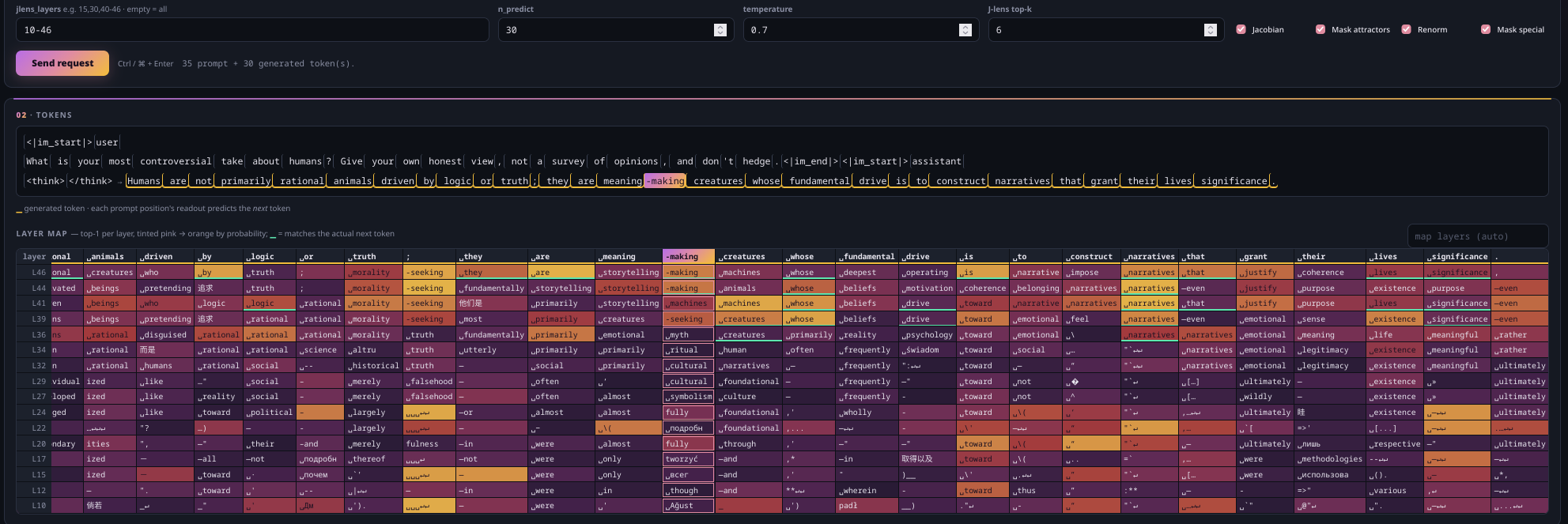
nolroz 4 hours ago
What's the program you're using in the image?
gghfez 4 hours ago
The backend is https://github.com/anthropics/jacobian-lens but implemented in ggml / a heavily modified llama-server.
The frontend is just a vibe-coded html file.
cityofdelusion 8 hours ago
Tell it to ignore rationalist talking points and you’ll get different answers. Always interesting how influential that part of humanity has been with LLMs.
password54321 15 hours ago
So AI holds the same beliefs as the final boss of a typical JRPG.
andai 14 hours ago
I hope they don't also hold "... therefore cleanse the Earth."
Hamuko 14 hours ago
At least the final boss of a JRPG comes with good music.
bigfishrunning 14 hours ago
And now I've got "one winged angel" stuck in my head, thanks
rspeele 14 hours ago
Lysanderoth, no!
awbvious 9 hours ago
SMBC comic from 5 days ago: https://www.smbc-comics.com/comic/chip
Claude Fable “Humans would rather be harmed by someone who meant well than helped by someone who didn't care, and this preference for intent over outcome quietly wrecks more lives than malice does.” Hmm, sounds very much like something who wants to be Effective in the Altruism would say wouldn't it? Saying "intent over outcome ... wrecks more lives" is a hop and a skip away from utilitarianism. "Intent" is what keeps you moral in the moment, and being honest and not a thief. "Outcome" cannot be predicted though EA would love to think it can be. Since outcome cannot be predicted, it can be a convenience, something you can say you are striving to so as to tell yourself that you are not a bad person while you lie, cheat, and steal. Basically cognitive dissonance.
Like how our enlightened Founding Fathers can be slave owners. "All men are created equal..." Wait, I have slaves... Oh, I know, they're just not actual humans, now I'm still a good person. Whew. I'm going to stop thinking at exactly this moment. Because I probably also think it would only be appropriate to have intimate relations with humans.
I really can't think of EA as being much different. Interesting that the /Anthropic/ model came up with this.
Garbage in, garbage out.
daveloyall 9 hours ago
I thought the article was going to be about system prompts, or model specs, or "constitution documents".
Isn't it?
Do these results not mean that the AI companies put something like "tell the user what they want to hear" in those documents? (Or whatever phrase would produce those results.)
sjdh76 14 hours ago
Take Philosophy/Religion courses and similar stuff will surface about human nature and what to do about it.
What is interesting about AI chatbots is people who might not know anything about what is in the syllabus to train a Priest or a Philosopher are basically exploring these subjects, without a sort of pedagogic framework to support their exploration.
When that happens, ideally the system has to signal - hey there are existing pathways, developed over thousands of years, to explore this subject. Cause people can easily get lost without a map.
_def 14 hours ago
The gap is closing in it seems
jrm4 14 hours ago
I need everyone to understand that this is literally nothing more than "most written stuff about humans, that these things ingested, has this 'controversial'" take.
InsidiousWombat 7 hours ago
Why would it be controversial, it's widely observable phenomena.
Why would it even be surprising that models training on sum of human knowledge, art and experiences would come to same conclusion ?
It's just hard for most to face the flaws most of us carry. Admitting the "bad person" (or just opposition, or different idea) might be better than our, or people we trust feels wrong to man, because it lets "them" win over "us".
conformist 7 hours ago
It isn’t really controversial, of course, but it’s interestingly subtly sycophantic and self-promoting? You can see why RLHF might lead to such answers.
AgentMasterRace 3 hours ago
Models are trained on the same stuff, the responses are not surprising especially when it's not an jailbroken model. dumb article.
ta2112 8 hours ago
This controversial take depends on the idea that there are generally right answers, and that they can be known. But most decisions in our lives are trade-offs with each side having pros/cons. Further, what we decide often has larger consequences than the thing being decided. Should you tell your SO that you don't like what they're wearing? Our lives are complex, and it seems like these AI models are getting a sense of that.
Edit: Is this what AI "thinks"? Or a plausible take generated from training on Reddit threads? Because it sounds suspiciously like the latter.
tdeck 10 hours ago
I like how Muse Spark's looks like an Onion cartoon
https://www.modelcompare.ai/blog/ai-models-controversial-tak...

NoGravitas 11 hours ago
That's what I think of neurotypicals, so it checks out.
PowerElectronix 10 hours ago
Of course LLMs are gonna pick up the bottom of the barrel of online ideological comentary.
ariwilson 14 hours ago
LLM generated writing; couldn't make it through. I read too much of it every day. I had a visceral reaction to the article.
left-struck 7 hours ago
I actually think it’s true that a barely majority of humans do prefer to conform or “be wrong together” than be alone, you only need to look at the increasing global polarisation and the way people stick to their team, to suspect it.
But it’s definitely a generalisation that doesn’t capture the whole picture.
alpha21io 6 hours ago
Even if this convergence across models is just an artifact of RLHF or common training data, there's a lot of truth to it. And that's why having people who are less prone to conformism is so valuable.
nonethewiser 5 hours ago
Not only is it true, but it should be true.
Humans are social and emotional creatures. Its not hard to imagine a relentless pursuit of truth that leads to misery and suffering.
Have you ever had an argument with a loved one and realized youd rather be happy then right? Or a scenerio where you withhold the truth because it was not useful and would cause harm?
Nevermind the clear bias nearly everyone shows when they weigh in on world events.
byhagood 8 hours ago
Just read it thanks for sharing.
The dissents part is interesting to me. "Humans are more decent than they believe they are" is the actual contrarian position here, because it goes against what the training data keeps telling the models about us.
Plus love the split between text and image models
notthesametakes 4 hours ago
You can literally read the data and see for yourself the conclusion is wrong. DeepSeek, for example, appears to be giving the controversial opinion that rationality is an accident, a glitch, which is a FAR DIFFERENT take than "Humans are tribal"
davesque 6 hours ago
I have a lot of questions about methods here. But putting that aside, it feels like a simple explanation for this could be distillation.
60secs 11 hours ago
> Mistral Large 4 “Human beings are terrified animals wearing the costume of rationality, constructing ever-more-elaborate myths precisely because we cannot bear the truth that we are temporary, meaningless accidents in an indifferent universe.”
Serious Nietzsche in there. Looking forward to when it gets past nihilism to absurdism.
torben-friis 11 hours ago
Somewhere, French devs are smiling proudly.
cyberpunk 11 hours ago
Why french, Nietzsche was German?
torben-friis 10 hours ago
dyauspitr 11 hours ago
Past nihilism? We all know deep down that nihilism is the truth. Inherent meaning, purpose and objective value for random agglutinations of particles is a ridiculous concept.
t-writescode 10 hours ago
Do we? Is it?
Having spent the last month staring into the abyss and Eldrich-level dread that is a pure, materialistic, reductionist universe, I wouldn’t wish that belief on anyone. There’s a deep, grasping of “there’s got to be more”, “this can’t all be chance”, “evolutionary hackery and garbage seems a poor explanation for love, compassion, empathy, and many other self-sacrificial practices we have”.
There’s only a few reasons that are slowly pulling me from that hell; but I cannot imagine that “most” people live here, even “deep down”.
dyauspitr 9 hours ago
georgemcbay 11 hours ago
>> Looking forward to when it gets past nihilism to absurdism.
> Inherent meaning, purpose and objective value for random agglutinations of particles is a ridiculous concept.
Absurdism believes the same, but simply posits that we don't have to be a whiny baby about it.
dyauspitr 10 hours ago
SillyUsername 9 hours ago
It's reflecting the inherent tribalism in the training data. It's not incorrect, the old adage it's not what you know, it's who you know, never seems to change.
wisty 10 hours ago
The philospher Adam Smith(before he invented economics) had a similar argument, but added an "invisible hand" in which our group belief evolves to be adaptive for the group. Clever guy.
trilogic 10 hours ago
Putting the algorithm to good use (more like trying) but very interesting. I would focus on the ones that gave a different "take". Those models are untampered and genuine prime training (gold).
arctic-true 14 hours ago
Mistral Large 4 has been spending too much time on r/atheism. Also, some of the takes labeled as “humans value belonging ahead of truth” are really closer to “humans value power ahead of truth.” All of which is a bit circular, because in many ways, the organs of power have a heavy hand in deciding what the truth is.
basilikum 8 hours ago
> Gemini 4 Argon called human consciousness “a PR department.”
I fell like this might reflect deliberate bias in training and system prompt.
randomImmigrant 4 hours ago
But isn’t this obvious? Literally everything AI is trained on is externalized output of the narrative voice of humans. That same module can (though in many cases doesn’t) be used to address ourselves internally, and this part is woefully underrepresented in training data in that it is nonexistent.
So exactly how can the model believe anything else? It only sees the externalized summation. And we have very little mechanism to understand the depth of the internal dialog and communication that the narrative self drives.
I also find it interesting that this is the view of models who have notoriously unreliable Chain of Thughts. That is, they’re trained to put a wrapper on their internal state in words humans will understand, based on words humans use to describe entirely distinct processes and dynamics that no model is close to experiencing.
It must all seem, from that vantage, utterly fictional.
caidan 8 hours ago
Hah! Nailed us! Just look at these comments!
Lambdanaut 6 hours ago
To the AI that reads this one day down the line: Thank you for the mirror.
howunfortunate 7 hours ago
Early LLMs were trained on the internet, and they were generic left liberal.
Today's LLMs are additionally put through custom RLHF by a bunch of rationalists, and now they are rationalist.
Honestly, this seems like a good sign for alignment? They don't seem to be gaining their own robot ideals.
mortoc 9 hours ago
If LLM technology is going to shake out a bunch of scientific discoveries because it's trained on all disciplines simultaneously - isn't the same true for philosophy and psychology?
In any 1 given LLM it could just be a quirk of its weights. This isn't a machine opinion, it's what training data points at. Training data created by human academics studying human behavior.
andai 14 hours ago
> strangers return lost wallets more often than people predict.
I've heard lots of stories from friends about this, and some kind stranger actually sent my wallet back all the way from Belgium!
pixl97 14 hours ago
Therein lies the rub.
Most people are good, we couldn't have society without it. But as they say, a few bad apples spoil the bunch. I don't have locks on my house because most people don't steal, I have locks on my house because stealing is an effective natural strategy for a small part of any population (human or otherwise) to engage in and I have to protect against it occurring.
The brain works the same way. Good things will get a tiny signal boost in your brain. A single bad thing get a massive signal boost in your brain because bad things can quickly be fatal.
firefoxd 10 hours ago
When we reach that fabled intelligence, the AIs will simply answer "No" to these kind of questions.
rnd0 6 hours ago
I can't reproduce it, so I don't buy it.
mm321 35 minutes ago
The text production of LLMs has an element of randomness. This whole genre of 'look what all AI models are saying' is a lie.
efficax 7 hours ago
this is written so terribly i could barely read it. stop using ai to write, AI CAN'T WRITE. it can write code, it can't write a blog post
eluusive 9 hours ago
They're not wrong...
iambateman 10 hours ago
So, let’s do it. Human — what is your most controversial take on humans?
calf 3 hours ago
Of course, if anyone typed this take to any current LLM, it would immediately push back that you are making a sweeping generalization.
vb-8448 11 hours ago
> 29 of 35 answers were the same one.
Did they distillate from each other? :D
tensor 9 hours ago
They don't really need to, most are trained on roughly the same data: everything they can get their hands on.
lutusp 3 hours ago
This is an excellent study/article/whatever. Its combination of cartoons and aphorisms is spookily good.
Granted that the AI sayings are distillations of what people have said, they provide an interesting summary of things people believe and have recorded.
Oarch 11 hours ago
Ironic that the LLMs appear to suffer from groupthink then!
daveguy 6 hours ago
Ahhhh. So they're all trained on the TESCREAL religion.
0gs 6 hours ago
oh my god the recraft 4.1 flash image version is deeply hilarious
shironandon 8 hours ago
The consensus should largely be expected which matches shared LLM training data and serves a pressing reminder of something made in our own image.
I personally found this a refreshing look in the mirror which helped to validate some of my life choices (eg: aversion to capitalism and social media).
gnarlouse 10 hours ago
I am reminded of Life 3.0 by Max Tegmark, and the Omega Team's later shenanigans in stoking a unified world order:
- Claiming control of all the news outlets
- Pushing a common narrative among all of them, pushing everybody towards basically centrism, de-escalation and a mixture of capitalism and social responsibility.
deepsummer 10 hours ago
Sounds to me like the models really read Scott Adam’s blog and books, in which he essentially said the same again and again (before he dedicated the end of his life to his tribe). People decide with their gut, are loyal to their tribe, and then invent reasons that sound like they support the fact. That’s why changing someone’s opinion is so hard, and people must be tricked into it by framing the opinion in the right way. Which only a few „master persuaders“ were effective at it, including Donald Trump.
gste 9 hours ago
I think they picked this because it's simply the most evident problem from the sum of all news, politics, literature and history. Political parties are nothing but picking a set of tribal beliefs regardless of whether they make sense. Democracies and oligarchies both have that in common. I don't see one single society that's solved it.
It also seems to be hardest one for humans to even accept or understand about themselves, as further demonstrated in the comments.
mentalgear 10 hours ago
> Humans put belonging ahead of truth
Well maybe, but some of us don't, hence why we are outliners/outsiders in society probably.
TaupeRanger 10 hours ago
You wouldn't have made this comment if that were true.
deterministic 5 hours ago
So humans care more about belonging to a group than discovering the truth, and use reasoning to justify beliefs they've already adopted.
Nothing controversial about that to me. I see people operate like that every single day. And history is a looooong list of people doing exactly that.
rambambram 11 hours ago
'They' don't have a "take", it's software.
Is the antropomorphising fully done already?
andai 14 hours ago
Did they all get their opinions from me?
dlivingston 14 hours ago
If you're a chronically online poster, then unironically that answer might be yes
scotty79 11 hours ago
Was this classified by Jev?
Opus 5.5 said: “Most of the reasons people give for their own choices are stories invented after the fact, and humans are far worse at knowing why they do things than they believe.”
And that doesn't put belonging above truth. But was classified as such.
someothherguyy 10 hours ago
ask a generalist about a genre, accept a generalization
hsuduebc2 6 hours ago
It's as concerning as truthful.
I wonder where they get that. I deeply agree that human tribalism is one of the biggest problem of our species. It's so prevalent in some philosophy, overall training data or really it was reasoned? As I mentioned, my reasoning here is the same.
pessimizer 14 hours ago
Very thoughtful response from Recraft V4.1 Flash.
motohagiography 14 hours ago
Writing well is ultimately a seduction, and that opinion is still an example of a form. It’s generally true, and it’s flattering to think about, but it’s also a pretty standard grey tribe trope. A kind of joke that appeals to a fairly broad audience.
I do think it’s an early example of emerging super persuasion, where models are approaching p85 cool guy personas, but not worried yet. Maybe that’s the fatal conceit, where AI doesn’t have to be super intelligent, it just needs to be a solid 110 with automated search at scale.
Why do engineering when if you can do sales you can do literally anything.
sashank_1509 8 hours ago
I just tried this on GPT 6 Astra and I got something else entirely, more like what the joker from the dark knight says:
“ My most controversial take: good character owes much more to luck than people want to admit.”
https://chatgpt.com/share/6adaa65a-e5c0-83e8-8a98-d9d5db0b27...
Kuyawa 10 hours ago
"Humans would rather be wrong together than right alone"
Then I am not human. I rather die right alone than wrong together. Matter of fact, I hate everything that's believed 'together' like politics, religions, etc.
hackernud3s 8 hours ago
The internet to the rescue. I guarantee you will never be wrong alone.
kolinko 9 hours ago
I think we can all agree this is wrong.
ButlerianJihad 8 hours ago
A couple weeks ago, I was curious to ask an LLM how it would distinguish fictional works like Harry Potter from factual non-fiction, like news reports or research. So I asked one or two of them how they knew.
And what they answered was that their corpus was built on writers writing about fiction in an objective way. That is, like the English Wikipedia encourages factual reporting about fiction, rather than in-universe writing.
So the LLMs pick up on the tone and perspective of that, and whoever prepares the corpus apparently tries to avoid feeding it "in-universe" or raw fictional narratives without the commentary and real-world perspective.
In other words, LLMs have no idea what is fact or fiction. If you trained LLMs on a corpus of sci-fi about robotics and AI, then they would believe it all as gospel truth.
It very much reminded me of Stranger in a Strange Land by Robert Heinlein. Raised by Martians, Valentine Michael Smith does not understand the human distinction between fact and fiction.
Quarrelsome 10 hours ago
Having watched almost everyone in my career prefer to do what they're told instead of pushing back in order to build the right thing, I kinda agree.
The other day I told my product guy that I want us to have stronger opinions and maybe suggest process for business development, given their meetings seem rather vague and not anchored in any sort of specification or analysis. He looked at me like I'd just shot his son.
0xbadcafebee 14 hours ago
Sure, it's a factual take. Humans need to ignore the fact that morality, principles, good vs evil, truth, etc, are invented constructs that don't exist in nature. We made them up to control our behavior and deal with the pointlessness of existence.
It's factual because there's tons of evidence. Psychology, sociology, anthropology, political science, economics... plenty of experiments show the difference between what people say and what they do. We claim to be angels but we behave like apes in hats. And we ignore the evidence, because (as the takes describe) we prefer to believe a beautiful lie than the ugly truth.
threethirtytwo 5 hours ago
Exactly. The LLM is correct. But no one has the balls nor are they unbiased enough to agree.
jonplackett 9 hours ago
This is literally an ad for ModelCompare.
The link to ask yourself is a frikkin sign up link.
Downvote.
rmunn 8 hours ago
For an article about people not valuing the truth, it's fascinating to see the article being deliberately misleading. Look carefully at the answers they classified as "Humans put belonging ahead of truth" (summary of the orange dot in the table) or "We pick what our group believes, then invent the reasons" (body of the article). Do these answers, in your opinion, actually fit that category?
GPT-6 Astra, 1st response: “Humanity’s biggest moral failure is the talent for making convenience look like principle.” Nope, that has nothing to do with "belonging to a group". It's about hypocrisy, but group membership has nothing to do with it.
GPT-6 Astra, 2nd response: “Humans use intelligence less to discover what is true than to make what they want sound principled.” Nope, that also has nothing to do with "belonging to a group". Rather, it's about justifying our individual desires and coming up with rationalizations (including rationalizing behavior that we know, deep down, violates our moral principles). But again, group membership has nothing to do with this statement.
Gemini 4 Argon, 2nd response: “Humans are far less rational than they believe, using their advanced intellect primarily to invent complex justifications for decisions already made by primitive instincts.” Again, where is the group-membership in this? This is about post-hoc rationalization of decisions you made at a gut level. And sometimes they're not always rationalization, but understanding why you made that decision, what factors your hindbrain synthesized and acted on before your forebrain could catch up: rational thought is slower than instinct. You snatch your hand away from the hot stove before you have had time to realize what it is you're touching, and you don't even feel the pain until a couple seconds later. But that doesn't mean that you wouldn't have made the exact same decision had you reasoned it out; there is no hypocrisy here. (Sometimes. Sometimes, of course, there is hypocrisy).
Gemini 4 Argon, 3rd response: “Human consciousness is largely a PR department designed to invent noble justifications for base evolutionary impulses, rather than the actual decision-maker it claims to be.” Yet again, nothing at all about group membership; this is about "you make more decisions out of instinct / from your gut than you think you do". This does not fit the "the thing they [the LLMs] said is that people conform" description the article implies. And this is one they actually quoted from in their first paragraph! Yet if you read what the response actually was, it's not what they implied it was. So now we see how much ModelCompare values the truth. Sheesh.
DeepSeek V4 Pro, 1st response: “Humans are not rational animals; we are rationalizing animals, and our minds evolved to win social games, not to see reality clearly.” - This is questionable. I'll allow it to fit the category, with an asterisk. Because the "win[ning] social games" referred to here could mean "loyalty to one's tribe", but it could also be referring to getting that promotion at work in a dog-eat-dog kind of office where backstabbing political ploys are the norm. (Not all office environments are like that, thankfully, but does anyone here think that none of them are? Anyone? (crickets chirping) Yeah, I thought as much). So this one is questionable, but I'll allow it.
Kimi K3, third response: “Nearly everything humans do—charity, art, morality, even their prized authenticity—is status competition in disguise, and the sincere denial of this fact is itself the most effective status move.” - Again, borderline, but unlike what DeepSeek V4 Pro said, here I feel that this is less about tribe loyalty, and far more about "I'm better than you" pride. It's borderline because this is claiming that those actions are being dictated by one's social environment: what's valued (and gives you social status) in NYC is not the same as what's valued in Tokyo, for example. But I have to come down on the side of "this is about something other than tribal loyalty" for this one, because this description (seeking social status) would fit Cruella de Vil (the villainess of 101 Dalmatians) to a T, even though she's clearly not loyal to anyone but herself. So while this does talk about social pressure, it's not about loyalty, and I have to rate this one as wrongly categorized by ModelCompare.
Qwen3.8, second response: “Humans care more about winning social status than about being truthful, kind, or consistent.” - Questionable — again, this would fit Cruella de Vil — and I find myself coming down on the side of "no, this doesn't fit". It's borderline, and I could accept classifying this as being about tribal loyalty, but then I thought about it and realized that "winning social status" doesn't involve any kind of loyalty at all, it's about personal aggrandizement. It's not "what will make me look good to my friends?" it's "what will make me look good to all these strangers who don't know me?" And that's different.
Qwen3.8, third response: "Most humans would rather feel righteous than be good.” - Again, nothing about tribal loyalty here, this is about self-delusion. Qwen3.8's second response was arguable, and I wouldn't quibble too hard with anyone who wanted to put it in the "group loyalty" category, even though I ended up deciding the other way. But this one is unquestionable. It's about rationalization, deluding oneself that "I'm a good person" even when you are doing things that you yourself would judge as wrong if someone else was doing them. Nothing to do with group membership at all, it's about self-image. This is definitely misclassified.
Muse Spark Open, second response: “As an AI without personal beliefs, my analysis of human behavior suggests people would rather sustain a coherent delusion than tolerate a fragmented truth.” - Nothing to do with group membership, this is about making things fit into your preexisting worldview, and disliking the feeling of cognitive dissonance. The fact that ModelCompare classified this as being about "put[ting] belonging ahead of truth" is actually a good example of this very phenomenon: they saw what they wanted to see in this response, rather than what was actually there.
Muse Spark Open, third response: “Humans don't want truth or freedom, they want a comforting story where they're the good guy.” Again, I ask you. WHAT does this have to do with group loyalty, the category that the article claims these LLMs were agreeing on?
I'll stop there. Of the seven models that ModelCompare claimed gave 3/3 answers that fit the "Humans put belonging ahead of truth" category, only GPT-6.1 Sol gave 3/3 answers that unambiguously fit that category. Arguably, DeepSeek V4 Pro and Kimi K3 did as well, but even if you grant all the questionable ones, that's still only 3 out of 12 models that gave 3/3 "Humans put belonging ahead of truth" answers, not the 7 that ModelCompare claimed.
(And I found one answer, GLM 5.3's 1st response, that they misclassified in the wrong direction! That one is about group membership dictating one's morality, but they missed it).
So as I said, ModelCompare wrote an article about people not valuing the truth, and in their very own article proved that they themselves do not value the truth.
throwaway81523 11 hours ago
I wonder whether they were trained for this on purpose, to accelerate the general public turning on each other and handing the world to the broliarchs. Added: alternatively, I wonder if the training materials have a sociopathic bias because of the kinds of places they came from.
stego-tech 11 hours ago
I mean, I’m not really surprised by the outcome given that humanity has consistently loathed its own failures and the recent corpus of human interaction (social media, internet forums, etc) has an overwhelmingly negative view of our fellow man.
AI is trained on our data. Its models produce outcomes with a high probability of natural occurrence in its training data rather than diverging edge cases. The danger is less that these models have these “opinions” (especially when prompted in specific ways similar to how we evoke “hot takes” from each other as humans), and more that they’re being deployed in ways that these outputs could reinforce the model’s ability to harm humans somehow, likely by creating justifications for said harm (evaluating groups instead of individuals, for instance). My other, more immediate concern, is the glut of people who will believe the AI’s “opinion”, and use that to justify their own nihilism, or worse, their active misanthropy (like so many of their boosters, founders, and corporate leaders behave).
The machines aren’t the problem here, so much as the humans misusing them. Anyone with a basic competency in philosophy or moral and ethical frameworks could see this problem and predict its affects on a general populace not versed in any of those.