What we know so far about Spain train crash (bbc.com)
193 points by ZeljkoS a day ago
1718627440 8 hours ago
The following is hypothetical, since we do not have a proper safety report yet.
It sounds like the issue happened, because there was an error in the line-based train control system (LZB), which led to falling back to the point-based train control system (ASFA). However since there are more virtual blocks in LZB, than physical blocks in ASFA, this means that suddenly more than one train is in one block, which violates the most basic assumption of train control. That requires the trains to not rely on the train control at all, even if it says that the block is clear, but instead are operated manually.
I do not know what the proper procedures for that are in Spain, but in e.g. Germany that seems to require driving by sight. However that is also only after a number of accidents due this situation. So the following seem to be similar accidents from Germany:
- https://de.wikipedia.org/wiki/Eisenbahnunfall_von_Meerbusch-...
- On April 9, 2002, a near-collision occurred near Fallersleben. After a computer at the LZB control center in Fallersleben crashed, two trains on each of the two main tracks came to a stop. When the computer was restarted, the rear train in each pair was signaled a speed of 160 km/h, while the front train in each pair was signaled 0 km/h. One of the two train operators following saw the train stopped in front of him; the other, as a precaution, contacted the operations center, which warned him not to proceed.
1718627440 5 hours ago
From reading only the linked BBC article, I would come to a totally different conclusion. That would sound like more of a dispatcher ordering a manual operation of a train, without having assessed the situation correctly. While yes, this happens (https://en.wikipedia.org/wiki/Bad_Aibling_rail_accident), this happens on minor single-track lines where the dispatcher starts playing games on his smartphone full-time due to being bored, not on a major high-speed line. Also the issue with LZB doesn't fit into the picture that the BBC paints, neither do the many people involved, so I will prefer the theory mentioned above. Also that seems like a "reasonable" "sufficiently not-obvious" error to make, given the line and attention.
1718627440 7 hours ago
So to explain the used terms more: Most train control systems operate under the assumption of a fixed block. The whole network is separated into blocks, there can always be only one train in a block. Each block is protected by a signal, there must always be a red signal separating one train from the next, and there are sensors that detect when a train drives in a block, when it drives out of a block and how many carriages (train integrity is important too).
For point based train control systems, operation of a train is only enforced at every signal (and on the way in approach at specific points), this means e.g. that a train does not run over a red signal, does not drive faster than the maximum speed, and has acknowledged speed limits.
For line based train control systems, that supervising happens continuously over the whole track.
Since the physical signals and sensors are expensive in installation and maintenance and railway capacity depends on the number of blocks on a track, line based train control systems support virtual blocks. This means that the signals and sensors are not physically there, but simulated by computers (on the train and signalbox). From the view of the point based train control that means multiple trains are in a single block, because it does not know about the virtual subblocks. When a train is running that only supports point based train control it can only use whole blocks, so the capacity is simply reduced, but it is still safe, because every physical block is also known in the line based control system.
When the line based train control system stops being in use, the fundamental constraint of the point based train control system is being violated: there are multiple trains that are in a single block, and hence not actually protected by a red signal in between. This means that you must ignore the signals until every train has crossed at least one physical signal.
(This is speculation:) It seems that that the operators assumed that there is still a safety system in place, that they can rely on. Hence they did no tell the trains to use manual operation, (which might also require driving by sight [max. 40km/h], but not necessarily, I don't know the proper procedure in Spain), but told them to fall back to the normal safety system. It's reported that some train drivers and dispatchers questioned that, but that can also be an translation error and instead them repeating what was said, as is proper safety procedure. But the point based train control system will show a green signal, even if there is actually a train in front, because it is in the same block as you, but the signal shows whether you are allowed to drive in the next block, not into the current, as you are already in the current block. This seemed to be what happened here, the second train saw the green signal thought they are back in the automatic safety system and accelerated to 200km/h, not knowing that there is still a train in front. The first train should have also started driving, but did not, due to an error in the train. In normal situations this should never cause an accident, but in this case the accident would not have occurred if that wouldn't have taken place, but that would have been simply by luck.
You can see the green signal in some of the pictures, which to me looks really weird (kinda like a both dead and alive corps), because I would expect to put all signals to red in the case of an accident. I would expect to do that, while you are calling the emergency number, but I do not know if that is the procedure in Spain. You also see in the pictures that the whole cluster traveled about a train length and that the last carriages of the first and the first of the second train are merged into one. This indicates a surprisingly high speed for the crash, above 100km/h. That fits the explanation of the second train not being able to see the first until directly up to a few 100 meters before.
There were actually more trains in that block, so it's pure luck, that there were "only" two trains involved in this accident. Also some claimed, that there was a curve directly before, so the second train couldn't see the first until directly up to the accident. This would not have prevented the accident, it would have just reduced the involved crash speed and hence reduced the number of dead people.
It's quite ironic, that the accident would have likely not happened in case of no safety system being present.
---
Actual classical collisions of two trains like in this case are quite rare, because that's like the first purpose of every train control system, which exist since the 1870s. The accident from January this year in Spain was also a collision, but because a train derailed, while another train passed it. This can't really be prevented by a current train control system, other then not allowing the derailment to happen in the first place. Derailment in carriages is actually not rare at all, but daily, it's like going slightly on the shoulders of the street with your car, but train derailments are.
The accident from Meerbusch-Osterath from 2017 is similar in that is was also a collision. The cause itself is not really similar. The normal train control also failed, so the trains need to be operated manually. For that it was still relied on the automatic train detection and labeling system, but that had a bug (and some operator error due to a bug, this is simplified) and showed the number of the second train, where the block of the first train was. So they allowed the second train to advance. They did have contact with the first train, because they noticed something was wrong, but that driver didn't properly speak German and also failed to look out of the window directly where a hectometer sign was, so he couldn't tell the dispatchers were he actually was. The dispatcher forgot to tell the driver of the second train to use drive by sight (40km/h), so he accelerated to full speed (120km/h). The accident only caused 40 injured people and no deaths, because the second driver saw the first train. The accident happened at night, in the dark and at a speed of 85km/h. Train dispatchers are supposed to keep track of the trains and the actions they do too, but since the automatic train detection and labeling works most of the time, it becomes easy to rely on it.
The accident from Fallersleben from 2002 is similar, because the original failure of LZB and fallback to PZB is the same. Hence there was also more than one train in one block. The signalbox software told the second train to advance to full speed and the first to stop. This would have caused a crash, but the train driver of the second train noticed, that couldn't be and notified the dispatcher who then told them to not proceed, hence the accident didn't happen. This caused it to become mandatory to let the first train to drive again operate on sight [40 km/h].
potamic 2 hours ago
> the signal shows whether you are allowed to drive in the next block, not into the current, as you are already in the current block. This seemed to be what happened here, the second train saw the green signal thought they are back in the automatic safety system and accelerated to 200km/h, not knowing that there is still a train in front.
Don't think the second train saw a green signal. They were in the middle of the block, while the first train was waiting just before the exit of the block (with a green signal ahead).
What I'm gathering from other sources is that the Spanish system allows the controller to override the point-based rules and provide manual clearance (because the blocks are long and it takes forever to reach the next signal by sight). It's a failure of the system imo. Ideally, the system, under no conditions whatsoever, should have even allowed such a practice to be allowed.
N19PEDL2 2 hours ago
> The accident from January this year in Spain was also a collision, but because a train derailed, while another train passed it. This can't really be prevented by a current train control system, other then not allowing the derailment to happen in the first place.
Or by putting all the signals to red after the derailment of the first train so as to stop all the circulation on the line, which seems not to be the common practice in Spain unfortunately.
otherme123 2 hours ago
skew-aberration 2 hours ago
Surely a better fallback is possible. Like if a train is known to be in a PZB with other trains ahead of it, then when LZB goes down it has to slow down/wait/follow some different protocol until PZB rules can be enforced again.
swiftcoder a day ago
The level of human negligence here is astounding. The system did exactly what it was supposed to (lock the train down if the track can't be confirmed clear), and then a human controller ordered the crew to override the system, and ordered them to proceed at an unsafe speed towards a similarly disabled train?
dimal 14 hours ago
Usually when you look deeper at failures like this, it’s because there’s a morass of bad incentives from the surrounding human system that enforces this kind of behavior.
Here is a plausible alternative explanation:
They’ve probably seen false warnings over and over and overridden them enough times that they lost sense of the risk. They need to keep trains on schedule, using a buggy system, with a manager looking over their shoulder. They override the warnings over and over, nothing goes wrong, and they forget that it may actually be right. Look at the Challenger explosion, Chernobyl, or any other failure like this, and there’s usually a bureaucratic process that has run amok, and the individual is just following perverse incentives that have been socially normalized over time.
So I’ll wait until I have more information before I proclaim this as human negligence and the system doing exactly what it’s supposed to do. We don’t know how often it was doing the wrong thing and confusing the fuck out of the human.
lukan 4 hours ago
"They need to keep trains on schedule, using a buggy system, with a manager looking over their shoulder."
Also lots of potentially angry passengers who want to get to their destination in time. Will miss important appointments, or even the last train connection for the day and be stranded if the train drivers decide to wait a little bit longer to be on the save side.
m4rtink 20 minutes ago
peri-cl 14 hours ago
> "the individual is just following perverse incentives that have been socially normalized over time"
Normalization of deviance,
https://hn.algolia.com/?query=normalization%20deviance&type=...
jeffrallen 2 hours ago
whycome 12 hours ago
I recently saw a doc on the 2013 Spanish crash and it was full of absurd system problems. The govt pinned it on the driver as best they could but it's clear that it was entirely preventable.
gregglain 8 hours ago
w4der an hour ago
Trains in spain have been running at reduced speed, delayed or even cancelled for a while due to aging infrastructure, which might've actually caused another deadly accident back in winter, so this behavior does not surprise me.
swiftcoder 13 hours ago
> human negligence and the system doing exactly what it’s supposed to do
Negligence is not limited to the single human who issued the order. it's pretty unlikely that their order could have caused this without a significant amount of other negligence that eroded the safeguards. Nevertheless, the negligence is human, not machine in nature.
N19PEDL2 2 hours ago
It’s still gross negligence to place punctuality over safety, regardless of the reasons behind this behaviour.
esterna an hour ago
b3lvedere 2 hours ago
Rapzid 2 hours ago
> Show me the incentive and I’ll show you the outcome
> -Charlie Munger
toss1 11 hours ago
Normalization of deviance [0], wherein a clearly unsafe practice becomes considered normal if it does not immediately cause a catastrophe: "a long incubation period [before a final disaster] with early warning signs that were either misinterpreted, ignored or missed completely
crote a day ago
Whose negligence, though? "The system" isn't just the LZB equipment - the train dispatcher is just another cog inside the same system, and should be expected to occasionally fail just like every mechanical part.
This isn't a game of Hot Potato where the last person touching it goes to jail for gross negligence. You have to look at it through a Swiss Cheese model: every individual safety layer can and will have holes, but a disaster can only occur when all of those holes align.
Why did the LZB system fail? Why did the train dispatcher use the wrong backup procedure? Why did a backup procedure with zero safety checks even exist? Why did the train operator accept this backup procedure? Why did the train allow high-speed driving under those unsafe conditions?
It does indeed seem like the train dispatcher made a big mistake, but that was far from the only thing that went wrong, and it would be myopic to use him as the scapegoat for a far larger systemic issue.
internet_points an hour ago
Sounds like you have internalized https://how.complexsystems.fail/ :-)
Zigurd 13 hours ago
Overriding safety systems is itself a safety capability. But this wasn't a failure of the safety systems. It wasn't even a failure of the train drivers who had been over using safety system overrides. It was a management failure for not noticing that over use of overrides.
w4der an hour ago
sznio 14 hours ago
why does the dispatcher even hold the right to override the automatic system by themselves? this should involve multiple people, at least a signoff by a superior.
bobthepanda 12 hours ago
avereveard 21 hours ago
Dispatcher, conductor at that time could not have know that dispatcher ordered manual bypass ignorig the rest of the guardrails of a traffic resume procedure
barbazoo 15 hours ago
gregoriol 15 hours ago
larodi 14 hours ago
Indeed the system is all of it - all gear on another level of abstraction where it as a whole is just enabling processes, not the thing running it.
kazinator 15 hours ago
If you ignore a road sign and run someone over in your car today, nobody will make systemic excuses for you.
Someone was driving the train who couldn't estimate the stopping distance relative to speed.
If a car is stalled in the middle of the road, and you hit it, that's on you. 200% if a reflective warning triangle was up 100 meters back.
bobthepanda 15 hours ago
stetrain 15 hours ago
8n4vidtmkvmk 2 hours ago
pixl97 14 hours ago
ahelwer 14 hours ago
SkiFire13 13 hours ago
wat10000 14 hours ago
wjnc a day ago
I would argue that we should look at systems-level explanations. The human factor is so glaring we can get caught up in it. There are what, 50?, high speed trains in movement in Spain at the same time. Even GPS + Starlink + 1 monitor (is that 50k€?) could have prevented this. But it happened, and the question is what is going on with train security in Spain in general for people to (be able to) make such decisions.
jonny_eh 15 hours ago
After learning about a sufficient number of such "accidents" I'm now convinced the cause is never "operator error", it's always a system error. It's the humans that design (or oversee their design and implementation of) those systems that are at fault.
Maken 21 hours ago
The current control system dates from the early 90s. They started rolling a modern system with more redundancies and automatic blocking in 2022 but it's still not fully deployed.
1718627440 21 hours ago
siva7 12 hours ago
1718627440 a day ago
Trains are still not able to assess properly where they are, even using satellites and inside train sensors. Of course there is research on that, but it's still an unsolved problem. (Current alternative is to put markers in the track, but that's also expensive at scale.)
swiftcoder 21 hours ago
Pragmata a day ago
djankauskas 13 hours ago
lxgr 10 hours ago
wjnc 20 hours ago
IAmBroom 14 hours ago
cryptoegorophy 11 hours ago
oh man, the override thing is super dangerous. I use FSD in Tesla a lot and there is a lot of times I "override" with the gas pedal because I think it phantom breaks or being slow and there were at least 2 cases where there was legitimate reason to stop (person crossing in my blind spot).
thatfrenchguy 13 hours ago
They have a failsafe to use (visual) block backup signaling on that line and used it incorrectly. 200km/h is right at the border where you don’t need in cabin signaling.
tencentshill 15 hours ago
Too bad they don't run it with AI. Then it would be nobodies fault!
1718627440 a day ago
Sorry, but ordering trains to drive manually after the system locks itself down, is the proper procedure. Of course you are still supposed to only send trains to free sections, but the error is in that step, not that they ordered a train to drive on it's own.
Also the fallback procedure is also aided by automatic systems and a sizable number of accidents in the past were caused by that information being faulty.
julik a day ago
It is the proper procedure, and it does come (in a lot of countries, AFAIK) with a lot of guardrails:
There will be a so-called "train order" allowing passage of a specific section ignoring the safety system warnings, which has strict validity limits both in time and in the area where it applies, usually denoted by specific hectometric mileposts
When cab signaling is involved (LZB is one of these) and it malfunctions, the entire system normally changes to "driving on sight only" - which indeed limits the train to 40, 30, 20, sometimes - 15 km/h (see https://fr.wikipedia.org/wiki/Marche_%C3%A0_vue) or the line gets switched to lineside signaling - if it is available.
I don't know how you could violate all of those rules - both from the driver's side and from the traffic control side - but it sounds absolutely horrible. Like an override of at least 2 (if not 3) very explicit safety margins.
1718627440 7 hours ago
dist-epoch 21 hours ago
AdrianCX a day ago
Why is that?
I remember a long time ago I was stuck in a train in a field a considerable time because of a similar failure and conductor just wouldn't move unless green
I was expecting the same here, conductor is the first to die so just refuse until the idiots fix their system
1718627440 a day ago
robhlt 20 hours ago
_trampeltier a day ago
Yes, but just with max. 40km/h
wafflemaker a day ago
1718627440 a day ago
inglor_cz 13 hours ago
This really reminds you of the Chernobyl station computer printing all the warnings and recommendations to shut the reactor down when they started playing around with it ... and Comrade Dyatlov overriding it.
Dyatlovs seem to be born everywhere.
juliushuijnk 14 hours ago
It should not be possible for one person to make a mistake of this magnitude. In case of a disconnected/off main safety system, the train should be limited on a hardware level to not be able to go over 40km/h.
Zigurd 13 hours ago
If I read the description correctly, those hardware level systems were manually overridden, which should only be done in extremis. My guess is that this is going to turn into a normalization of deviance case, since such a cavalier attitude toward safety was unlikely to be one person's first time doing something so dangerous. There was no dilemma here and no time pressure.
Your suggestion about limiting speed after a shut down is a good one. On top of that, the rail operators should have spotted a trend of repeated safety system overrides and investigated why that was happening.
1718627440 7 hours ago
From what I read the opposite was the case. They kept relying on a fallback system, when manual operation was required: https://news.ycombinator.com/item?id=50298796
aquafox 14 hours ago
Exactly this was my first thought! I always thought highspeed trains operate under a model of clear sectors where one train is just allowed to enter when it was cleared by the previous train. From my layman point of view, those incidents point to a fundamental design flaw.
askvictor 7 hours ago
> It should not be possible for one person to make a mistake of this magnitude
Exactly. Which means a whole bunch of other people allowed for this situation to occur. So it isn't one person responsible for this mistake.
notenchange a day ago
Reading the text it seems to me this is due to a very widespread issue in Spain and other southern European countries: people don’t care about the warnings because there are too many false positives.
That’s why people here, when they hear the fire alarm they just wait for it to go off: the probability that it is actually a fire is minuscule… but the alarm triggers a lot.
Not sure how to actually solve this… but I’m also not making excuses for what happened. High speed trains is not the same as a fire alarm in some office building, the people in charge should be held responsible somehow.
PaulDavisThe1st 16 hours ago
I'm a volunteer firefighter in rural NM. We have a commercial property close to us that repeatedly has false alarms on its fire alarm/smoke detection system, to the point where even the best of us are suffering from "the boy who cried wolf" feelings.
Because of this, I discovered that (apparently) NY Fire Department charges $5000 per false call on an alarm system directly connected to the dispatch system.
Somethng to think about.
jcrawfordor 13 hours ago
ABQ Fire charges $300/call for false alarms after the first three. It steps up to $500 after number ten. There is, of course, also the $25 annual permit fee for a reporting alarm system. Failure to comply with these fees is a misdemeanor. Just in case some local precedent will help advocate :)
Honestly it's remarkable to me to think that anyone ever gets to that $500 "excessive" tier, I've had one false alarm where the fire department attended in years of having an alarm system and I was mortified. felt like the biggest idiot in the world.
brudgers 12 hours ago
jonah 15 hours ago
Pretty common in lots of places - you get charged after n false-alarms and are required to fix your broken sensors or whatever is causing the issue.
Maxion 15 hours ago
askvictor 7 hours ago
A tradie doing some welding in the kitchen I was working in some years back told me this as he disabled the smoke alarm (to prevent a false alert while he was welding): "if you set off a false alert on the fire alarm, quickly set fire to the wastepaper bin - it saves you from paying the false alert fee"
childofhedgehog 11 hours ago
I learned this from my last landlord after I kept causing issues for the whole building by cooking bacon. The detector was installed ABOVE THE STOVE. It was cheaper for him to move the detector than to pay for the repeat call outs over a mildly smoky apartment due to my need for crispy almost burnt bacon…
JumpCrisscross 11 hours ago
vikramkr 4 hours ago
Pretty sure that'll just drive people to turn it off. Or if they can't, try and set a small fire or something to get out of paying the fine
infecto 15 hours ago
These are elegant solutions imo.
futureproofd 15 hours ago
For example, my condo in Toronto charges $800 per false call.
munk-a 14 hours ago
Kinrany 15 hours ago
It should probably be X$ per alarm regardless of it being false or not, minus first N per year.
rtkwe 15 hours ago
uniq7 15 hours ago
comeonbro 14 hours ago
https://en.wikipedia.org/wiki/Alarm_fatigue
> Healthcare: The constant sounds of alarms and noises from blood pressure machines, ventilators and heart monitors
> Amber Alerts: sent to cell phones as far away as [...] 15 hour drive
> "known to the state of California to cause cancer"
etc
https://www.youtube.com/user/USCSB
See also a million USCSB industrial disaster postmortems
prmph 11 hours ago
I've had the thought that: "known to the state of California to cause cancer"
Should probably be: "known to the state of California to be a class N carcinogen"
eastbound 13 hours ago
I've deactivated my (EU equivalent of) Amber alerts the second they sent ONE irrelevant notification. It took me a few tries but fortunately they also tried their system a few times A WEEK during installation.
I prefer to risk my life every day at not knowing what the government thinks is really important for me to know.
1718627440 a day ago
It just means that a false positive rate is as dangerous as a false negative rate. Just issuing a warning doesn't come for free when you are designing a security system.
karmakurtisaani a day ago
This is very well illustrated in the fable Boy who cried false positive.
mercer 19 hours ago
jryle70 11 hours ago
coopykins a day ago
Something similar is happening in my region after the flood that happened two years ago: The alarm was raised late; Now, even mild rain is triggering an alert.
Guess whats the consequence of that? Less and less people pay attention to the alerts.
ricardobayes a day ago
What you mention makes me frustrated, as it also signals the infrastructure is so underdeveloped even moderate rain grinds daily life to a halt: kids don't go to school if rain is forecast. We need to elevate our professionalism in Spain and not accept African-level infrastructure in the 21st century. It's really sad within one continent we have countries producing AI and photon computing, and others can't even figure out how to put gutters and rain drains.
cbovis 13 hours ago
piinbinary 15 hours ago
jonny_eh 15 hours ago
To your point, a contributing factor here was the front train couldn't start due to either a minor or bogus "security" alarm. Whatever alarm that was, it wasn't worth triggering such a tragic accident.
jameshart 14 hours ago
To be fair the Spanish word for security is the same as the Spanish word for safety: seguridad. It could as easily be a ‘safety’ alarm and a mistranslation.
1718627440 9 hours ago
jonny_eh 12 hours ago
throwitaway222 13 hours ago
The fix is to do things right every time, and if we're losing money to false alarms, spend more money to make sure the false alarms stop happening. Make it a new persons problem rather than just making someone "used to it" and start ignoring it.
sznio 14 hours ago
> Not sure how to actually solve this…
fix the alarms? I only had one false fire alarm in my life. and thankfully zero real ones. it's possible.
do fire drills? if alarms get ignored, and you can't reduce the false-positive rate, then introduce fake alarms and monitor the response?
whycome 14 hours ago
Then what? In this case, Suspend the train engineer? The company itself is incentivized to ignore the warnings to keep things on track.
(...on track)
eastbound 13 hours ago
pelagicAustral a day ago
> That’s why people here, when they hear the fire alarm they just wait for it to go off
This literally happened to me last night, I was having dinner at my apartment, and suddenly I start hearing a smoke alarm, but not quite inside the apartment, I just kept having dinner thinking "bah, someone probably burned a toast".
Then it wont stop, I walk to door and hear people talking, still don't bother enough, wait a few minutes, then go out and my neighbor said "there are three fire trucks down there, I think it's a real one" hahhaha
The hallway was kind of hazy and smelled like burnt food, for sure... so I just grabbed my laptop and went out hahaa.
D-Coder 12 hours ago
My apartment has both a local fire detector and a building fire alarm.
The building fire alarm is soooo loud and obnoxious, you _want_ to leave the building at speed. (Which I think is the right way to do it.)
avereveard 21 hours ago
Because they don't get held responsible enough for bypissing procedures. Some system are too complex for fully automated operarions, and the human need to play along.
Safety culture is blameless, but only if everyone plays along.
inglor_cz 13 hours ago
"bypissing procedures"
I know that this was likely a typo, but it is also a genuinely great word for the sort of attitude related to these situations.
tintor 15 hours ago
Issue and enforce fines for every false positive alarm, and problem will solve itself.
kazinator 15 hours ago
Or, how about, issue a mandatory repair order and follow-up inspection for every false positive alarm that appears to be due to equipment failure. The follow-up inspection checks that the alarm has not simply been disabled.
gambiting 11 hours ago
The escalator failure in 2018 in Rome that caused severe injuries to 24 people was found to be partially caused by safety systems being disabled and overriden because they caused too many false alarms.
IAmBroom 14 hours ago
In a modern passenger rail control system[0], ignoring the warnings results in automated responses like dumping all the hydraulic pressure, setting all brakes at once. This will have two effects: (1) the wheels will slide on a fixed spot, grinding a flat spot, and (2) the operator will either require central control to remotely release the emergency brake state, OR the operator will have to continue at the safest (lowest) speed.
What I'm saying is: false positives should not be ignorable, and modern systems take that choice away (at least, just before the situation becomes unavoidable in worst-case analyses).
That being said, previous fatal accidents in Spain's high-speed rail have resulted in "primitive" uncontrolled areas between controlled areas. Those SHOULD NOT exist. You are essentially saying "lives don't matter that much here " ($/life).
[0] I work in rail safety.
esafak 16 hours ago
[flagged]
electroweak 14 hours ago
I think aircraft are so safe in this regard because, essentially, they are required to use a single international collision avoidance system that is well defined. And modern cars have AEB systems built by vendors aiming for commonality to meet worldwide rules.
But train traffic systems seem to be a hodgepodge of different systems, perhaps locally grown and driven by the local vagaries of politics and rulemaking.
What a surprising inversion of expectations regarding safety.
djankauskas 13 hours ago
The newest signaling systems, ETCS and related sibling CTCS, are quite standardized and interoperable across international borders, so this is an area the EU especially has been making big strides on.
Zigurd 13 hours ago
I'm totally not on the spectrum so I've only watched about 80% of the Plainly Difficult channel on YouTube, but if you want a painless and entertaining, if you're into that kind of thing, way of learning about train signaling and safety, and how safety systems have evolved, I highly recommend it.
thr0waway001 13 hours ago
tren
hilbert42 9 hours ago
This accident seems to have been caused by human error. Moreover, (from the news) the working arrangements and procedures seem to be such that in the event of a controller (or driver) making a mistake there was no automatic failsafe protection in place to stop the Renfe train.
An automatic failsafe mechanism should be installed to stop/cut the power to the moving train in situations like this, it should work irrespective of any instructions or actions by the controller or the driver.
When safety parameters deemed the Renefe train to be travelling too fast and too close to the Iryo one it should have stopped automatically. Such safety measures aren't rocket science but straightforward engineering, (interlocks, etc.). Over the years there have been too many accidents in situations such as this for such equipment not to be installed.
For a moment I visualized myself in that busy control room and easily making that mistake even though I'd made the correct decision hundreds of times previously. Not only are 69 lost lives a terrible tragedy but the life of the person who made this momentary slip has been ruined forever.
It should not have been allowed to happen. It's worth remembering that Westinghouse brake systems (which are well over a century old) automatically default to on (stop) when there's a fault, and the high speed (now decades old) Shinkansen has very sophisticated stopping mechanisms and has never had a major crash. The question is why such safety measures weren't installed here.
1718627440 9 hours ago
Fundamentally I don't know what the cause is, because there is no full safety report yet, but I doubt that it was a driver error alone, which is what automatic braking systems at signals are actually targeting.
There are situations where the dispatcher needs to instruct the driver to ignore the road signals and hence also ignore the automatic enforcement of the signals. It shouldn't happen to often, but the real world is always more messy.
bombcar 9 hours ago
Some were installed. But what wasn’t there was the old mechanical ones that cannot be overridden, like ATS that blows the air if you pass a red signal.
https://en.wikipedia.org/wiki/Automatic_train_stop
Any failsafe that can be bypassed manually is just a deferral to humans and eventually will result in disaster.
dang 16 hours ago
Earlier thread:
What we know so far about Spain train crash - https://news.ycombinator.com/item?id=50286197 - Oct 2026 (84 comments)
anonymous2024 14 hours ago
I still don't know why the train drivers don't have a simple data: The distance to the train that is next in in that railway in its direction. With this information, that accident will have never happened.
amiga386 14 hours ago
Signalling systems are never simple.
The LZB system, which broke down, had the data you describe. It knows when trains pass over fixed sensors so it computes where they are, and sends data packets to specific trains informing them their current speed limit, and the next, and how far away that is. If the driver won't slow down, the train will.
When LZB broke down, they had to switch to their other system, BSL (fixed block signalling: https://en.wikipedia.org/wiki/Automatic_block_signaling). You can then know the distance to the next block, and if it's occupied or not, but not where the train is inside the block. You can only guess.
In the next few days we'll likely find out if the control centre also fucked up the block signals...
bgnn 13 hours ago
I'm wondering why don't they use GPS as a redundant data source too.
1718627440 7 hours ago
cyberrock 5 hours ago
This isn't as simple as a Disney monorail. There can be many tracks, multiple routes can share some segments of track, trains can go from one track to another, tracks can be stacked on top of each other on some bridges and go inside tunnels so GPS/GNSS is insufficient, the train in front of you can stop for emergency, etc. It's like the aeronautical collision issue, but the tracks are in charge of determining and transmitting position.
bell-cot 14 hours ago
General case, it's not that simple. Say there's another train a mile ahead of you...but it's on a siding. To compute the effective distance, you'll need to know the positions of the switches connecting the main line to that siding. And switch positions can change far faster than you can stop, even if the other train doesn't move.
maxglute 14 hours ago
There's like 100s location data on each train, do they not just have a map of where all nearby trains are.
ironman1478 11 hours ago
If it was so easy then this never would have happened.
fhub 8 hours ago
Human override could have 2 keys that get turned concurrently at two locations by people who never meet each other, never talk, each has different job incentives.
absoluteunit1 14 hours ago
This was a terrifying read because I initially read about this at the air port in Madrid after taking a Renfe train from Alicante; literally at the same time...just a different line
germandiago 13 hours ago
The main problem comes from under maintenance. I am spanish, we have known this for years.
15 or 20 years ago when I took the train it worked well.
Now there are more trains and they increased the traffic like by 70% if I am not wrong and the budget for railway infrastructure by only 17% and it seems to not scale well enough, for whatever reason I do not know all the details.
There are a lot of railway tracks that are not in good state so speed must be lowered. There are incideents and delays routinely, all the time.
This did not happen until like 10 years ago and it has gotten worse and worse since then, not only in high speed trains.
The roads is a mess also: 52% of infrastructure for roads has bad or very bad defects in it.
The thing is that we have a record in government incomings and the services, ALL of them (healthcare, roads, infrastructure...) slowly collapsing.Part of the money is not going to the right places. I think that nearly 40% of the budget goes for retired people. We have 9.5 million pensionists in Spain.
We have to change that system and rationalize government spending and welfare or eventually everything will collapse.
Grombobulous 12 hours ago
I’m very wary of finger-pointing like your comment that ultimately serves to advocate for cutting quality of life for citizens.
Roughly 31% of Japan’s budget goes to social security. They don’t have problems keeping their high speed trains safe.
Cutting pensions won’t make trains safe.
I will also point out that on its own without further context, a high percentage of government spending going toward something doesn’t make that spending irresponsible or misappropriated. In the United States, a very high percentage of federal taxes are spent on Medicare and Social Security. But it should come as no sirprise that a very large percentage of federal income tax revenue is directly appropriated to pay for those things.
Al-Khwarizmi 12 hours ago
Pension expenditure in Spain is out of proportion from any point of view, though. I'll provide links to some graphs because I think they give more information than my words could:
https://elequidistante.github.io/graficos-jongonzlz/pensione...
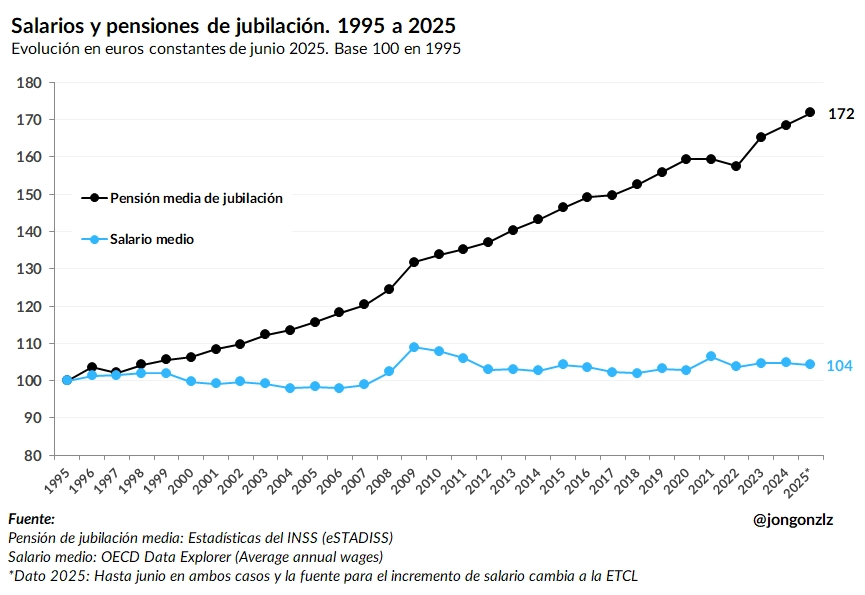
https://elequidistante.github.io/graficos-jongonzlz/pensione...
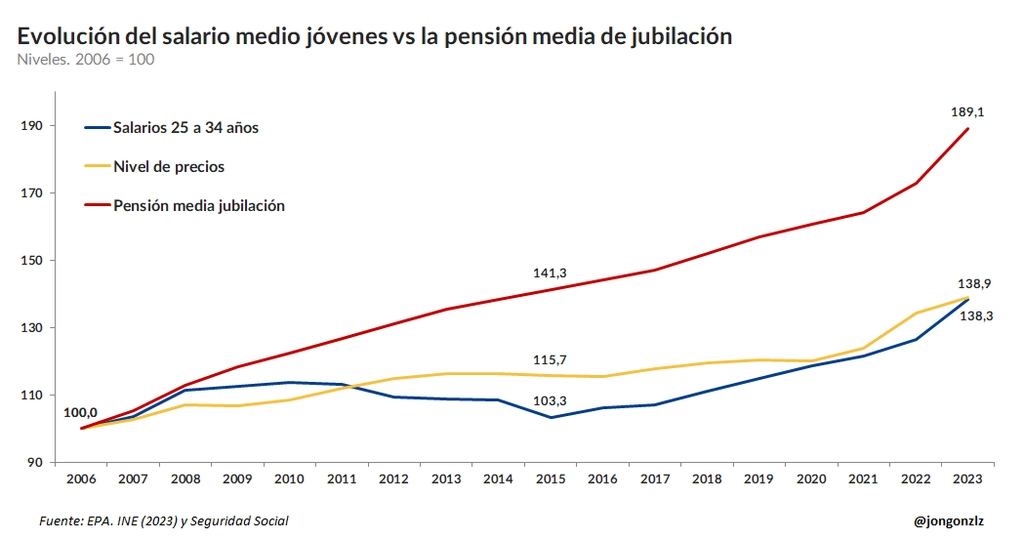
https://elequidistante.github.io/graficos-jongonzlz/pensione...
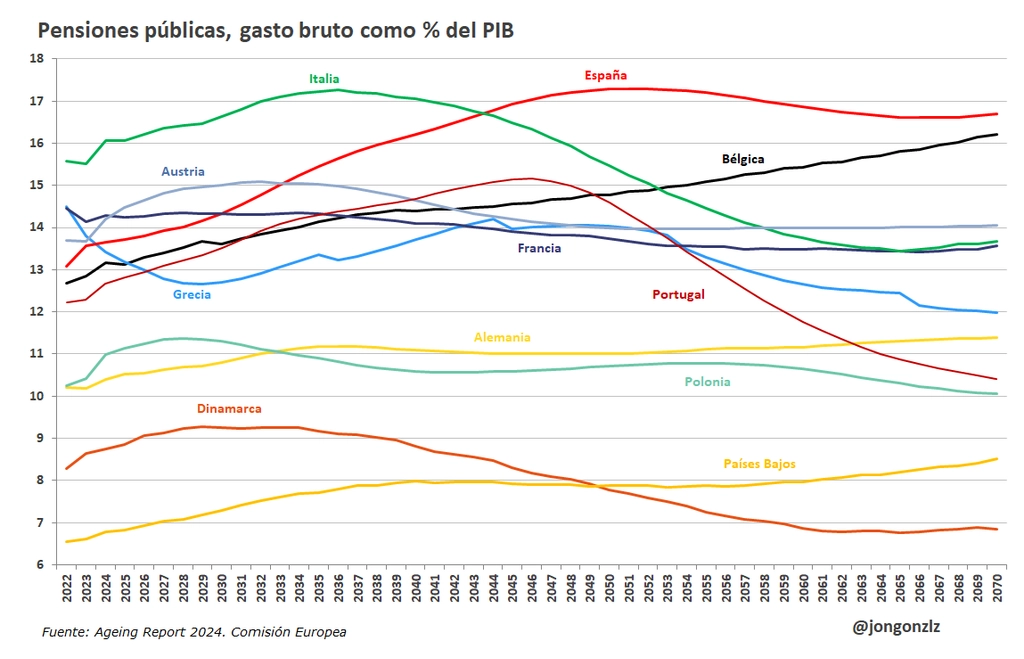
And maybe this is the most illustrative:
https://i.redd.it/uwvgxycxhjeg1.jpeg

So yes, the reason why we are underinvesting in pretty much everything is basically pensions. GDP is up, tax collection is up, debt to GDP is sligthly decreasing... but pension expenses keep growing at a fast pace so there's less and less money for everything else. And I say this with both of my parents earning the maximum pension, so I don't have an axe to grind, but it's just reality.
bombcar 8 hours ago
germandiago 12 hours ago
I am not suggesting cutting down pensions. My own parents are pensionists... so that you get an idea.
I am giving an objective explanation in all honesty: Spain needs a pensions reform probably at some point bc it is 40% of the expenses in the yearly budget, with a deficit and a demographic deficit. This will explode.
If it can be taken from elsewhere, better.
But you know how much are pensions in Spain and know our pension system in detail (it is literally a Poncy system...)? They are often higher than people working!
Whether we like it or not, we need to reform or collapse in the future. I wish it could be taken from elsewhere, but 40% is a lot...
There is a lot of useless expenses in public work in our "federal system" (comunidades autónomas).
Grombobulous 7 hours ago
LtdJorge 12 hours ago
We're financing pensions with debt, that's why it's a problem.
pofferfish 12 hours ago
You will notice that 31 is less than 40
square_usual 12 hours ago
Japan is a terrible comparison here because their rail network is privatized. They're also paying their pensions with debt, and their economy is really stagnant and not a shining example of a country doing well with a pension burden that high.
Grombobulous 11 hours ago
qurren 12 hours ago
> They don’t have problems keeping their high speed trains safe
Their trains are safe, but they also have 2X the national suicide rate as Spain, which amounts to about 17000 more deaths per year. I'd attribute a big chunk of that to their work culture treating people like machines, whereas Spain's work culture tends to lean towards treating people like humans.
That isn't an excuse for railway mishaps, of course, but I'm just trying to de-romanticize Japan as some kind of magical perfect place. It's not. They might have gotten their railways right, but they have massive safety issues around mental health.
nbajka 11 hours ago
xorcist 11 hours ago
Not saying maintenance isn't a problem, it probably is. It's a problem everywhere in Europe. Have you seen train service in England, Germany or Sweden? Absolutely terrible, compared to just two decades ago.
But under-maintenance causes trains to stand still and be late. It does not cause them to crash.
Crashes are caused by running at speeds higher than the (under-maintained) rail can support, or (against all rules and every regulation) no cap on speed when the signalling system is down.
The latter can not be solved with more money and resources. It is a culture problem. Rules can not routinely be disregarded for arbitrary reasons, especially not when they are completely in line with common sense.
naranjito 9 hours ago
The rumor is that staff is being pushed to restore service as fast as possible after a problem is "solved". EU push for green transport and privatization means lines were opened to competition, increasing the number of trains compared to some decades ago when only one operator used them with less trains than it does now. IIRC currently the lines have two operators (3 in some places?), meaning that traffic more than doubled. Those in power do not want the service to have more delays. And instead of updating and maintaining the infrastructure, Adif stresses it even more, both in the technical and personal fronts. Thus the accidents. But nobody at the top resigns, blame low level scapegoats instead.
The Iryo train was stopped and unable to restart, because it's safety system did not allow that until the signalling issue was corrected. The AVE was commanded to move again like normal (200 Km/h or more). When the Iryo reported to be stuck, all the trains in the line should have been notified to stop once more, or go at line-of-sight speeds (40 Km/h). Both options are bad for delays. Current news is that five minutes after the Iryo call, the AVE rammed its back at 160-200 Km/h.
CEO of Iryo company complained 3 weeks ago about LZB being problematic, their trains taking a long time to recover connection. Safe but old, he said. It should have been replaced by ERTMS by 2024-2026.
1718627440 5 hours ago
rwyinuse 12 hours ago
Over here in Finland our road infrastructure sucks too, and pensioners take lion's share of all the resources. Yet our trains aren't crashing. There's something wrong with systems and safety culture in your railroads. Bad maintenance doesn't cause trains to crash into each other if proper procedures are followed.
Still I agree, pension systems in most EU countries are unsustainable.
JaumeGreen 12 hours ago
Deterioration started long before that, according to my sources it started on 2008, but yeah, last 5 years or so it has gone worse. The budget for it has been increasing year by year. It seems that the main problem is not just lack of maintenance but that there's more traffic and new construction.
Pensions is 13%PIB which is on the European median.
The problem is demographic. Also take into account that retired people have paid for their retirement.
Your rhetoric is not what I'd like to be promoted as the first answer entering. Just reading the title of the news I knew what kind of messages I'd see promoted.
nbajka 11 hours ago
>Also take into account that retired people have paid for their retirement.
No, they have not. It's a pyramid scheme. Whatever they put into the system when they worked probably doesn't even cover 5 years of retirement.
jltsiren 8 hours ago
nbajka 11 hours ago
In Spain, half a million more people depend on money they get from the government than work in the private sector: https://theobjective.com/economia/macroeconomia/2024-09-16/a...
rimeice 11 hours ago
Off topic I know but, the BBC has adopted this clickbaity title pattern of “what we know so far about x” for the last year or so and it really jars me. Especially when x is very serious and involves people dying. It’s like an amateur tictoc’er is in charge of headlines at the moment.
gib444 2 hours ago
They've done clickbait for quite a bit longer. They love testing different headlines too. And pushing out a short article then updating it as they go
It's well beyond time to move on from holding up the BBC as the pinnacle of journalistic integrity. (I'm a Brit, not a Russian troll :)
iSnow 11 hours ago
>In one recording, the controller tells the driver of the Renfe train to disconnect and reconnect the LZB mechanism that monitors train speeds, and then resume the journey at normal speed.
Wait, I thought Spain's high-speed rail network was all ETCS L1 or even L2?
mdurana 10 hours ago
They don't all use ETCS. Madrid–Seville still uses LZB and Adif awarded a contract in 2021 to upgrade it to ETCS L2, but the project is delayed/unfinished
steelframe 15 hours ago
This event was pretty chilling for me because I just took the Renfe line from Seville to Madrid a couple of weeks ago while visiting Spain. I generally like to think that I have a pretty good instinct on relative risks and make reasonable decisions based on that. This time around, between the incident earlier this year and this most recent incident, depending on how you interpret and apply the statistics (of course that's always up for healthy debate), it looks like it would have actually been safer driving between Seville and Madrid. That's a pretty low bar in terms of safety!
I set my favorite agent on the task (Opus 5.5 in the Kagi Assistant), and given the two rail crashes in Spain this year, these are the stats it came up with for "chances of dying" via various modes of transportation between Seville and Madrid:
* EU high-speed rail, long-run average: ~1 in 36 million
* This rail line, counting both 2026 crashes: ~1 in 400,000 to 1.2 million (prior to the most recent crash it was 1–3 million; now ~2.5× higher)
* Flying with a European airline: ~1 in 80 million
* Driving: ~1 in 1 million or worse
Of course this is hindsight. Heightened awareness of risks, higher propensity to overreact to anomalies or alarms, procedural changes, and so forth in the wake of this second crash might push high-speed rail in Spain to be higher than the European average in the future.
loloquwowndueo 15 hours ago
Ask it to look for high-speed train crashes globally over the past 15 years (to include the 2013 one in Spain as well) to be honest I don’t remember any HS accidents other than the three in Spain so, odds or not, I am NOT taking a high speed train in Spain ever.
dogscatstrees 14 hours ago
Is there an international consortium for best practices in high-speed train control? Surely there are countries that have good systems in place, or have benefited from knowledge-sharing. I have to believe these train systems were built with outside help and then organic improvement or the opposite. Spain, talk to them.
iSnow 11 hours ago
The issue (at least in Europe) is that there are too many historical train control systems. There are more than 25 different, non-interoperable train control systems currently used across the European rail network.
That's where the EU came in and developed ETCS (https://en.wikipedia.org/wiki/European_Train_Control_System) as a modern alternative. Unfortunately, the EU doesn't have the legislative power to force member states to adopt it and also not the money to bribe them. So ETCS is still competing with the legacy systems.
However, the reason for that crash apparently was the dispatcher who greenlit the cab driver to go full speed ahead after the train control system on that track had crashed even though they knew that another train was reporting that it was unable to restart and get going. Procedures in case of a train control outage are clear: all trains can only move at a max speed of 40Km/h - slow enough to drive and brake on sight.
Instead, that train crashed into the stationary one coming from 200Km/h
dogscatstrees 10 hours ago
> the dispatcher who greenlit the cab driver to go full speed ahead after the train control system on that track had crashed even though they knew that another train was reporting that it was unable to restart and get going
Apologies in advance for what may be a pedantic and possibly dumb question, but is there a failsafe or guardrail against such forced errors?
naranjito 8 hours ago
The contract to make the line ERTMS compliant was published in 2020, with 2024 as completion target. Errors meant it had to be offered again, pushing it to 2025 and then 2026. The crash could have been avoided.
djankauskas 13 hours ago
There's definitely international communication, LZB is a German signaling system and the intended 40kph speed limit after system restart is common across Europe.
satellites 14 hours ago
Japan has had high-speed trains since the 1960's and have had zero passenger fatalities. They must be doing something right.
fortran77 8 hours ago
At least California's high-speed rail will never kill anyone.
dlcarrier 2 hours ago
It's already resulted in five injuries: https://abc30.com/post/five-high-speed-rail-workers-injured-...
enriquto 13 hours ago
it's a matter of budget and political will. Spain simply cannot afford all these train lines, and the system fails. But hey, we have high speed train between Villacojón del Caudillo and Cagalera de la Reina, because they happen to be aligned to the center of the country (Madrit). These railways make no economical sense, they were built for political reasons, to support a "radial" concept of the country that does not really exist yet.
Meanwhile no high speed rail between València and Barcelona, because that would somehow erode the power of the central elites.
gib444 2 hours ago
The BBC keeps repeating this inaccuracy and at this stage I wonder if it's deliberate:
> The driver replies, "At normal speed?" To which the controller says: "Yes."
That is not how the conversation went. The driver reads back the order from the controller, saying "at normal speed? Hm okay agreed / understood" then the controller starts wrapping up the conversation
ie the driver did not really question the order and it was barely a questioning tone (I write without judgement)
You only need intermediate Spanish to understand that part of the clip. The BBC has no excuse to be honest as I'm sure they have plenty of native speakers on hand
Whether it's a material difference I'm not sure, but the BBC should be more accurate
ktallett a day ago
I can't imagine what every passenger who survived and the families of those who passed are going through. Such a catastrophic incident with multiple human failures is so tragic and so needless. From the controller to the driver, every single one of them should have said hey we shouldn't just ignore a signal and should investigate why it's on first. For this to be such a quick decision suggests it's not a one off. I would be extremely interested to see how many near misses or ignored signals there has been across Spain. The crash earlier this year was due to inexperienced workers and it seems as if significant training improvements and protocols are needed.
bigDinosaur a day ago
To have had this many incidents compared to other HSR networks around the world gives all the signs of a classic case of normalisation of deviance.
Sadly we'll probably watch a lot of individuals being blamed/scapegoated for systemic issues, but hopefully even Spanish politics can organise a proper investigation after this many deaths in a single year.
spaniard89277 9 hours ago
Plenty if reports of lack of maintenance, overwork in all levels, blame culture, etc.
Also systems in place not trusted by the workers, which means they're used to bypass them.
It's a systemic failure.
jplrssn a day ago
If as a driver you get told by the control centre to get the train moving again at maximum line speed, surely you should be able to trust that it is safe to do so?
I don't see how this would fall on the drivers at all.
gpvos a day ago
My thoughts as well. It appears that such signal failures happen so often that the controllers regularly let trains run through red under verbal authorization. I don't know the exact protocols, but I would expect a driver to ask for confirmation, as happened here, and then trust the control centre. However, there is clearly a huge systemic problem, with added complexity for the controllers, and there should at least be double checks in the control centre.
1718627440 21 hours ago
crote a day ago
Trust but verify. You wouldn't drive your car into a lake just because your satnav tells you to, would you?
As we also know from the aviation industry, controllers are human and therefore will make mistakes. A controller shouldn't issue a wrong order, but a driver also shouldn't accept an order they aren't certain about, and there should be technical systems backing both sides of that up.
It doesn't "fall" on the driver, but it doesn't "fall" solely on the controller either. It's a systemic issue, and many pieces have to fail for a disaster to happen.
1718627440 21 hours ago
gus_massa 15 hours ago
1718627440 a day ago
> From the controller to the driver, every single one of them should have said hey we shouldn't just ignore a signal
A train driver has zero insight in what is going on and where other trains are. They do need to trust the orders they get, if you want to question every order you will never start to drive.
AdrianCX a day ago
The train driver's job is to say: "it's red, I'm no moving, not my problem, you make it green if you want me to go"
That's why it's a union job
Also he's the first person to die on accident so it's that and the safety of everyone else
They do not 'need' to follow others, they just need to refuse unless all safe and green.
If they never start to drive it's the companies problem to deal with angry non-dead customers
stevage 21 hours ago
1718627440 21 hours ago
dutchbart a day ago
The even more insane thing to me is that the controller knew that there was another train in that block, knowing it was no signal failure. The driving train should’ve never been commanded to continue on full speed by the controller.
cedws a day ago
Trains shouldn’t even be manually driven in 2026. We have self driving cars now which is a way harder problem to solve. Relying on a system of signals and driver attentiveness is archaic.
delta_p_delta_x a day ago
renehsz 4 hours ago
dns_snek 21 hours ago
kube-system 15 hours ago
1718627440 a day ago
Yokolos a day ago
So based on this, the safest place to sit is presumably the middle carriage?
1718627440 21 hours ago
That has been true in the last century, but now the classic collisions are way rarer. See https://en.wikipedia.org/wiki/Eschede_train_disaster .
I would actually sit in front now. Sometimes you would be able to still get vital information and being actually able to act. But the safe decision would be no to enter the train.
flohofwoe 14 hours ago
> But the safe decision would be no to enter the train.
You might just as well never leave your bed, that's even safer ;) Train travel is much safer than travelling on roads, and in the same ballpark as commercial flight.
barbazoo 15 hours ago
> Sometimes you would be able to still get vital information and being actually able to act.
Optimistically assuming you have a minute to react (I'm imagining closer to 10s), what could one possibly do?
1718627440 15 hours ago
comrade1234 a day ago
That's where the bus hits you.
schnitzelstoat a day ago
It's incredible the minister didn't resign after the January crash and I doubt he will now either. I understand that perhaps the problem started in the control centre but surely at the end of the day the minister is responsible - they don't get paid a fortune just to pass the blame on to the workers.
Xenoamorphous a day ago
> they don't get paid a fortune
Salary for ministers is around 80k euro per year. Yes significantly more than the minimum salary but hardly a fortune.
logicchains 13 hours ago
The average salary in Spain is around 30k euro, and almost nobody makes 80k there.
baal80spam 12 hours ago
agarsev a day ago
I fail to see how the two accidents, which seem to have very "down to earth" explanations (maintenance failure by workers, protocol override by operators) are being assumed to be a political responsibility so quickly by some and asking for the minister resignation. Now, two in a row seem to point to systemic issues. Is this responsibility of Adif or Renfe? maybe those state companies have to be thoroughly revised. is it due to lack of funding? maybe taxes should be raised, or money diverted from somewhere else (though seeing the spanish budget, it's hard to tell where from, both teachers and doctors are currently protesting for lack of funding). Maybe it is, in the end, a political directive that should have responsibilities declared in the executive. But seeing so many interested parties jumping to that conclusion literally hours after the crash means it's not done out of any reasoning but political animosity
Xenoamorphous a day ago
> are being assumed to be a political responsibility so quickly by some and asking for the minister resignation
It sucks but that's how it is over here. It's "my" party the one in power when a catastrophe like this happens? It's not the politicians, it's someone else. Is it the "other" party? Surely the politicians are ultimately responsible.
This reflects on the news media as well.
ChrisArchitect 13 hours ago
pvaldes 12 hours ago
"the collision occurred after one train stopped on the line unexpectedly due to an Automatic Warning System fault causing it to brake. It was then hit from behind by the second train that had passed a red stop signal protecting the stationary train in front"
- Not Spain. This was Bedford (UK) in June 2026.
https://en.wikipedia.org/wiki/2026_Bedford_train_collision
The train collided rear-end into the rear carriages of the other train and derailed, which also resulted in the three rear carriages of the first train to derail
- This was Białośliwie train collision (Poland) in June 2026
https://en.wikipedia.org/wiki/2026_Bia%C5%82o%C5%9Bliwie_tra...
One carriage was reported to have overturned and four more were derailed. 44 of the passengers were injured
- And this was the Cleon Derailement (France) by sabotage in September 2026
https://en.wikipedia.org/wiki/Cl%C3%A9on_derailment
In this last case Police suspected sabotage after a 300 Kg piece of rail was found deliberately laid in the railway.
"A fire was detected in the rear cabin of the high-speed train. Following safety protocols, the 283 passengers on board have been evacuated"
This was an AVE passenger train in the line Madrid-Barcelona, in October 2026. Most probably another case of sabotage.
vagab0nd 15 hours ago
Tell your travel agent:
"Add a global memory. Whenever I'm in Spain or planning to go there, remind me of this: <story url>, and plan to avoid it."
whycome 14 hours ago
Why isn't there basically adsb data for trains?! They can broadcast speed and position. Other trains can then see things ahead on their track. This seems like a solved problem so I must be missing something obvious.
iSnow 11 hours ago
Two main reasons:
- trains go in tunnels or tracks are between houses. When train control systems were defined in the 1990's, there was no way to make them sensitive enough to record GPS positions. Instead there is a different location system based on so-called balises with a fixed position on the tracks. Every time a train crosses one, it knows where it is.
- Planes go in 3 dimensions, trains in one. If ATC wants to ensure two planes do not collide, they will assign them different headings and/or heights. Precise position isn't that important. Trains cannot avoid each other, that's why they move in blocks.
And yes, they do signal their position back to the control center, it's just a different protocol
jcdavis 14 hours ago
Modern signalling systems are basically adsb for trains. (ETCS is the modern standard in Europe, this line was using the older German LZB). Problem is that they can, and do, fail. And when that happens too frequently (as it seemingly has been in Spain due to a lack of maintenance), its easy to get sloppy on the manual handling
flohofwoe 14 hours ago
Safety systems don't help much when they fail themselves. E.g. usually there are automatic systems in place that prevent that two trains are on the same rail network section at the same time, but this system apparently has failed. Details are in the article.