My monitor was cutting my download speed by 75% (blog.tymscar.com)
371 points by soheilpro 10 hours ago
senko 7 hours ago
This reminds me of a (completely different, but felt equally) bizzare problem with ghostty (the terminal emulator) on Linux and Steam, specifically Baldur's Gate 3.
At the start of the game after an update, BG3 compiles the (Vulkan) shaders. To avoid hammering the computer, it checks the load, including I/O pressure, and then throttles itself. It turns out that Ghostty uses io_uring, and even if it's not doing anything this somehow counts as pressure. This was made worse by the fact that I usually have a dozen or so Ghostty windows.
End result, BG3 compiles shaders using 1 core, throttled, instead of all available 20 cores. Instead of a minute or so, it'd take several hours.
(For closure: I configured ghostty to use epoll instead. Probably not optimal but works around the problem.)
pm215 4 hours ago
Interesting to see the "io_uring vs io pressure measurement" issue come up here; it's turned up on qemu-devel recently too: https://lore.kernel.org/qemu-devel/4EF13FE7-E6F3-42E2-83F9-6...
If I am reading the thread correctly, the io_uring maintainer's position is that applications trying to use the metric that "poll via io_uring" handles differently from "poll via epoll or select" are fundamentally misguided and measuring something that doesn't make sense, so they don't want to slow down io_uring to placate those apps.
gavinsyancey 3 hours ago
From https://lore.kernel.org/qemu-devel/962d44d3-ca7b-4cc8-b0f7-7...
> iowait is fundamentally incompatible with sane accounting in the first place, that is the problem. It really tells you nothing, and was deprecated since the days of uniprocessor systems. The problem here is not how iowait is done in the kernel, it's that people are using this metric in the first place. Which is why you just want to NOT do that, and do sane accounting on your disk drives, if you care about that kind of thing.
> Which is why I refuse to cater to any kind of iowait accounting metrics, it's just adding overhead to support a metric that is largely nonsensical in the first place. It doesn't answer any questions that an application/tier owner would want to know. Those questions might be things like "am I I/O bound?" or "is the device I'm using being slow?". I wish people would realize that, rather than continue to place value in iowait as a metric for ANYTHING, and stop trying to work around it.
It sounds more like their position is "iowait is a useless metric" and that polling with io_uring completely breaks iowait metrics but fixing it would add a minor slowdown so they refuse to do so because they don't think it's a valuable metric to begin with.
nomel 2 hours ago
spease 2 hours ago
ajasmin 2 hours ago
An app can use io_uring_set_iowait to change that behavior. Since a terminal’s waiting on I/O isn’t hugging the disk but just waiting on mouse and keyboard input, that seems like the honest thing to do.
dustbunny 5 hours ago
Amazing. How did you figure this out?!
senko 27 minutes ago
I asked Claude to help me debug and research it.
It looked at fossilize code (open source component used in the process), found a couple of threads online that suggested io_uring/iowait and told me first to try closing the ghostty windows and then to try to switch to epoll. This did the trick.
I have a very vague understanding of what's going on (actually better now that I've look at the links/resources from the replies in this thread!), and would probably have been able to figure it by googling in my own. But, my first hunch was that it's a problem with steam, proton, or the game, so I'd probably waste a lot of time in that direction first.
simonask 7 hours ago
I hate this. We have a whole operating system doing its absolute best to prioritize hardware resources. Don't be out here throttling yourself.
Especially for something like compiling shaders. It literally never happens unless the user is about to go play a game, which is going to consume most resources anyway. To the user, there's nothing more important running right now.
kevin_thibedeau 4 hours ago
My motherboard crashes when I peg all the cores. Presumably it can't maintain the core voltage under load. Vendors need to guard against these scenarios by being extra cautious because it's a hard problem to diagnose that they'll get blamed for.
Dylan16807 4 hours ago
0c3ca83 3 hours ago
FuckButtons 2 hours ago
MichaelZuo 3 hours ago
MBCook 35 minutes ago
But why use that metric. The OS already has support for this.
Why not just re-nice the process or whatever equivalent for the threads that do the compiling? Tell the kernel what’s going on, it will handle it for you.
Don’t hack your own solution.
cowlevel 5 hours ago
Especially on Linux, the default throttling just doesn't work very well.
embedding-shape 7 hours ago
> To the user, there's nothing more important running right now.
Well, to a certain degree. I have a relatively uncommon GPU, and run games on Steam (and Linux), so literally every game does shader compilation for me. Even with a beefy CPU and beefy GPU, if the shader compilation uses more than 16 threads, my computer basically freezes until its done with it, as it's so performance intensive, kind of have to throttle things if I want to be able to use the desktop for the 10 minutes the shader compilation takes sometimes.
Edit: "Do you use Linux? That only happened to me when I was using a dram-less ssd for swap and doing IO heavy operations on the NFS mounted drive"
I do! I do have NFS drives, but not for Steam games or anything else relevant. I'm also not using swap at all. RAM seems fine during this, it's just pegging all cores to 100% usage immediately and stays there, making everything else suffer.
Aurornis 6 hours ago
braiamp 6 hours ago
Hendrikto 6 hours ago
sayotte 4 hours ago
io_uring you say… one of the most infamous subsystems for security, best reserved for stringent performance requirements. Why on earth would Ghostty default to that?
BenjiWiebe 3 hours ago
Maybe because one of ghostty's selling points is performance.
Also if you're running untrusted code that attacks your not-very-common terminal emulator, you're probably in more danger from the "untrusted code" part. Threat model and all that stuff.
manarth 5 hours ago
Better description: "My USB network switch was cutting my download speed".
The fact that it's a monitor is a little bit irrelevant.
xp84 4 hours ago
Same old adapter worked perfectly if the monitor was taken out of the path. Kind of an interaction thing with both, really.
dcrazy 3 hours ago
The twist is it would happen with any additional device in the signal path. The mere presence of a hub causes the USB control message to take slightly longer to reach the adapter—about the same amount of time it takes to receive 5 Ethernet frames at 2Gbps.
The fix is to cut the overhead by sending more than 4 frames per interrupt. Unfortunately that required buying a new adapter with a different chip.
alt227 3 hours ago
brigade an hour ago
eptcyka 2 hours ago
I was under the impression that in the Apple ecosystem, you pay for better integration. Apple’s XDR display should really be able to handle this better. Or have the drivers negotiate with the chipset better.
intrasight 4 hours ago
> 2026 Studio Display XDR, with everything plugged into it so switching laptops is one cable
I think I'd have accepted having two cables from the get-go. And if I observed this problem, the first diagnostic I would do is to plug the Ethernet directly into the laptop.
Fewer technical pieces in a puzzle sometimes trumps ease of use.
npteljes an hour ago
"Better" is subjective. I think monitor is a better title, because it gives misdirection, so we the readers learn the same time OP did in the story. Unreliable narrator and all that.
I understand that not everybody likes this, because it can feel like a trick, or patronizing, or lying. But in my experience, it works very well for people.
devmor 32 minutes ago
I didn’t like it because it was a very generic and common technical occurrence that I would not be interested in reading about normally.
Now I feel as though my time was wasted by a dishonest author trying to get me to believe that their story was interesting when it was not.
In the grand scheme of things, it’s not a very big deal, but I feel quite annoyed since I was baited into expecting a fun read.
pavinjoseph 4 hours ago
I view anything "USB" with more than a little suspicion after my hellish journey into running RAID over USB drives.
ssl-3 2 minutes ago
I've got a few USB drives that are always attached that I do stuff with.
To pick a not-RAID example, I've got an old (2012-vintage) 180GB SATA SSD, from Intel, on my desk. It gets used as scratch space for big-ish file operations, where it gets hammered hard periodically, usually in bursts. It's plugged into a cheap SATA <> USB 3 adapter, and is otherwise-unadorned. It is bus-powered.
It's usually connected to the back of the PC, but it's been plugged into different USB ports (with different controller types) and also external hubs.
I don't recall what its exact status was when I starting doing that with it after pulling it out of a gently-used Thinkpad T530 about 5 years ago, but I do recall thinking that it had lots of life left.
Here's where it is today:
  - 10.6 years powered on
  - 81TB written (of 36.5TB promised); ~222% over spec
  - Zero reallocated sectors
  - One singular hardware-reported error (corrected)
  - Zero sector reallocations
- Zero reported errors according to ZFS checksums
The other USB storage devices here that are used 24/7 are similar in this way. It's not hellish at all. It's quite lovely.
I'm inclined to further extrapolate that it would not have better data integrity when connected directly to a SATA port on the motherboard, or in a disk shelf attached via iSCSI or SAS or some other more-stodgy thing. It's hard get results that exceed beyond perfection.
(But in this example, I'm not chasing down minute bus timing issues with multi-gig networks. That's a very different kind of discussion.)
sixothree 2 hours ago
You really must hate yourself to attempt that.
fancyfredbot 6 hours ago
Since lots of comments misunderstood the article, the extra latency from going through the monitor meant his laptop couldn't acknowledge the packets quickly enough. That led a buffer on the ethernet adapter to fill and that led it to drop packets.
A different adapter which required less frequent acknowledgement fixed the problem for him.
It is quite a nice post which gets to the bottom of incredibly opaque behaviour of USB hubs.
jayd16 4 hours ago
The fix is that it could send more packets per ack not that it needed to happen less. If the buffer was bigger but still capped at 4 packets per ack, the full buffer drain speed would remain at ~2.
alansaber 6 hours ago
Probably a stupid question, but why is USB behaviour so opaque?
jayd16 4 hours ago
There's not much monitoring built into usb hubs. It's actually far less when you think about all the monitoring a network switch has.
throw0101d 6 hours ago
Meta:
> Somehow I am one of those few very lucky people to have the opportunity of owning a 2.5 gig symmetrical line for my internet.
I'm not going to complain against more bandwidth (as a GenXer I stared my online journey at (IIRC) 9600bps (maybe lower): much celebration with V.32/V.90), but I'm curious to know how many residential use-cases can take advantage of that much bandwidth. Linux ISOs?
How many services allow that much speed on a single stream / (TCP) session? Maybe you could have five at 500 Mbps?
Certainly downloading security updates or games may be quicker, but I would think that above 500Mbps (and certainly 1 Gbps) there would be major diminishing returns. Is anyone regularly getting close to that utilization in their daily work / hobbies (and not just a momentary spike on patch Tuesday)?
Zyst 6 hours ago
Torrents, and things like downloading games from Steam feel really good if you have a very strong connection. A lot of games can be downloaded in the time it takes to go grab a drink from the fridge. It adds some nice quality of life, there isn't as much need to keep a large downloaded set - just download when you need it, and it'll be there quickly.
I think going from something like 100 Mb download to 1 Gb is slightly overrated. You hit heavy diminishing returns. Symmetric Upload, for me, is what really changes your quality of life a lot. Uploading a youtube video suddenly isn't an event, it takes a few seconds. Want to upload an image in any chat? Done before you consciously see it uploading. Heavy commits are instant, even with a bunch of resources. It changed my behavior. I started uploading more stuff to remote servers because the cost in time got so much lower.
Guillaume86 6 hours ago
Yup as someone on a 1000/20 link (can’t get anything better in my little village in BE), decent upload is far more useful than more download after a point (far before 1gbps).
sbrother 18 minutes ago
Not sure this counts as a "residential" use-case, but I have 2 gig symmetrical for my office, and it lets me rent out two GPU servers to third parties offering 750M symmetrical on each, while keeping 500M reserved for my own use even if both of those are saturated. It's awesome.
Aurornis 6 hours ago
The major CDNs routinely deliver full throughput.
It’s great when experimenting with LLMs because I can quickly try new models and download from the internet almost as fast as if coming from my NAS.
Game updates are also a great use case. I don’t game often so when my friends want to play I often have to update the game. Some patches are 60GB or more. When they come down at full line speed that’s valuable time I’m getting back to spend with my friends in game.
dabinat 2 hours ago
I think it’s less about being able to max it out and more about having background events (like backups) or other users on the network not impact your own usage.
But I run servers at home and regularly download enormous video files so I can think of plenty of ways to max out a 2.5 Gbps connection (alas my own is nowhere near as fast).
microtonal 2 hours ago
Indeed. We have 4Gbps because it's not much more expensive than 1Gbps fiber (plus it required our ISP to upgrade our fiber connection from AON to XGS-PON, which is more future-proof).
The benefits are two-fold:
1. Background tasks don't impact your own issue (as you say).
2. Many CDNs can saturate 4 Gbps, so if you download something, the waiting time is much shorter than say 100Mbps.
Whether it's worth it all depends on the price difference.
4Gbit is kind of the sweet spot currently. 2.5Gbit equipment became quite cheap (e.g. Ubiquiti Flex Mini 2.5Gbit managed switches are often around 50 Euro), existing Cat 5e cabling still works reliably, and if you have a router with 10Gbit upstream and multiple 2.5Gbit downstream ports, none of the subnets can completely saturate the upstream bandwidth.
Also, these bandwidths rock for doing an initial backup, downloading a full backup, pulling many Docker images, large and frequent NixOS rebuilds (unstable-small, yay). Downloading GTA 6 (not me though, not a gamer).
xp84 4 hours ago
Do not underestimate the possibilities. I have 1.0/0.1Gb cable, and doing remote access is a complete joke. Even streaming a 1080p movie up from my house is extremely challenged.
This also locks me out of hosting my own “cloud” storage at home where it belongs - I don’t want to be out and waiting forever to get a file, so I stick to traditional cloud services for now. Slower than local storage on the LAN of course though.
A fiber isp is digging trenches soon. Cannot wait!
wpm 2 hours ago
Yeah upload is usually the game changer for home internet. I have symmetric gigabit and I would happily halve my download speed if it meant I could double my upload. Sending large backup .tars to cloud storage, sending data to VPCs, object storage, allowing more concurrent Plex users remotely, etc etc, 2Gbps would make so many things easier.
boston_clone 4 hours ago
I mean, yeah, you have a 100 Mbit/s (or 12.5 MB/s) upload rate under ideal conditions. If my math is right - haven’t had my coffee yet - that’s just 4% of the OPs bandwidth.
nunez 5 hours ago
2.5Gbit (or 5Gbit in my case) is INFINITELY helpful if you run k8s clusters. Container images download as quickly as moving a big file on a spinning rust hard drive even if someone else is watching TV or doing equally intensive stuff.
kakacik 4 hours ago
Watching TV is nothing, even 4K netflix stream is around 15-20 mbit and shouldn't spawn many concurrent threads unlike say bittorrent.
wpm 3 hours ago
eptcyka 2 hours ago
Backups are a lot faster. For some that matters. Running 2.5g locally has a lot of benefits. With a 1g network, you need just 3 people on the network for UX to degrade.
npteljes an hour ago
I know I'm far from saturating my 1G symmetrical on my normal PC. Cable conditions downgraded it to 100Mbps and I didn't notice for the longest time. (Nor did I fix it since then :P)
WhiteDawn 6 hours ago
99% of the time I don’t need it. However, when I do need it, it sure is nice to move quickly during updates or downloading sdk/assets.
Even better is those can saturate as much bandwidth as possible while the rest of the family are uninterrupted with Netflix or video calls.
nojs 3 hours ago
I also have this on paper. It’s surprising how much home hardware caps out at 1 Gbps or below. I had to replace several routers and run cables everywhere to get the full speed. Once you add on tailscale, a VPN, etc it’s a proper challenge to get it consistently working above 1Gbps.
qingcharles 3 hours ago
Literally everything is better with multi-gig symmetrical. I work from home and I have to pull multi-gig archives of documents for processing and that's better. Then I need to push them to web servers, and while I'm on 2Gbps I haven't managed to get an upload to anything useful higher than 600Mbps, but that was 30Mbps last month on cable, so tasks I'm waiting on are getting done 20x faster.
coryrc 3 hours ago
Some games are hundreds of GB of disk space and also have a terrible patching algorithm where they need to make an entire duplicate of all files to patch them, despite downloading less than a GB of patch. So you have to uninstall stuff. With fast Internet you can actually use most of your drive because you can uninstall then download a new install which only needs X space not 2X.
penagwin 6 hours ago
I think steam lets you get to at least 2gbps.
An interesting side effect is that bufferbloat becomes less of a problem - you’re more likely able to pull 1gbps without spiking your ping.
But to be honest unless you have a household with multiple people, it’s something you mainly notice occasionally with updates, backups, large assets, etc.
tomxor 2 hours ago
> Linux ISOs
Yeah definitely Linux ISOs. It's nice to settledown in an evening, pick a new Linux ISO I haven't used yet, and veg on the sofa watching it install.
Of course unlike the netinstall images all the normies use, you have to download it up front before you start wa, uhm, installing it. But I prefer it that way so I can watch the install without being interrupted... Then again I guess at 2.5Gbit the only thing that's going to interrupt you is a crappy integrated network interface, aka Apple monitor. I don't have enough money to have that problem though.
NBJack 5 hours ago
I doubled my measly 20 MPBps upload speed to 40 simply because of how long it was taking me to get rendered assets to someone. Having higher bandwidth than that (eventually, I hope) would be a real help in video editing.
makeitdouble 6 hours ago
> Maybe you could have five at 500 Mbps?
Let's say you're on a Meet call with a dozen of people, one of them presenting their screen to explain an ongoing incident. You're following along while checking your dashboards and code on a remote server. You're of course keeping Slack sessions in the background.
I don't think you'd be saturating a 2.5G bandwidth, but perhaps about half of it ?
If your family is also using it in parallel that could get close to full use.
toast0 2 hours ago
If it's a call with a dozen people, media will flow through Meet's server. Some group call servers do p2p for calls with two or three people, but approximately nobody does for a dozen.
Where I work, group call participants send about ~1Mbps of video, and maybe more for screen share, could be ~2Mbps.
So you're looking at 15 Mbps inbound and 1 Mbps outbound for the call. Plus some overhead for congestion control. That's not even 1% of your 2.5gbps connection. IIRC Meet uses higher limits, so maybe double it to 30 Mbps.
You don't need gigabit for video conferencing, unless you're running the conference out of your house. Or you have 20 people all on conferences. You may want some QoS if your usage is near your bandwidth limits. Conferencing is sensitive to jitter and loss.
At my current ISP, speed is either 100M or 1G, so if you had 3+ people who conference simultaneously, 100M might well be limiting, so you would probably want 1G ... otoh, conferencing is usually bandwidth adaptive too, so it would still work, as long as everything plays nice with congestion.
Aurornis 6 hours ago
> Let's say you're on a Meet call with a dozen of people, one of them presenting their screen to explain an ongoing incident. You're following along while checking your dashboards and code on a remote server. You're of course keeping Slack sessions in the background.
This is closer to 1-10Mbps than 2.5Gbps. Slack is negligible bandwidth. Video conferencing is high compression, low bandwidth video.
The 1G and 2.5G lines benefit bulk file downloads.
jayd16 5 hours ago
throw0101d 5 hours ago
> Let's say you're on a Meet call with a dozen of people […]
I have been on Zoom and Google Meets calls with that many people on my laptop which has a Wifi connection of ≤400 Mbps (sometimes <200Mbps). You don't need >500 Mbps for online meetings.
Are you in meetings where everyone is sending 4Kp60?
silvestrov 5 hours ago
rayiner 6 hours ago
That wouldn’t come close to saturating 100 mbps. Screen sharing even at 4k is ridiculously efficient, maybe 4-5 mbps for what you’re describing where most of the image isn’t changing most of the time.
bloopernova 3 hours ago
Downloading big models is much nicer on a 1Gbit fiber line. Uploading test docker images too if you're forced into modifying them locally.
jamiek88 30 minutes ago
Games mostly. Getting a 40gb LMU or iracing update when logging in for a session gets old quick. Maxing my 5 gig ftth connection feels good man.
I only upgraded because my isp charged $90 for 1gig and offered 5 gig at $65 for two years so for the price of a pci nic I thought why not. It’s also nice that every device in the house can max out their capability simultaneously but that’s a rare event.
rayiner 6 hours ago
I have 10 gig into my house, and most services can’t saturate it. Microsoft is crap, big game downloads don’t even top out the gigabit link in the xbox. Apple gets 2-3 gig downloading xcode updates and the like.
wpm 2 hours ago
A lot of times downloads for games are going to be compressed/encrypted and decrypted/decompressed on the fly. It's why CPU power is actually usually the limiting factor for Steam downloads, then disk I/O capability.
nunez 5 hours ago
I wish I could get 10Gbit; friggin' AT&T lol.
Fetching from Google or anything on S3 can definitely fill your pipe
zeristor 6 hours ago
I do homebrew updates regularly, and quite often it can take more than an instant. On my 40Mb connection it’s slow.
Run it in background, don’t update so often perhaps; I guess I just update as tic.
seiferteric 5 hours ago
My cable is I think up to 2Gbps now and I regularly see game updates in steam hit like 1.4gbps. Probably it is closely located in a CDN I would assume.
locknitpicker an hour ago
> but I'm curious to know how many residential use-cases can take advantage of that much bandwidth.
I don't know what you have in mind regarding what qualifies as residential usecases. I can tell you that I use my residence for work, and as part of my work I have to hold video calls and download all kinds of packages from the internet, including pulling container images, including media asset bundles that take several GB.
This often takes place when other members of my household are doing their work or watching streaming services.
If you have a 2.5Gbps connection, you often are not looking into sustainable transfer rates but bursts. A difference between 500Mbps and 2.5Gbps is whether it takes you half a minute to pull a package or 5-10 minutes.
IshKebab 4 hours ago
Yeah basically nothing. I have 900 Mbps and pretty much the only things where the other end gets about 250 are Steam, Docker images, and Bittorrent. You really don't need more than 250 or at most 500 Mbps for the vast vast majority of cases.
monster_truck 6 hours ago
You definitely notice it
vachina 4 hours ago
4K HDR BRrip in 1 minute
gh123man 6 hours ago
I have nothing useful to add other than I feel so validated reading this. Ive been struggling with this issue on and off for over a year. With the release of Astra, it was able to finally unstick me to the point of enabling flow control which has been good enough.
I experienced this problem with a macbook and a thunderbolt dock. I had tried multiple different brands of docks and ethernet adapters, and various macbooks. One interesting thing I discovered is if I plugged a non-thunderbolt cable between the dock and the laptop, I would achieve full speed with no packet loss, so interestingly the issue doesn't occur over pure USB but only over thunderbolt.
This has got to be a bug on Apple's side right? Would be nice if they fixed it.
dcrazy 3 hours ago
What kind of Thunderbolt cable, and what kind of USB cable? The downside of using the USB-C connector for everything is that it obscures the difference between active and passive Thunderbolt cables.
xp84 4 hours ago
Oof. That is the kind of thing where Apple will never do anything. They implement standards, but they guarantee absolutely nothing if even so much as one cable involved isn’t Apple-branded. Using docks and Ethernet adapters? Good luck! They’ll just ask if you’ve considered buying a $5000 monitor with a $1000 stand to use as a dock instead. (And ironically, that’s what OP did and still had the problem :D)
wpm 2 hours ago
> Using docks and Ethernet adapters? Good luck!
All the more irritating is that all this dock and dongle bullshit was popularlized by them.
nagisa an hour ago
I recently had this same problem with a multigig copper SFP+ module. These SFP+ modules (usually) advertise 10Gbps to the NIC they're plugged in, but will negotiate lower speeds on the copper side. So when NIC tries to send to SFP+ at higher rate than whatever speed SFP+ has negotiated internally, the SFP+ module will just drop a bunch of packets and incur a significant hit in throughput.
These tend to not support sending pause frames to its SFP+ side either, so the best option I found was to set bandwidth limit on the NIC…
frizkie 3 hours ago
I had the same problem recently when trying to figure out high bandwidth game streaming from my desktop to my Steam deck in the living room. The beta streaming tech is “pyrowave” and it is super low latency and looks INCREDIBLE compared to traditional codecs, but as a trade off it is extremely sensitive to packet loss, and uses an appropriately large amount of bandwidth (7-800mbit at 4k120). Wired network isn’t _strictly_ a requirement but it might as well be, and the steam deck doesn’t have a physical port - but the steam deck dock does.
Anyway, the exact same situation arises, where some network condition or physical configuration (there’s a lot of hardware in between these two devices, including MoCA adapters) meant that the network adapter buffer fills up and starts dropping packets. The buffer size is configurable through some terminal command and maxing that out makes the issue disappear immediately.
umvi 2 hours ago
Unrelated to this particular issue, but I've had subtle monitor behaviors catch me off guard as well. Usually I think of monitors as being unrelated to the underlying program running, but this is not always the case. For example I released a JavaScript programming game on steam that uses chrome (Electron) for sandboxing. This game has a tiny community but already there are a couple players doing speed running [1], and one discovered that you can complete the game many seconds faster if using a 120Hz monitor instead of 60Hz. The reason is that the JS API requestAnimationFrame [2] is tied to monitor's refresh rate (which I didn't realize) and I originally didn't do any sort of logic limiting it to 60fps (and actually I was using PixiJS tickers[3] which I didn't realize were using requestAnimationFrame under the hood).
[1] https://www.speedrun.com/Pragma_Twice
[2] https://developer.mozilla.org/en-US/docs/Web/API/Window/requ...
toast0 2 hours ago
> Basically, when a device receives Ethernet frames it can’t keep up with, it just drops them. With flow control (it’s something your router or switch has to support), it can send the sender a “pause” frame, and the sender then buffers the data on its side, instead of the receiver (the adapter in this case) on its side.
One thing that can happen with pause frames (and why I hate them) is pause propagation. If you have a switch between your server and client and the client sends the switch a pause frame, the switch may send a pause frame to the server. If it does (and the server accepts pause frames), the server will pause sending to all destinations.
So your one slow client can disrupt all the other flows from the server. Which is totally unhinged.
bjackman 2 hours ago
Funnily enough I recently noticed my network was slow, told Claude to investigate, it came up with "replace the DisplayPort cable on the right monitor".
Immediately 10X'd my bandwidth, turned out I was using a cheap cable that wasn't shielded like it was supposed to be, and it was running right past the WiFi antenna and causing loads of interference.
slickdork 2 hours ago
how much back and forth was there between you and claude to troubleshoot this? you make it sound like you gave it one prompt and it found that solution, which to me seems incredibly impressive.
array4277 23 minutes ago
Having the correct driver is crucial for any 2.5Gb+ adapter. I know because I've run into this problem with 2.5 and 5Gb dongles too.
zodwick 5 hours ago
>It’s run by this one guy
This was super surprising, have always thought ISPs are a super hard businesses. But good for you mate, good ISPs are lifesavers.
I have had the opposite experience with my ISP guys. One of the VMs I got as part of work only had IPv6 and to my shock my internet didn't have one. When I contacted my ISP they legit told "You can either have IPv4 or IPv6, but not both". Unfortunately I was on a 12 month plan and couldn't easily cancel so ended up working around using tailscale.
eska 4 hours ago
There are communities of small towns and villages running their own ISP and providing help materials for others who want to try.
zodwick 3 hours ago
Do you have any pointers ? Idt this is a thing where I live tbh
srcreigh 8 hours ago
Nice post. Unsatisfying conclusion - did you ever figure out why the original adapter was throttled when plugged into the monitor, and not when plugged into the computer?
cibyr 8 hours ago
The additional latency from going through the monitor made the bandwidth-delay product exceed the amount of data the adapter was able to send before receiving an ack. I thought that was fairly clear from the explanation, but now I notice that he didn't mention the latency without the monitor.
nh2 5 hours ago
That doesn't seem to be described by the article at all.
The latency added in the monitor is described as around 8 us, completely negligible compared to any Internet connection's latency.
So the latency without the monitor should be completely irrelevant.
toast0 2 hours ago
db48x 3 hours ago
nh2 5 hours ago
The article answers this
"if the speed of the drain from my adapter to my Mac is half a gig slower than the speed of the input, then you can imagine the buffer getting filled more and more until it overflows. Those are dropped packets, which result in a hard backoff when the router resends them, so you drop loads in speed. And that’s the reason for all of this."
With diagram https://blog.tymscar.com/studio-display-ethernet/bottleneck....
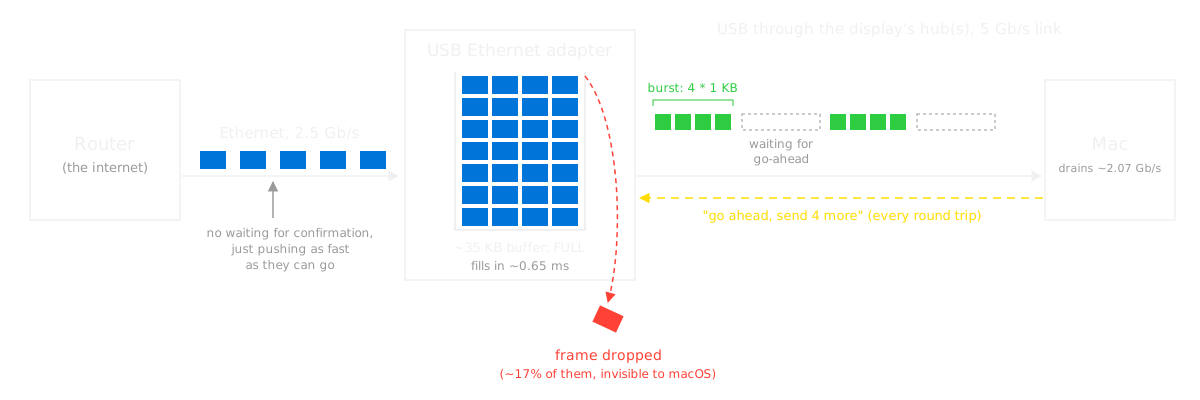
The monitor decides to send the adapter's packets on at only 2 Gbit/s, which leads to buffer overflow, thus packet loss, thus e.g. TCP congestion-control backoff.
The only thing we don't know is _why_ the monitor chooses to limit the bandwidth to those 2.07 Gbit/s (computed as the 41 KiB blocks per (7.6+8.2) µs). If it sent e.g. 81 KiB blocks, doubling the bandwidth, the problem wouldn't happen.
That'd be between Apple and the monitor.
db48x 3 hours ago
No, you’ve misunderstood. Any time the NIC signals that one or more packets have arrived the CPU must reply back to the NIC to give it a DMA buffer to copy the packet(s) into. By the time that reply arrived at the NIC it was already too late. The NIC could only buffer four packets and the fifth or even sixth packet had already arrived and been dropped. The NIC then sent the four packets it had to the DMA buffer and started over.
The monitor was not really at fault. All USB hubs must read USB packets on all of their ports and copy them over to the upstream port. Those packets must all go into a buffer first so they the hub can send them individually even when they arrive simultaneously. That introduced just enough delay to allow the NIC’s internal buffer to fill up. Any hub would have caused the same problem. The solution was to buy a NIC designed for a higher speed because it has a bigger internal buffer. That new NIC will probably have the same problem with USB hubs, but at 5Gbps instead of 2.5Gbps.
nh2 an hour ago
brigade 2 hours ago
nh2 an hour ago
Hm, HN garbled my syntax involving asterisks. I meant to write
computed as the 4*1 KiB blocks per (7.6+8.2) µs). If it sent e.g. 8*1 KiB blocks
computed as the 41 KiB blocks per (7.6+8.2) µs). If it sent e.g. 81 KiB blocksarcherx 8 hours ago
I’m guessing it’s a USB bandwidth issue. I learned about these kind of limitations when I tried to have 3 kinects running at the same time on the same USB bus.
swiftcoder 8 hours ago
> I’m guessing it’s a USB bandwidth issue
It's explicitly not a bandwidth issue (that would also affect the SSD). It's a latency issue - the chip doesn't have a big enough buffer to keep sufficient packets in flight at once.
nh2 5 hours ago
KeplerBoy 8 hours ago
He states that high speed SSDs through the monitor are fine though.
prepend 7 hours ago
Uploads were fine.
js2 2 hours ago
Usually people discover the bandwidth delay product on long fat pipes. Neat to read someone discover it on a very fast very short link.
throw0101d 6 hours ago
What's the difference in BOM cost for Realtek RTL8153 (1GigE) versus RTL8156 (2.5G) versus RTL8157 (5G) versus RTL8159 (10G)?
Palomides 5 hours ago
chips are probably like $2 to $50 across that range, hard to tell since realtek sucks
ryankrage77 an hour ago
Maybe I need to look into frames and dropped packets. My LAN can't quite reach 1Gbps, it's more like 7-900Mbps. Last time I investigated it, I came to the conclusion it's sub-par ethernet cables, but perhaps there's more to it.
brigade 2 hours ago
> because the issues don’t start at 1 gig
Actually, the speed of gigabit Ethernet adapters are also known to cut 60% behind a studio display. TBH I assumed it was because USB ECM sucks and NCM (which RTL8156 implements) was supposed to fix it.
glitchc 3 hours ago
I suspect the problem here is the UGreen ethernet adapter. I have soured on UGreen after a couple of their recent hardware bits proved flaky and one damaged two laptop motherboards (it was a usb-c hub).
linker3000 4 hours ago
Used to get this with dial-up modems when they were either placed on top of the CRT (just to get very toasty?), or the incoming phone line ran too close to some CRTs.
This would reduce the established connection speed due to electrical noise from the monitor.
cozzyd 6 hours ago
Would bbr congestion control help here to.get speeds to 2 Gbps?
nh2 5 hours ago
Seems likely. BBR (v1) does not do the hard 30% "multiplicative decrease" on packet loss (caused by the frame drop in the article's diagram), so I'd expect it to be able to correctly estimate the bandwidth to the ~2 Gbit/s bottlenecked by the monitor-Mac connection.
cozzyd 4 hours ago
Yeah, I'd expect it too, but doing some research it seems Apple still doesn't support BBR. But I wonder if a speedtest with quic would show better results for the author.
toast0 2 hours ago
usr1106 7 hours ago
Could this be some kind of https://en.wikipedia.org/wiki/Bufferbloat problem?
Sure we are talking about a different level in the networking stack and very different protocols. But with every component you add things get less synchronous. Well, no buffering needs to involved by the middleman, the mechanism for the throttling could also be different. What do I know...
nh2 5 hours ago
No, the problem does not match the topics discussed in https://en.wikipedia.org/wiki/Bufferbloat
The 35 KiB buffer from the article is not very large, and the problem would exist unmodified if it was smaller.
As the article explains, "if the speed of the drain from my adapter to my Mac is half a gig slower than the speed of the input, then you can imagine the buffer getting filled more and more until it overflows", and this would hold for any buffer, smaller or larger.
Bufferbloat causes primarily latency problems, not bandwidth problems.
Bandwidth problem would occur at most as secondary effects, e.g. if a packet is delayed by a buffer for so long that the sender-expected timeout for an ACK expires, it considers the packet lost, and throttles down sending. But that's not happening here.
iamflimflam1 5 hours ago
I recently tracked down some poor network performance to some dodgy Ethernet cables in my patch panel.
mikenew 8 minutes ago
I found it so funny that the author is using an M3, Studio Display, and a 2.5 GB symmetric internet connection to play Sauerbraten. A (very fun) 22 year old game made by 3 people.
entrope 7 hours ago
What a click-bait headline. The conclusion was that it was due to having a more bottlenecked USB-to-Ethernet adapter path. Would the same result have held with a discrete Thunderbolt 5 hub, either with a built-in 2.5 Gbps or faster Ethernet port or with the original USB-to-Ethernet adapter? Would it have held with another USB hub? Who knows -- just blame it on the expensive monitor!
rustyhancock 7 hours ago
In a sense it felt like the obvious outcome of a "one cable" setup.
It's unreasonable assumption to expect such a setup to manage multiple full speed connects in my opinion.
If I was running support it and later heard on I just unplugged the ethernet from my monitor direct to my laptop and the speed improved I'd dispair.
ricardobeat 7 hours ago
> It's unreasonable assumption to expect such a setup to manage multiple full speed connects
The bandwidth in question is nowhere near saturating even a single USB3 connection.
jayd16 4 hours ago
dan_grec 7 hours ago
But now it is doing exactly that.
ricardobeat 7 hours ago
The explanation is not that clear, but you missed the point. It is a networking issue known as 'bandwidth-delay product': the combination of latency and bandwidth is what limits the speed, and in this case the extra latency from the monitor hop was the culprit. Not the adapter. The faster adapter is a workaround.
entrope 3 hours ago
You sound like Steve Jobs: "the adapter is fine, you just plugged it in wrong." No: if the buffers are too small to tolerate an intervening USB hub, the peripheral was designed poorly.
Edited to add: Unlike networks in general, the USB standard imposes maximum diameters and latencies, so designers know what to design for. If the higher-spec adapter also had awful goodput, then it might be reasonable to point fingers at the monitor.
MadameMinty 2 hours ago
>I have a cupboard full of USB-C Ethernet adapters. Don’t ask.
Weird. It's the first time I hear someone has a cupboard of those. Everyone I know keeps them in a drawer.
eska 4 hours ago
My whole wifi slowed to 5kb/s because of a bluetooth smartwatch interfering with the 2.5ghz wifi. I was always told bluetooth and wifi sharing a spectrum could not possibly ever be problematic. Needless to say I hate Bluetooth even more since then.
husseinhb 2 hours ago
Too bad, I have the 4mb plan and I get 6mb speed instead, I think im blessed
ferdzo 8 hours ago
I've encountered a similar problem, the wifi on a MacBook Air was dying once connected to a Dell monitor over USB-C. The wifi signal was going from full to nearly no signal. Connecting to the same monitor with a dongle and HDMI didn't have the same outcome. Never had a time to find the culprit. Probably EMI or bad grounding.
gdevenyi 6 hours ago
USB3 has huge EMI issues that haven't been very discussed. It's messing with your signal.
jmyeet 7 hours ago
A couple of thoughts:
1. These 1 cable solutions are nice but (IME) incredibly finnicky. I've gone through several Caldigit docks that have died;
2. When you think about it, these docks (and monitors) are really 100+ Gb/s switches. It's kind of no wonder that there are odd behaviors;
3. IME that cable that provides power to the laptop and handles power/video (you know, so it really is 1 cable) is the absolute worst. Whenever you buy them, buy 2-3 because I can almost guarantee 1 will be faulty and it'll be weird, annoying problems eg the screen gling black for a split second randomly;
4. I did a lot of testing with 1GbE USB-Ethernet adapters and it's true that they are not all created equal. In a perfect world, they should do ~930Mb/s. Depending on which one you get it'll be as low as 880 (or lower); and
5. I would honestly expect better from Apple. With the price premium you pay for these Studio monitors, I would expect the hub part to be pretty much seamless.
Pxtl 5 hours ago
What's your handle on Sauerbraten?
tymscar 3 hours ago
Tymscar, as everywhere else! I don’t play often enough
Sopel 7 hours ago
> So I thought I would do what any ~~human~~ apple user would do, and I spent more money on a new adapter.
Moto7451 7 hours ago
Most people probably would buy another adapter. Most people would probably not debug the USB connection for its latency and throughput over USB.
alt227 6 hours ago
Most Apple users would do this. Most other people would have just used wifi on the laptop and an HDMI cable for plugging their monitor in.
Sopel 6 hours ago
Jingling9188 4 hours ago
What is this clickbait headline? It's the monitor hub and/or the USB adapter they were using.
Betelbuddy 4 hours ago
Unnecessarily long...TL;DR: The monitor introduced a tiny delay in USB communication, which caused the Ethernet adapter to lose data packets...
luxuryballs 5 hours ago
I'm always jealous of people who have the willpower and time to investigate this kind of stuff, I would have plugged it into the laptop and moved on! It's perhaps the most nerdy "grass must be greener" luxury I can imagine (in a good way).
taneq 7 hours ago
Hah, well if my monitor at home ever does this to me I can take my revenge by slowly removing my jacket, or sitting down on my chair. (Samsung Odyssey G9, it's ultra-sensitive to ESD anywhere near it so if I'm wearing the right jumper I can move my chair or wave my arms around and the capacitative heresy will make it wig out for a good 2-3 seconds.)
At work we run HP Z40c monitors and while they've been bulletproof in terms of image quality, on my old laptop the mouse cursor was definitely more laggy when running in a one-cable setup. We're using Logitech MX Master combos so I just moved the dongle from the monitor to my laptop and that fixed the lag issue.
Wow this sounds like a shill post. If anyone from HP or Logitech wants to talk message me. Otherwise Logitech Opti+ or whatever its called can fk off.
candl 7 hours ago
I hate this attitude: "I wasn’t getting three quarters of the speed I was paying for" No, you were. It was not the ISPs fault. I get constant support requests like that. People install their own equipment, adapters, wifi repeaters, sketchy unmanaged switches and keep complaining about speeds when the ONT/CPE whatever works perfectly and the connection is fine. All it takes is to connect to the CPE directly and do a measurement. It's like people calling the power plant operator directly if one of their light bulbs is dimmer than the rest.
alt227 6 hours ago
> I hate this attitude
Well yours seems pretty great!
TacticalCoder 7 hours ago
I've only read the headline: USB degrading speeds?
(five minutes passed, I skimmed through TFA)
Ah yup, of course it's somehow related to USB.
It's like the infamous line: "It's always DNS" (and when it's not it's the firewall).
When download speeds are degrading like that, it's always some weird USB thing.
In the earlier days people didn't know that, for example, plugging a monitor into an USB hub could, as a result, make the rest degrade to USB 2.0 speeds. Unplug the monitor, HUB is speedy again now that it doesn't need to deal with that 4K / 60 Hz or whatever monitor data.
It's not a criticism or anything and I'm not saying that's what's going on here: I'm just saying USB has many gotchas and there can be, as in TFA and as in many other (document or not) cases, weird things happening.
At times (and doubly so when troubleshooting), you're better to simply try to plug your USB cable directly in the computer instead of in a USB hub / monitor USB hub. (EDIT: ah yup, ofc eventually he try that)
There are thing too complex to ever be secure and then there are things too complex to not have gotchas.
USB is... Wild?
P.S: and then of course in addition to this USB wildness there's the mad insanity of USB... Cables.
thefz 7 hours ago
I knew it was Apple even before clicking
skibble 6 hours ago
No, it was his Ethernet adapter.
alt227 6 hours ago
When he plugged the original ethernet adapter straight into the laptop it worked as expected. It was the monitor not supporting that specific setup and chip.
aaronmdjones 5 hours ago
thefz an hour ago
It was the crappy Apple display
imp0cat 38 minutes ago
> I wanted to have a one-cable setup ...
The root of all evil right there. ;)